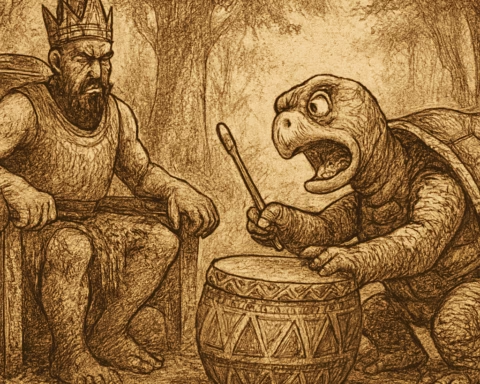
In the deep forests of Igboland, where ancient trees stretched their branches toward the sky like the arms of ancestors reaching for the heavens, and where the earth was carpeted with layers of fallen leaves that whispered secrets with every breeze, there lived a tortoise named Mbe. Unlike the swift antelope or the mighty elephant, unlike the soaring eagle or the cunning python, Mbe had neither speed nor strength, neither wings nor venom. What he possessed, however, was something far more valuable in the dangerous world of the forest, a mind as sharp as the hunter’s blade and a tongue smooth enough to talk the rain out of falling.
The forest in those days was a place of constant danger for the small and slow. Every shadow could hide a predator, every rustle in the undergrowth could signal the approach of death. For Mbe, with his heavy shell and short legs, the journey from one end of the forest path to the other was fraught with peril. But Mbe had survived many seasons, many encounters, many narrow escapes, and his reputation as a clever creature had begun to spread through the animal kingdom like smoke from a cooking fire.
One afternoon, when the sun hung high and hot in the sky, turning the forest floor into a patchwork of light and shadow, Mbe was making his slow way along a narrow path. He was heading home after visiting the stream, his throat still cool from the fresh water he had drunk. The forest was quiet too quiet, perhaps and Mbe’s ancient instincts began to whisper warnings. His eyes, which missed very little, scanned the undergrowth on either side of the path.
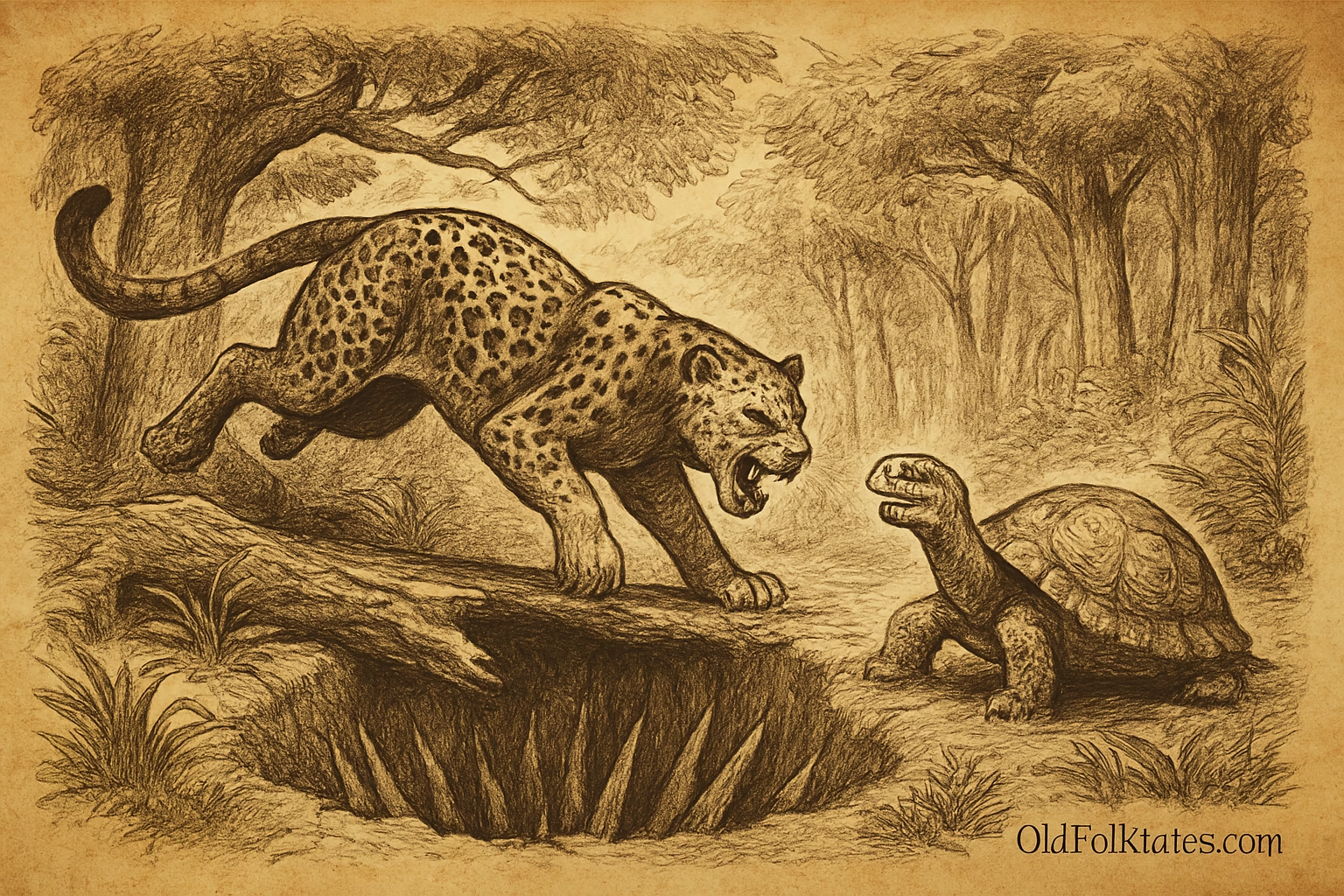
Then he saw it or rather, he saw him. Agu the Leopard, magnificent and terrible, lay stretched across a fallen log just ahead. The leopard’s spotted coat blended perfectly with the dappled sunlight, making him nearly invisible until Mbe was almost upon him. Agu’s muscles rippled beneath his sleek fur, his yellow eyes gleamed with hunger, and his tail twitched with the anticipation of an easy meal. There was nowhere for Mbe to run, no hole to hide in, no tree to climb. The path was narrow, bordered on both sides by thick thorny bushes that would tear his soft flesh if he tried to push through.
Agu rose slowly, deliberately, the way a cat rises when it knows its prey cannot escape. His lips pulled back to reveal teeth like white daggers, and a low rumble emanated from deep within his chest a sound that had been the last thing many creatures heard before darkness claimed them.
“Well, well,” Agu purred, his voice smooth as palm oil but cold as stream water in the harmattan season. “What do we have here? Mbe the Tortoise, slow and fat, wandering alone on my path. The forest spirits must favor me today, delivering my meal right to my paws.”
Mbe’s heart hammered within his chest like a talking drum, but he did not let his fear show. He had learned long ago that in the forest, the moment you showed weakness was the moment you died. Instead, he drew himself up as tall as his shell would allow, and when he spoke, his voice carried an authority that made even Agu pause.
“Agu!” Mbe exclaimed, not in fear but in apparent delight. “The very creature I have been sent to find! How fortunate that our paths have crossed, though I confess I am surprised to find you lounging here when there are such important matters demanding your attention.”
The leopard’s eyes narrowed with suspicion. He had been ready to pounce, to make quick work of this small, helpless creature, but something in Mbe’s tone gave him pause. “What are you talking about, tortoise? What important matters?”
Mbe shook his head sadly, as if disappointed that Agu did not already know. “Have you not heard? I have just come from the Great Council of Forest Elders. They have appointed me, yes, humble Mbe as the Chief Judge of the Forest. A heavy responsibility, I can tell you, but one I must accept for the good of all creatures who dwell beneath these trees.”
Agu’s tail stopped twitching. His predatory crouch relaxed slightly. “Chief Judge? You?” Disbelief colored his voice, but also a seed of uncertainty. The forest had its hierarchies and powers, its spirits and authorities, and even the mighty leopard knew not to dismiss such claims lightly.
“I know, I know,” Mbe said, his voice carrying just the right note of humble pride. “It surprised me as well. But the elders were unanimous. They said, ‘Mbe has the wisdom and the fairness required for this great office.’ And my first duty, Agu, is to ensure that all forest dwellers are prepared to obey the new laws that the Council has decreed.”
The leopard sat back on his haunches, his hunger momentarily forgotten in the face of this unexpected development. “New laws?”
“Indeed,” Mbe replied gravely. “And I must test each creature’s loyalty and obedience before I can certify them as law-abiding citizens of the forest. Without this certification, any creature risks severe punishment, perhaps even banishment from the forest entirely.” He paused, then added thoughtfully, “Or worse.”
Agu’s ears flattened slightly. He was a proud creature, a hunter who answered to no one, but even he understood the importance of not running afoul of forest laws and the powers that enforced them. “What kind of test?” he asked warily.
Mbe appeared to consider this carefully, stroking his chin with one claw as if deep in judicial thought. “The test is simple but must be performed exactly as I instruct. Do you see that clearing just beyond those bushes?”
Agu turned to look where Mbe indicated. Through the undergrowth, he could indeed see an opening in the trees, a small clearing where sunlight pooled like honey.
“In that clearing,” Mbe continued, his voice now formal and official, “the Council has placed a sacred circle. It is a test of courage and obedience. You must step into the center of that circle and stand perfectly still for the count of ten. This demonstrates that you are willing to trust the forest authorities and follow instructions without question. It is a simple thing, really, but essential.”
What Agu did not know what he could not know, because his pride and his natural sense of superiority blinded him—was that the “sacred circle” Mbe spoke of was actually a hunter’s trap. Mbe had seen it there earlier that very morning on his way to the stream. The hunters from the nearby village had dug a deep pit, covered it with branches and leaves, and baited it to catch exactly the kind of large predator now standing before him.
Agu considered the tortoise’s words. Part of him wanted to simply eat this presumptuous little creature and be done with it. But another part,the part that remembered the old stories of forest magic and the powers of the elders hesitated. What if it was true? What if there really was a new Chief Judge, and what if defying him brought trouble?
“Very well,” Agu finally said, rising to his full impressive height. “I will take your test, tortoise. But know this if you are lying to me, if this is some trick, I will hunt you to the ends of the earth and make you regret the day you hatched from your egg.”
“No trick at all,” Mbe assured him solemnly. “Simply walk through those bushes, step into the center of the clearing, and stand still. I will count to ten, and then you will be certified as a loyal forest citizen.”
Agu pushed through the bushes, his powerful body parting the undergrowth easily. Mbe held his breath, watching as the great leopard approached the covered pit. The leopard’s eyes scanned the clearing, seeing nothing amiss just an open space beneath the trees, peaceful and sunlit.
With a final glance back at Mbe, Agu stepped forward confidently into the center of what he believed to be a sacred circle.
The trap gave way instantly.
The carefully arranged branches and leaves collapsed under the leopard’s weight, and with a roar of shock and rage, Agu plummeted into the deep pit below. His yowls of fury echoed through the forest as he scrabbled uselessly against the smooth walls of his prison, unable to climb out.
Mbe, still standing safely on the path, allowed himself a small smile. He approached the edge of the hidden pit cautiously and peered down at the furious leopard below.
“My apologies, Agu,” Mbe called down, his voice now stripped of its false formality. “It appears you have failed the test. Perhaps next time you will think twice before deciding that smaller creatures make easy meals.”
And with that, Mbe turned and continued his slow, steady journey home, leaving behind the roars and threats of the trapped leopard. The hunters would find their prize soon enough, and Mbe would live to see another day not through strength or speed, but through the sharp wit that the spirits had granted him in place of claws and fangs.
Click to read all Myths & Legends – timeless stories of creation, fate, and the divine across every culture and continent
The Moral Lesson
This timeless Igbo folktale teaches us that intelligence and quick thinking can overcome even the most overwhelming physical threats. Mbe’s survival depended not on fighting the leopard or outrunning him both impossible tasks but on understanding his adversary’s psychology and using words as weapons. The story also contains a warning about pride and blind obedience: Agu’s downfall came from his arrogance and his willingness to follow instructions without questioning them. In life, true strength comes from combining physical capability with mental acuity, and even the mightiest can be brought low by their own assumptions. As the Igbo say, “Onye nwere ntị ya nụ” let those who have ears hear meaning that wisdom is about listening, observing, and thinking, not just about physical power.
Knowledge Check
Q1: Who is Mbe in Igbo folklore and what qualities make him a recurring character?
A: Mbe is the tortoise character in Igbo folklore from Nigeria, famous as a trickster figure who uses intelligence and cleverness to survive in a dangerous world. Despite being small, slow, and physically vulnerable, Mbe consistently outwits larger, stronger predators through quick thinking, psychological insight, and creative deception. He represents the triumph of mind over matter.
Q2: Why was Mbe in particular danger when he encountered Agu the Leopard?
A: Mbe was in extreme danger because he was on a narrow forest path with thorny bushes on both sides, making escape impossible. As a tortoise, he had no speed to run away, no strength to fight, and no natural defenses against a powerful predator like Agu. His only weapon was his intelligence, making this encounter a true test of wit over physical capability.
Q3: What psychological tactic did Mbe use to manipulate the leopard?
A: Mbe exploited the leopard’s pride and his respect for forest hierarchy and authority. By claiming to be the “Chief Judge of the Forest” with power to certify or punish forest creatures, Mbe appealed to Agu’s fear of supernatural consequences and social exclusion. The leopard’s arrogance made him believe he was too important to ignore such official matters, even when presented by a potential meal.
Q4: What does the hunter’s trap symbolize in this story?
A: The hunter’s trap symbolizes the hidden dangers that exist in the world and how knowledge and awareness can turn threats into opportunities. Mbe knew about the trap beforehand and used that knowledge to save his life. The trap also represents how the same circumstances can mean different things depending on your perspective what was a death sentence for the tortoise became a prison for the leopard.
Q5: What character flaw led to Agu the Leopard’s downfall?
A: Agu’s downfall came from a combination of arrogance and blind obedience to perceived authority. His pride made him believe he was too important to question or ignore a “Chief Judge,” while his arrogance prevented him from recognizing the absurdity of taking orders from a creature he had been about to eat. He followed instructions without proper examination, a fatal mistake for a predator.
Q6: How does this tale reflect Igbo cultural values about intelligence and survival?
A: The story embodies the Igbo cultural emphasis on “igwele nkịtị” practical wisdom and cleverness as essential survival tools. In Igbo tradition, physical strength alone is not enough; one must also possess sharp wit and the ability to read situations and people. The tale teaches that success comes from using one’s mind, that the weak can survive through intelligence, and that underestimating others based on physical appearance is foolish. It’s a celebration of mental agility as a form of power.
Source: Adapted from Life in Southern Nigeria by P. A. Talbot (1923), tale of “Mbe and Agu (Leopard),” and from common Igbo oral storytelling cycles widely preserved throughout southeastern Nigeria.
Cultural Origin: Igbo People, Southeastern Nigeria, West Africa