In the deep and often unfathomable waters of the Great Lakes region dwells one of the most powerful beings in Anishinaabe aadizookaan tradition: Mishibizhiw, the Underwater Panther, sometimes called the Great Lynx. Among the Ojibwe, Odawa, and Potawatomi, Mishibizhiw is both feared and revered, a creature embodying the vast, unknowable power of the water world. His presence is not monstrous, but cosmological: a force whose nature commands respect, ceremony, and humility.
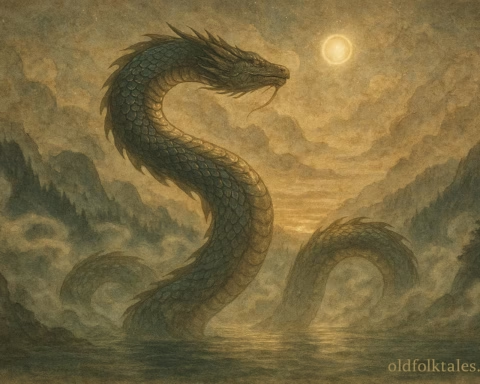
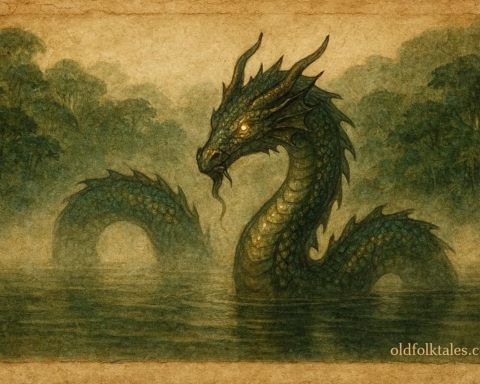
Descriptions differ from storyteller to storyteller, as is characteristic of living oral traditions. Yet several features appear consistently across accounts recorded in missionary journals, ethnographic field notes, and Indigenous-language retellings: the body of a great cat, covered in scales, with a saw-toothed spine, antlers or horns, and a long, whip-like or prehensile tail. Many stories emphasize that his tail is made of copper or sheds copper flakes, a detail noted in both 19th- and 20th-century literature. Because natural copper is found in abundance around Lake Superior, the mythic detail aligns closely with historical Anishinaabe relationships to copper extraction and trade.
Mishibizhiw’s size ranges widely depending on the narrator, sometimes described as roughly lynx-sized, and sometimes vast and serpentine, large enough to churn the depths of a lake into storms. In all forms, he is a powerful water guardian, ruling beneath waves, whirlpools, and river mouths. He is beautifully terrifying: shining scales, lethal claws, glowing eyes, and antlers that curve like a buck’s but radiate the energy of a spirit-being.
Mishibizhiw is known to guard the deep places of the world, especially those connected with burial grounds, islands, or copper deposits. Some traditional narratives describe how those who steal copper from sacred islands, especially the copper from the creature’s back or tail, may suffer misfortune, storm, sickness, or death. A commonly cited account, noted in Mii Dash Geget’s summary of Radin and Jones, tells of four men who died after attempting to take copper from a site belonging to the Underwater Panther’s realm.
He is not merely an aquatic animal; he is a manidoo, a spirit-being whose body blends animal, mineral, elemental, and otherworldly features. His scales and horns mark him as a creature of power. His copper tail connects him to sacred materials and natural forces. His underwater domain represents depth, mystery, danger, and wealth. To encounter him is to brush against forces older than human memory.
Cultural Role
- Master of the Water World: In Anishinaabe cosmology, the universe is filled with beings who maintain balance among land, sky, and water. Mishibizhiw is the most powerful water manidoo, governing not only the creatures of the lakes and rivers but also the spiritual forces that dwell beneath the surface. His presence is tied to whirlpools, sudden storms, drownings, and the hidden movement of currents. To live near water required not just physical caution but spiritual awareness, and Mishibizhiw’s stories functioned as teachings about this relationship.
People avoided disturbing certain waters known to be his domain. Offerings, tobacco or other gifts, were placed before traveling across treacherous lakes. Boaters and canoe travelers showed humility, recognizing that water was alive, inhabited, and deserving of respect.
- Keeper of Copper: Copper was essential in the Great Lakes region for tools, adornment, and ceremonial objects. Many oral traditions frame copper not merely as a mined resource but as a sacred substance belonging to the beings of the water. Mishibizhiw’s association with copper, his tail shedding copper flakes or his body containing veins of sacred metal, makes him both a guardian and a source of the mineral.
Taking copper without proper respect was dangerous, and the stories of those who perished after stealing from Mishibizhiw’s sacred places serve as cautionary teachings about greed, imbalance, and improper relationship with the land.
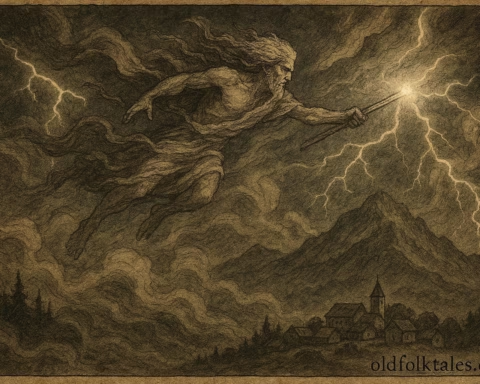
- Cosmic Tension with the Thunderbird: A defining feature of Mishibizhiw’s mythic landscape is his adversarial relationship with the Thunderbird, the mighty sky-being who commands storms and lightning. The Underwater Panther and the Thunderbird represent two cosmic poles:
- Water vs. Sky
- Depth vs. Height
- Currents vs. Thunder
- Hidden danger vs. open power
Their conflict generates storms, clashes of elemental force, and the equilibrium of natural law. Yet their relationship is not simply one of good versus evil. Rather, the tension between them is part of the balance that keeps the world in harmony. Each checks the other’s power.
- A Symbol of Depth, Danger, and Transformation: Mishibizhiw symbolizes the dimension of reality that is unseeable, dangerous, and transformative. Water is a source of life, but also a source of risk and change. The Underwater Panther embodies this duality. He is neither villain nor hero; he is a force. His stories teach listeners to approach powerful places, especially waters, with respect, humility, and the proper protocols.
- Guide and Challenger: In some stories, Mishibizhiw challenges heroes or young people undergoing rites of passage. Encounters with him represent trials of courage and spiritual maturity. In others, he appears as a protector or an ally to those who understand the deep laws of the manidoog.
Because his nature is ambiguous and complex, he reflects a cosmology in which beings may be dangerous but still part of creation’s fabric. A respectful person may coexist with him; a disrespectful one may fall victim to him.
Encounter dragons, spirits, and beasts that roamed the myths of every civilization
Author’s Note
Descriptions of Mishibizhiw vary across regions and storytellers. This entry draws from documented summaries and ethnographic notes but cannot replace the teachings of Anishinaabe knowledge keepers or the context of ceremony, language, and lived tradition. Mishibizhiw is more than a creature of folklore, he is a presence embedded in a living world of relationships.
Knowledge Check
- What type of being is Mishibizhiw?
A powerful water manidoo (spirit-being) in Anishinaabe cosmology. - Where does he live?
In deep lakes, rivers, and underwater realms, often associated with dangerous or sacred water sites. - What physical features distinguish him?
Panther-like body, scales, saw-toothed back, horns/antlers, and a long copper tail. - What natural resource is he associated with?
Copper, which he guards and is sometimes said to shed from his tail. - What cosmic force is often his rival?
The Thunderbird, representing sky and storm forces. - What does Mishibizhiw symbolize?
The danger, power, and sacred depth of the water world, as well as natural balance.
Source: Anishinaabe oral tradition (Ojibwe, Odawa, Potawatomi); Native-Languages.org summary; Jesuit Relations; ethnographies by Jones, Radin, Kohl; Canadian Encyclopedia
Origin: Great Lakes / Northeastern Woodlands, pre-contact Indigenous cosmology