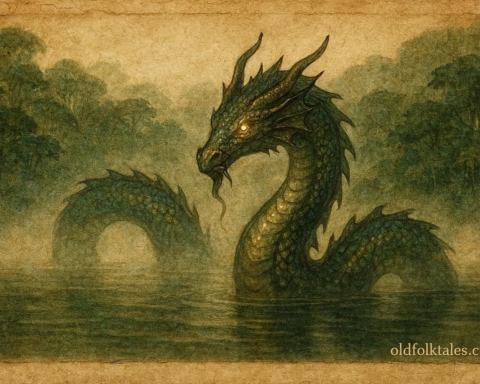
In the river-carved valleys and highland wetlands of the Sotho-Tswana landscape lives one of the most feared and respected beings of traditional lore: the Nianene (also called Nyane, occasionally spelled Niane in missionary texts). Depicted as a massive serpent or lizard-like creature dwelling in sacred pools, the Nianene embodies both danger and divine authority. Its presence marks the line between ordinary water and a place inhabited by ancestral, elemental, or spirit forces. While often harmful when provoked, the creature represents a powerful guardian of taboos and natural boundaries.
The appearance of the Nianene varies across regions, but some features remain consistent: it is colossal, far larger than any natural reptile, and its skin glistens with a slick, wet sheen like polished stone. Some descriptions portray it as serpent-bodied but crowned with a lizard’s head; others give it crocodilian jaws and a serpent’s flexibility, allowing it to coil within deep pools and slide through reeds without disturbing the water. In certain Basotho accounts, its scales shimmer black-green or blue-black, reflecting both sky and water, while others describe a reddish underside like the embers of a fire burning underwater.
Its eyes are luminous, glowing like coals or like reflected moonlight. Missionary collectors often noted the language of fear and awe surrounding the creature: even adults lowered their voices when speaking of pools said to contain the Nyane. People avoided looking directly into such waters at dusk, lest the creature rise unexpectedly.
The Nianene is a water-bound being; it rarely leaves its sacred pool except when enraged or provoked by human wrongdoing. Most myths emphasize that if humans respect the taboos of its habitat, the spirit remains dormant or neutral. But when taboos are broken, whether through pollution, unnecessary noise, cruelty, or forbidden entry, the creature emerges with destructive intent.
The Nianene’s powers depend on the tradition told. In some Sotho-Tswana stories, it can churn the water into deadly whirlpools, dragging humans or cattle into its depths. In others, it releases a poisonous breath or exhalation that brings sudden sickness to villages. A few tales depict it as able to summon storms, sending dark clouds swirling over the hills when sacred waters are defiled. Its roar is described as earth-shaking, echoing through gorges and startling livestock into stampeding.
Despite these terrifying attributes, the Nianene is not senselessly destructive; its aggression is almost always tied to violations of sacred rules. For example, women in certain Basotho groups were traditionally told not to wash clothes or bathe in designated pools where the Nianene lived. Men were forbidden to water cattle there. Children were warned never to skip stones or shout across the water’s surface. Sound, disturbance, and disrespect angered the spirit.
Many missionary-era records, particularly those from the late 1800s, describe local elders recounting the Nianene as a guardian of sacred waters, places where ancestors visited or where ritual cleansing occurred. The creature therefore protects both the physical pool and its spiritual significance.
Some elders interpreted the Nianene as the manifestation of an ancestral serpent, a being that bridges earthly life and the realm of Modimo (God) or badimo (ancestors). In these narratives, it serves as a mediator who punishes moral transgressions or environmental disrespect. When humans forget their obligations to ancestors, especially in matters of purity, humility, or water-use rituals, the Nianene rises to remind them.
There are also echoes of deep ecological wisdom embedded in these tales. Sacred pools were often sources of drinking water during droughts, breeding sites for fish, or places of dangerous depth. The Nianene myth encouraged people to tread carefully, to avoid contamination, and to leave certain waters untouched. In this sense, the creature is not only supernatural but also environmentally protective, shaping community interaction with fragile ecosystems.
Another recurring motif is that the Nianene is not merely an animal but a sentient judge of human behavior. It recognizes disrespect, greed, and defiance. In one popular tale collected by early missionaries, a young man insists on washing his hunting spear in a forbidden pool despite warnings. The Nianene emerges, swallowing him whole, and the village interprets his fate as a lesson in arrogance and disobedience. In another story, a group of boys secretly attempt to fish in a sacred pool, only for the Nianene to rise and send them fleeing in terror. None die, but the experience becomes a lifelong reminder of spiritual boundaries.
The creature can also appear in dreams or visions, especially to spiritual leaders or healers. Among some Sotho-Tswana healers, a serpent appearing in a vision may indicate the presence of ancestral calling. While this is not always interpreted as the Nianene itself, it shows the broader cultural connection between serpentine imagery and spiritual authority.
Folklore emphasizes that the Nianene is most dangerous when humans behave carelessly or pridefully. But if left undisturbed, it remains silent beneath the waters, watching. It is a guardian, a warning, a reminder that certain spaces belong to forces older than humans.
While the Nianene does not appear often in modern popular culture, it remains present in rural memory, particularly among elders who grew up near pools considered taboo or spiritually charged. Even today, some families avoid swimming in particular ponds or rivers said to house the creature’s descendants.
Ultimately, the Nianene / Nyane is a mythological embodiment of sacred boundaries, a creature who enforces the respect owed to water, ancestors, and the natural world.
Cultural Role & Symbolism
-
Spiritual Symbol: Represents ancestral presence and the sanctity of certain waters.
-
Moral Symbol: Warns against arrogance, disobedience, and disrespect for cultural taboos.
-
Environmental Symbol: Protects ecologically fragile waters and discourages harmful human intrusion.
-
Social Symbol: Reinforces community rules, ritual purity, and shared identity around sacred places.
Encounter dragons, spirits, and beasts that roamed the myths of every civilization
Author’s Note
The Nianene is a powerful reminder that in Sotho-Tswana cosmology, the natural and spiritual worlds are inseparable. Missionary collections often misunderstood the creature as simple superstition, but within its cultural frame it served as both ecological guardian and moral teacher. Its stories reveal the deep reverence communities held for water, ancestors, and the unseen forces that shape life.
Knowledge Check
-
Q: Where does the Nianene dwell?
A: In sacred pools, wetlands, and deep waters. -
Q: What triggers its harmful behavior?
A: Breaking taboos related to water, purity, or respect. -
Q: Is the Nianene always aggressive?
A: No, only when disturbed or disrespected. -
Q: What does the serpent symbolize spiritually?
A: Ancestral authority and sacred boundaries. -
Q: Why were certain pools off-limits?
A: They were believed to house the Nianene and held ritual significance. -
Q: How does the Nianene protect the environment?
A: By discouraging pollution or harmful use of fragile water sources.
Source: Sotho-Tswana oral traditions; 19th–20th-century missionary folklore collections
Origin: Basotho and Batswana communities of Southern Africa