In the age when the Mekong flowed like a silver serpent through unbroken jungles, when spirits walked as freely as men, a child was born beneath an omen of thunder. The skies rumbled, not in anger, but in recognition. For this was Nong Taotae, the infant whose cry echoed with the timbre of a young elephant, whose destiny was braided with the great guardians of the forest.
His mother, a humble woman from an Isan village, dreamt on the night of his conception that a white elephant, radiant as moon-washed clouds, lowered its tusks to her and breathed life into her womb. When the boy was born, the elders whispered: “He carries the breath of Chang Saming, the divine elephant protector.” They wrapped him in cloth woven with elephant motifs, knowing that he belonged both to humankind and the realms unseen.
Explore the shadows of world mythology, where demons test the soul and spirits watch over mankind
Taotae grew swiftly in stature and spirit. By seven rains, he could pull an ox-cart alone. By ten, he understood the speech of elephants, hearing their footsteps through the roots of the earth. Yet strength did not blind him; he was gentle, bowing to elders and offering rice to forest shrines before entering any sacred grove.
But the peace of his youth was cracking. Stories drifted along the riverbanks, tales of phi phet, the cannibal giants who stalked the borders between villages, stealing away wanderers at dusk. Worse still, deep in the Mekong’s darkest bend, a river demon older than kingdoms stirred. Its hunger was endless; its hatred of human light unquenchable.
One monsoon dusk, when low clouds sagged with rain, Taotae felt a trembling in the earth. Three divine elephants emerged from the mist, one black as rain-soaked soil, one gray as old stone, and the last white as morning light. Their voices thundered in his mind.
“Grandson of our breath,” they said, “the balance breaks. Take our strength. Become protector, not conqueror.”
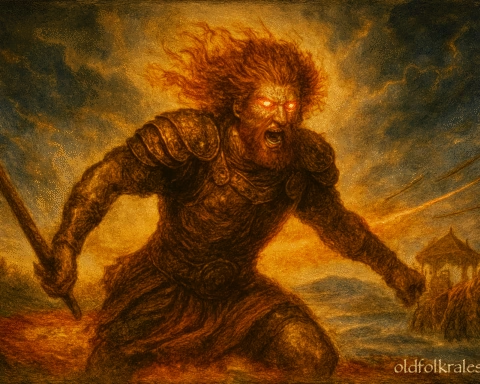
They touched their trunks to him. Power surged, bones grew dense as ivory, sinews wove with spirit-light, and upon his brow appeared a faint gleam like a newborn tusk. And thus was born Nong Taotae, the Elephant-Spirit Warrior.
THE FIRST CHALLENGE: THE CANNIBAL GIANTS
Word reached Taotae of a village swallowed by the phi phet. Taking only a hardwood staff carved with elephant sigils, he journeyed across rice fields trembling with wind. When he reached the ruins, silence hung like smoke. Only the giants remained, massive, bone-stringed beasts whose mouths dripped with shadow.
They laughed when they saw him.
“Little calf,” they growled, “your bones will flavor our soup.”
But Taotae planted his feet. The three elephant spirits thundered within him, and the ground trembled in answer. He spun his staff in wide arcs, each swing resounding with spirit-force. The giants fell, not only to his strength but to his refusal to kill needlessly. One giant, wounded and trembling, begged for mercy.
Taotae hesitated, a mortal fear whispered that sparing evil might doom others. But his heart answered: Power without mercy becomes tyranny. He let the giant flee into the deep wilderness, teaching compassion even to his own fear.
THE SECOND CHALLENGE: THE RIVER DEMON
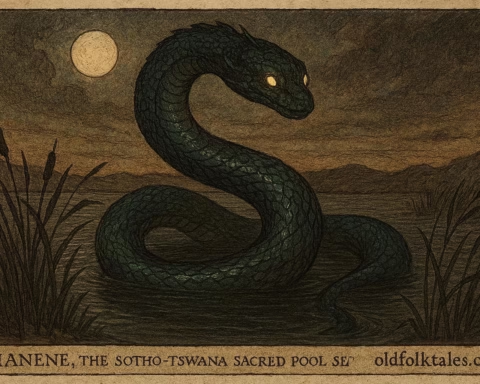
Yet the river demon, the phi nahm, was a foe forged from darker realms. Villagers spoke of whirlpools that swallowed boats whole, of voices luring fishers into black waters. When Taotae stood at the river’s edge, the surface boiled like a pot in storm.
A colossal head rose, scales shimmering with corpse-light. Its voice slithered through the mist.
“Elephant-child… your strength is stolen. Come into the water and return it.”
Taotae felt doubt strike him for the first time. What was he without the spirits? Were his deeds truly his own? The demon sensed the tremor in his heart and dragged him underwater.
Beneath the river, in a cavern lit by ghostly algae, Taotae confronted not the demon first, but himself. A shimmering reflection formed, showing a version of him drunk on power, commanding spirits like slaves, ruling over men with tusked pride.
He recoiled. Was this what he feared? That divine power would warp his human soul?
The elephant spirits whispered through the depths:
“Strength is a gift. Choice is your own.”
Renewed, Taotae rose from the depths in a whirl of bubbles and light. His staff burned with ivory brilliance. The river demon lunged, fangs like scythes, but Taotae struck its head, its coils, its heart. With a final bellow, he called the spirits’ thunder through his staff, shattering the creature’s darkness in a storm of light.
The Mekong calmed. Fireflies rose like drifting souls. Villagers knelt as Taotae stepped ashore, dripping river water and radiant with the quiet strength of one who has conquered not only monsters, but doubt.
THE SYMBOLIC OUTCOME: THE ELEPHANT’S PATH
Rather than claim a throne or revel in fame, Taotae returned to the forest’s edge. He planted his staff in the ground, declaring:
“Strength must guard, not dominate. Let the elephants teach those who listen.”
The staff sprouted into a towering tree whose roots touched river and hill alike, a living reminder that guardianship must be rooted in humility.
To this day, Lao and Isan storytellers say Nong Taotae still walks between realms, appearing to those who defend the innocent or speak with respect to the spirits of the land.
AUTHOR’S NOTE
Nong Taotae endures as a symbol of sacred strength balanced by compassion. His tale teaches that power derived from the divine is most righteous when guided by humility, ethical restraint, and harmony with the natural world. In the Thai-Lao cultural imagination, he stands as a bridge between human courage and the wisdom of ancient spirits.
KNOWLEDGE CHECK (6 QUESTIONS)
-
What divine beings granted Nong Taotae his spiritual strength?
-
Why did Taotae spare the wounded cannibal giant?
-
What inner fear did the river demon exploit?
-
How did Taotae ultimately defeat the river demon?
-
What symbol grew from Taotae’s staff at the story’s end?
-
What moral balance defines Taotae’s heroism?
CULTURAL ORIGIN: Lao and Isan (Thai-Lao) epic traditions from the Mekong cultural region, rooted in animist and Buddhist-influenced folklore of Northeast Thailand and Laos.
SOURCE: Based on Lao and Isan narrative cycles as documented by Charles Archaimbault in “La geste de Xiong et autres mythes du Laos” (1959), including oral traditions from Mekong-region storytellers.