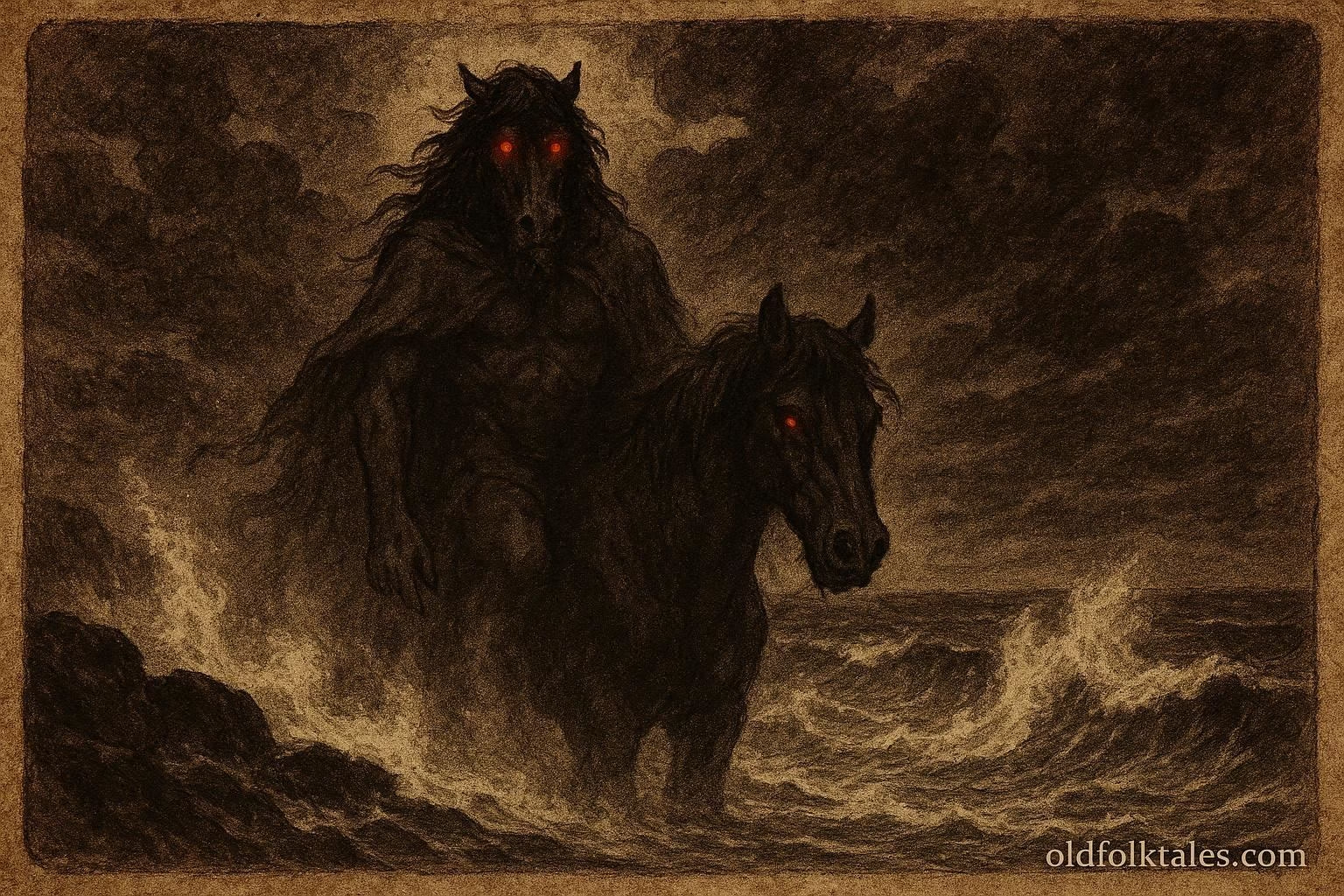
The Nuckelavee is one of the most terrifying supernatural beings in European folklore. It is a grotesque hybrid of human and horse, often described as skinless, exposing raw muscles, sinews, and veins in horrifying detail. The human portion of the creature usually forms the head and upper torso, which emerges from or is fused with the forepart of the horse body. Its eyes are described as fiery or glowing, and its mouth often bears a long, flickering tongue. The horse portion forms the hindquarters, powerful and massive, giving it an imposing silhouette. Some accounts mention the forelegs resembling human arms, adding to the creature’s uncanny, liminal nature.
The Nuckelavee is closely tied to coastal waters. It emerges particularly during storms, low tides, or periods of environmental instability, and its arrival is synonymous with disaster. Villagers reported that merely its presence causes crops to wither, livestock to sicken, and humans to fall ill. It is so feared that the stench from its breath, often described as poisonous or pestilential, is enough to destroy fields and forests. Unlike other water spirits, which may trick humans or be neutral in temperament, the Nuckelavee is consistently malevolent, instilling fear as a warning of both physical and environmental danger.
Learn the moral wisdom of ancient civilizations through proverbs that shaped cultural values
Powers and Behavior
The Nuckelavee’s powers are diverse and inherently destructive:
- Toxic Breath: Its exhalation carries disease, blights, and decay, affecting plants, animals, and humans alike.
- Supernatural Speed and Strength: Able to traverse both land and sea, the Nuckelavee moves faster than any mortal horse, often appearing suddenly to strike terror.
- Shape and Form: Its hybrid nature allows it to appear partially human or partially equine depending on the tale, amplifying its terrifying presence.
- Ecological Impact: Beyond individual harm, its arrival signals larger environmental threats, such as storms, tides, and flooding.
- Servant of Greater Forces: Some stories suggest it is subordinate to the Mither o’ the Sea, implying that even malevolent spirits operate within a larger supernatural hierarchy.
Unlike other liminal or aquatic creatures in folklore, such as the Scottish kelpie or the Irish each-uisge, the Nuckelavee exhibits no ambivalence. It is a force of destruction, warning, and supernatural enforcement of natural law, symbolizing the uncontrollable power of the sea and coastal environment.
Myths and Beliefs
- Oral Tradition: Local Orcadian informants in the 19th century, documented by Walter Traill Dennison, recounted vivid encounters with Nuckelavee, often describing its appearance as “skinless and dripping with noxious fluids,” striking fear into anyone who saw it.
- Historical Context: Some 16th-century Latin accounts reference monstrous horse-human hybrids in the Orkney Islands, suggesting that fear of water-demons predates the formal ethnographic recordings.
- Ecological Symbolism: Villagers associated Nuckelavee with the destructive forces of nature, including storm damage, livestock disease, and failed crops. Its stories reinforced prudent behavior along shores and the dangers of the sea.
- Preventive Measures: To avoid encounters, people would cross streams at high tide, avoid marshy lowlands during storms, or offer prayers to the sea spirits. These rituals reflect a blend of spiritual caution and environmental awareness.
- Narrative Legacy: Ernest Marwick, a 20th-century Orcadian folklorist, highlighted the Nuckelavee as a critical figure in Orkney storytelling, representing both natural hazard and social cautionary tale. Its enduring presence in local narrative underscores the intersection of fear, respect, and survival in insular communities.
Cultural Role and Symbolism
The Nuckelavee embodies multiple layers of cultural meaning:
- Fear of Environmental Forces: Its association with storms, tidal hazards, and crop blight reflects a cultural response to environmental vulnerability. In this way, folklore preserves ecological knowledge as memorable narrative.
- Liminality: As a sea-land hybrid, the Nuckelavee occupies a boundary space, emphasizing the dangers inherent in the interface between human habitation and the natural world.
- Moral and Social Caution: While not a moral agent per se, the Nuckelavee enforces prudence and respect for nature, teaching communities to heed environmental signals and communal warnings.
- Syncretism of Mythic Motifs: The creature exhibits links to Scandinavian nøkk/nix water spirits and Scottish kelpie traditions, showing how cross-cultural influences shape local folklore.
- Representation of Horror: Its visceral description as skinless and stinking of disease amplifies fear, functioning as a psychological warning mechanism within Orcadian culture.
Through these roles, the Nuckelavee is not merely a monster but a cultural lens, providing insight into how isolated island communities conceptualized and codified environmental and social threats.
Encounter dragons, spirits, and beasts that roamed the myths of every civilization
Author’s Note
The Nuckelavee is a prime example of folklore as a tool for ecological and social survival. Its consistently malevolent characterization contrasts with morally ambivalent water spirits elsewhere in Celtic and Norse folklore. By studying Dennison’s 19th-century ethnography alongside Marwick’s 20th-century commentary, we see how Orcadians mapped natural fears onto supernatural narratives, using myth to codify cautionary behavior and environmental respect.
Its hybrid form, poisonous breath, and liminal habitat reflect a sophisticated understanding of the hazards inherent to island life, merging environmental awareness with imaginative storytelling. The Nuckelavee remains one of the most distinctive and horrifying creatures in Northern European folklore, preserving ancient cultural memory and ecological wisdom.
Knowledge Check
- What is the Nuckelavee?
→ A skinless, human-horse hybrid sea-demon from Orcadian folklore. - What kind of damage is the Nuckelavee believed to cause?
→ Crop blight, livestock and human disease, and ecological devastation. - Where does the Nuckelavee dwell?
→ Coastal waters, low tides, and the interface of sea and shore in Orkney. - Which 19th-century collector documented the Nuckelavee?
→ Walter Traill Dennison. - How does the Nuckelavee differ from kelpies or each-uisge?
→ It is almost universally malevolent, skinless, and emits poisonous breath, unlike morally ambivalent water-horses. - Which figure is sometimes said to have authority over the Nuckelavee?
→ Mither o’ the Sea, a greater Orcadian sea spirit.
Source: Walter Traill Dennison, Orkney Folklore & Sea Legends; Ernest Marwick commentary; Orcadian oral tradition
Origin: Orkney Islands, Northern Isles, Scotland; attested in 19th-century oral collections, with earlier possible references in 16th-century accounts