Ọ̀ṣun (Oshun) is the revered Yoruba Orisa of rivers, fertility, sensuality, beauty, healing, and divine sweetness. Among the pantheon of Yoruba deities, she embodies the nurturing power of fresh water, the life-giving force without which no community can survive. Her symbol is the flowing river, her colors are gold and amber, and her sacred animals include the peacock and the river fish.
She is honored as the gentle yet powerful mother of prosperity, the patron of pregnancy, childbirth, and feminine mysteries, and the spiritual provider of abundance and emotional balance. Devotees seek her during rites of divination, fertility requests, healing ceremonies, and moments when sweetness must replace bitterness.
Her worship remains vibrant in Nigeria and across the African diaspora, especially in Candomblé (Brazil) and Santería (Cuba), where she is often syncretized with Our Lady of Immaculate Conception while still retaining her essential identity as the radiant Orisa of flowing waters.
Mythic Story
In the beginning, when the world was young and the Orisa walked openly among humanity, the earth was still settling into its rhythms. Rivers had not yet carved their graceful paths, and the first communities struggled to cultivate crops on dry soil. Plants sprouted weakly, women faced difficulty conceiving, and the air felt heavy with an unspoken yearning. The land lacked sweetness.
Among the gathering of Orisa was Ọ̀ṣun, shimmering in golden cloth, her bracelets singing softly with each movement. Her presence stirred the breeze with warmth, and even the dust beneath her feet glimmered with hints of light. She watched humanity with compassion, sensing their struggle, not only for survival, but for joy itself.
The elders say that the Orisa once convened to determine how they might restore balance to the earth. Powerful deities such as Ṣàngó, Ọgún, and Obàtálá spoke boldly about strength, justice, and creation. Yet the council overlooked Ọ̀ṣun’s voice, believing that warfare, iron, and cosmic order alone would sustain humanity.
It is said that the world grew harsh as a result of this omission. Without Ọ̀ṣun’s presence in the divine work, fertility faded. The rivers slowed. Children were not born. Crops wilted. Even the Orisa noticed their sacrifices no longer carried sweetness, rituals felt hollow.
At last the priests cried out:
“Something is missing. Something essential.”
The diviners cast Ifá, and the sacred odu revealed the truth:
Without Ọ̀ṣun, no creation can flourish.
Without her sweetness, the world tastes only of dust.
The Orisa, humbled, went to seek her. They found Ọ̀ṣun by the dry riverbed, her expression serene yet distant, her golden fan moving slowly as though cooling her sorrow.
“Why do you stay apart from us?” they asked.
“You sought to shape the world with strength alone,” she replied. “But strength without gentleness is imbalance. Creation cannot thrive without tenderness, nourishment, and love.”
Recognizing their error, the Orisa asked her forgiveness and invited her to lead the renewal of the earth. Ọ̀ṣun stood, lifted her hands, and from her palms flowed clear, luminous water, the first sweet river. It cascaded across the barren land, forming streams, filling valleys, and washing over the roots of thirsty crops.
Where the water touched, the world awakened:
Fields became green again, and flowers unfurled.
Women conceived children, and communities rejoiced.
Laughter returned to the earth.
Yet one of Ọ̀ṣun’s most celebrated tales concerns the warriors who sought her aid. A great conflict threatened a Yoruba kingdom, and the warriors lacked guidance and spiritual protection. They journeyed to Ọ̀ṣun’s sacred river, drums echoing through the forest, offering honey, mirrors, and yellow cloth. They pleaded softly:
“Mother of sweet waters, bless our journey. Let your wisdom guide us.”
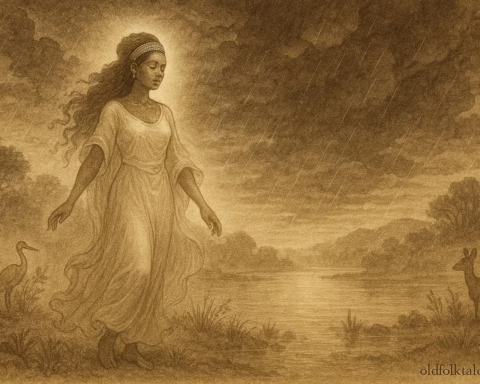
Ọ̀ṣun emerged as shimmering ripples on the river’s surface, her form rising like sunlight upon gold. She instructed them not in the ways of aggression, but in strategy, calmness, and unity. Under her guidance, the warriors avoided unnecessary bloodshed and defended their people with precision and minimal loss. Upon returning, they offered thanks, acknowledging that victory achieved through Ọ̀ṣun’s compassion carried no bitterness.
Another tale tells of a barren village suffering a devastating drought. The people prayed fervently, and Ọ̀ṣun appeared in a dream to the priestess of the shrine. “Cleanse the river path,” she instructed, “and bring offerings of honey, kola nut, and song.” The villagers obeyed. As they gathered to sing praise chants,“Ọ̀ṣun flows, giving life and sweetness”, rain clouds formed above them. By dawn, the river roared once more with life. Children ran to its banks, laughing, and the women danced with gratitude.
Ọ̀ṣun’s compassion extends beyond fertility and healing; she is also the guardian of emotional equilibrium, soothing hearts troubled by grief or conflict. When relationships fracture or families fall into discord, devotees appeal to her for reconciliation. Her essence teaches that sweetness must be protected, not taken for granted.
Today in Nigeria, worshippers still gather at the sacred Ọ̀ṣun-Ọṣogbo Grove, a UNESCO-recognized forest sanctuary, where annual festivals honor her with dance, drums, and offerings. The river remains a living witness to centuries of devotion, a physical embodiment of her unending grace.
In every Yoruba land and diaspora community, people say:
“Where Ọ̀ṣun flows, life flows.”
Author’s Note
Ọ̀ṣun reveals that life needs gentleness as much as power. Her myth teaches the necessity of balance, sweetness with strength, compassion with justice. Through her waters, she reminds us that healing, fertility, and love are not luxuries but essential forces that sustain the world.
Knowledge Check
Q1: What domains is Ọ̀ṣun associated with?
A: Rivers, fertility, beauty, healing, love, and emotional balance.
Q2: Why did the world become barren in one creation tale?
A: Because the Orisa excluded Ọ̀ṣun from their work, causing nature and fertility to wither.
Q3: What restored the world’s vitality in the myth?
A: Ọ̀ṣun releasing sweet, life-giving water to form the first flowing rivers.
Q4: How did Ọ̀ṣun aid the warriors in the tale?
A: She gave them wisdom, encouraging strategy and unity rather than unnecessary bloodshed.
Q5: Where is Ọ̀ṣun most famously worshipped today in Nigeria?
A: At the Ọ̀ṣun-Ọṣogbo Sacred Grove.
Q6: What does Ọ̀ṣun symbolize in emotional or relational matters?
A: Harmony, sweetness, and the healing of conflicts.
Source: Yoruba Oral Tradition and Ifá Corpus, Nigeria (West Africa)
Origin: Yoruba, Nigeria (West Africa)