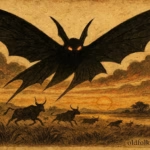
Among the Luo of Kenya, Obambo (plural: jo-obambo) are described as wandering, restless spirits of the dead, people who died improperly, were buried without the correct rites, or otherwise linger in a state of spiritual imbalance. The term “obambo” evokes movement, wind, drifting, and things that wander without rest. These spirits occupy an unsettling space between the living and the ancestral, and they appear not as tangible ghosts but as signs: flickering lights, cold winds, strange motions, or pale, drifting forms near homesteads and footpaths.
Appearance
Luo descriptions of Obambo vary, but they are consistently portrayed as spirits of lack, lacking warmth, a home, a lineage connection, or ritual closure.
Explore ancient traditions that connected the human spirit to divine realms and cosmic order
Accounts describe them as:
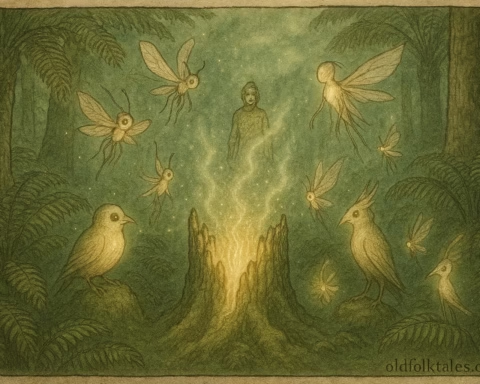
- Flickering lights hovering near the ground or moving erratically through the dark.
- Cold winds that sweep through silently, even when the night air is still.
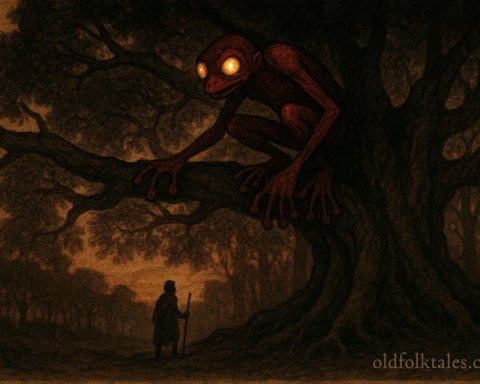
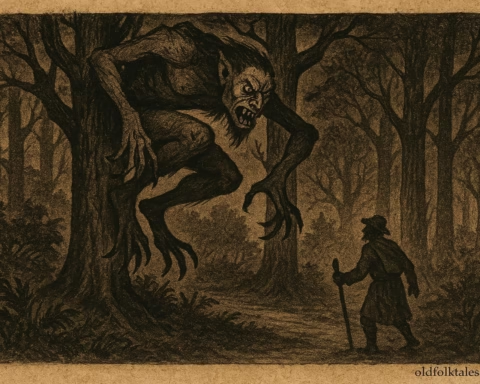
- Thin, pale figures, almost human but not fully formed, sometimes appearing as silhouettes without faces.
- Whispered noises, rustling grass, or the sound of footsteps where no person is visible.
- Long drifting shadows, especially along lake shores and riverbanks.
Some elders describe Obambo as “wind that remembers,” suggesting that they move like the breeze but carry the presence of a troubled soul.
Powers and Behaviors
- They wander without rest: Unlike properly honored ancestors (jok), who remain integrated into family memory and blessing, Obambo drift endlessly between homesteads and wild spaces. They do not attack directly; instead, they draw people toward danger by their presence.
- They create or ride cold winds: A sudden cold wind passing through a hut at night can signify an Obambo. People may feel a chill, a tightening of the skin, or a sudden eeriness that makes them alert.
- They lure or unsettle travelers: Night travelers may see a glimmer of light ahead and mistake it for a lantern or another human being. When approached, the light flickers away, vanishes, or reappears in another direction. Many stories tell of travelers becoming lost, turned around, or chilled with fear.
- They cause illness or spiritual confusion: Prolonged encounters can cause:
- weakness
- nightmares
- persistent fear
- wandering thoughts
- misfortune in the household
In older traditions, these are less “attacks” and more the consequence of interacting with a spirit that has no grounding or belonging.
- They mimic or echo human presence: Some Obambo imitate footsteps, faint voices, or even the distant cries of relatives, drawing individuals away from safe paths. In Luo thought, this behavior signals that the spirit longs for recognition and remembrance but cannot achieve it directly.
Myths and Beliefs
Obambo stories serve as cautionary tales embedded in cultural values about death rites, respect for the dead, and the need to maintain harmony between the living and the spiritual world.
- The Improperly Buried Dead: Traditional Luo society placed strong emphasis on burial rituals. A person who died far from home, was buried in secret, drowned, or died in social isolation risked becoming Obambo, forever wandering because their spirit was not “brought back” to the homestead through proper rites.
- The Forgotten Dead: A spirit ignored by its descendants might drift into an Obambo-like state. While rare, this belief emphasized the importance of memory, naming, and family continuity.
- Warnings to Children and Night Travelers: Parents warned children not to follow strange lights at night. Travelers were told never to whistle in the dark, never to call out to a light, and never to walk alone near lakes after sunset.
- The Lake Spirits Connection: Some Obambo are said to linger near Lake Victoria, drawn by the boundary between living land and ancestral depths. The lake is a place of many spirits, and the Obambo seek the wind paths there, drifting along its breath.
- Ritual Cleansing: If an Obambo was believed to haunt a homestead, ritual specialists could perform cleansing rites, pouring water mixed with herbs across entryways, invoking ancestors to “take” the wandering spirit into rightful company.
Cultural Symbolism
Obambo symbolize several core concepts in Luo worldview:
- The consequences of incomplete rites: They manifest the cultural understanding that death is a transition requiring community participation. Failure to honor this process results in spiritual disorder.
- The thin boundary between wind and spirit: Luo cosmology sees wind as a bearer of presence. An Obambo is literally “wind with memory,” reflecting the belief that spirits travel through nature, not apart from it.
- Loneliness and social dislocation: Obambo stories echo compassion for those whose lives ended in isolation. They remind the community of the duty to care for one another, both living and dead.
- Moral caution: They warn against reckless behavior, nighttime wandering, and disrespect toward sacred spaces.
- Memory and belonging: Obambo highlight that humans exist within a network of lineage and remembrance. To be forgotten or improperly buried is the ultimate loss, and the Obambo embody this sorrow.
Cultural Role
Obambo function as:
- Guardians of tradition, reinforcing proper funerary practice.
- Cautionary spirits, warning the living about danger near lakes, rivers, and dark footpaths.
- Moral reminders, emphasizing the need to honor kinship responsibilities.
- Spiritual indicators, signaling imbalance in the household or family line.
- Narrative teachers, used by elders to teach respect for the unseen and the ancestral.
They are not demons, nor are they benevolent ancestors; they are troubled echoes of humanity seeking rest.
Explore the mysterious creatures of legend, from guardians of the sacred to bringers of chaos
Author’s Note
Obambo lore stands out as one of the most poetic expressions of the Luo relationship between land, air, memory, and spirit. These wandering lights and winds invite reflection on the importance of ritual care, family memory, and the unseen ties that bind a community. Obambo stories are not merely ghost tales, they are cultural lessons encoded in atmospheric, haunting imagery.
Knowledge Check
- What are Obambo typically associated with?
Restless spirits of improperly buried or forgotten dead. - In what physical forms do Obambo most often appear?
Flickering lights, cold winds, or pale spectral shapes. - Why are Obambo considered dangerous?
They can lure travelers, cause confusion, or bring misfortune. - Which Luo cultural principle do Obambo reinforce?
The importance of proper burial and ritual remembrance. - Where are Obambo often sighted?
Near paths, homesteads, and the shores of Lake Victoria. - What symbolizes an Obambo’s lack of belonging?
Its wandering, drifting movement without a fixed home.
Source: Early collections of Luo oral literature; ethnographic notes by Okot p’Bitek; community oral histories recorded in the 20th century; additional rural accounts from Nyanza region.
Origin: Luo people (Kenya, especially the Lake Victoria basin). Associated with ancestral memory, funerary customs, wandering spirits, and night-time encounters along paths, lakeshores, and homesteads.