Before the beginning, before light and darkness had names, before the first breath of wind or drop of rain, there existed only Ginnungagap the Great Void, the yawning abyss that stretched into eternity. To the north lay Niflheim, a realm of primordial ice and freezing mist, where rivers of venom flowed and frost covered all. To the south blazed Muspelheim, a land of eternal fire and molten chaos, guarded by the fire giant Surtr with his flaming sword. Where the ice and fire met in the void, something miraculous occurred: from the collision of opposites, life was born.
First came Ymir, the primordial giant, massive beyond comprehension, whose body was formed from the melting ice. From his sweat emerged the first frost giants, beings of terrible power and ancient hunger. Then came Audhumla, the primeval cow, who licked the salty ice blocks and nourished Ymir with rivers of milk. As Audhumla licked the ice for three days, she revealed Búri, grandfather of the gods, whose descendants would shape the destiny of all existence.
Click to read all Myths & Legends – timeless stories of creation, fate, and the divine across every culture and continent
Búri’s grandson was Odin, mightiest of the Aesir gods, and he was born with two brothers Vili and Vé. The brothers looked upon Ymir and the chaos of the giants, and they knew that creation required sacrifice. In an act that would echo through eternity, they slew the primordial giant. Ymir’s death was cataclysmic his blood poured forth in such torrents that it drowned nearly all the frost giants, forming the seas and oceans. The brothers took his immense corpse and fashioned the world from it: his flesh became the earth, his bones the mountains, his teeth the rocks and stones, his hair the forests and vegetation, and his skull the dome of heaven itself, held aloft at four corners by dwarves.
From Ymir’s brains, the brothers created the clouds. From the sparks of Muspelheim, they made the sun, moon, and stars, setting them on their eternal paths across the sky. Thus was Midgard created the middle realm where humans would one day dwell, protected by a wall made from Ymir’s eyebrows. Above Midgard rose Asgard, the shining realm of the gods, connected to the mortal world by Bifrost, the rainbow bridge that shimmered with all the colors of creation.
But Odin, now called the All-Father, was not content with mere rulership. He hungered for knowledge with an intensity that bordered on madness, for he alone among the gods understood that even they were subject to fate, and that understanding destiny might be the only way to face it. His quest for wisdom would demand sacrifices that would have broken lesser beings.
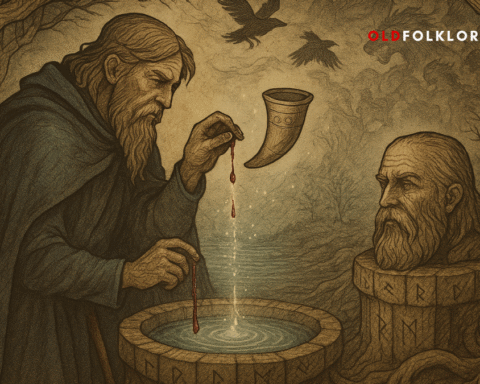
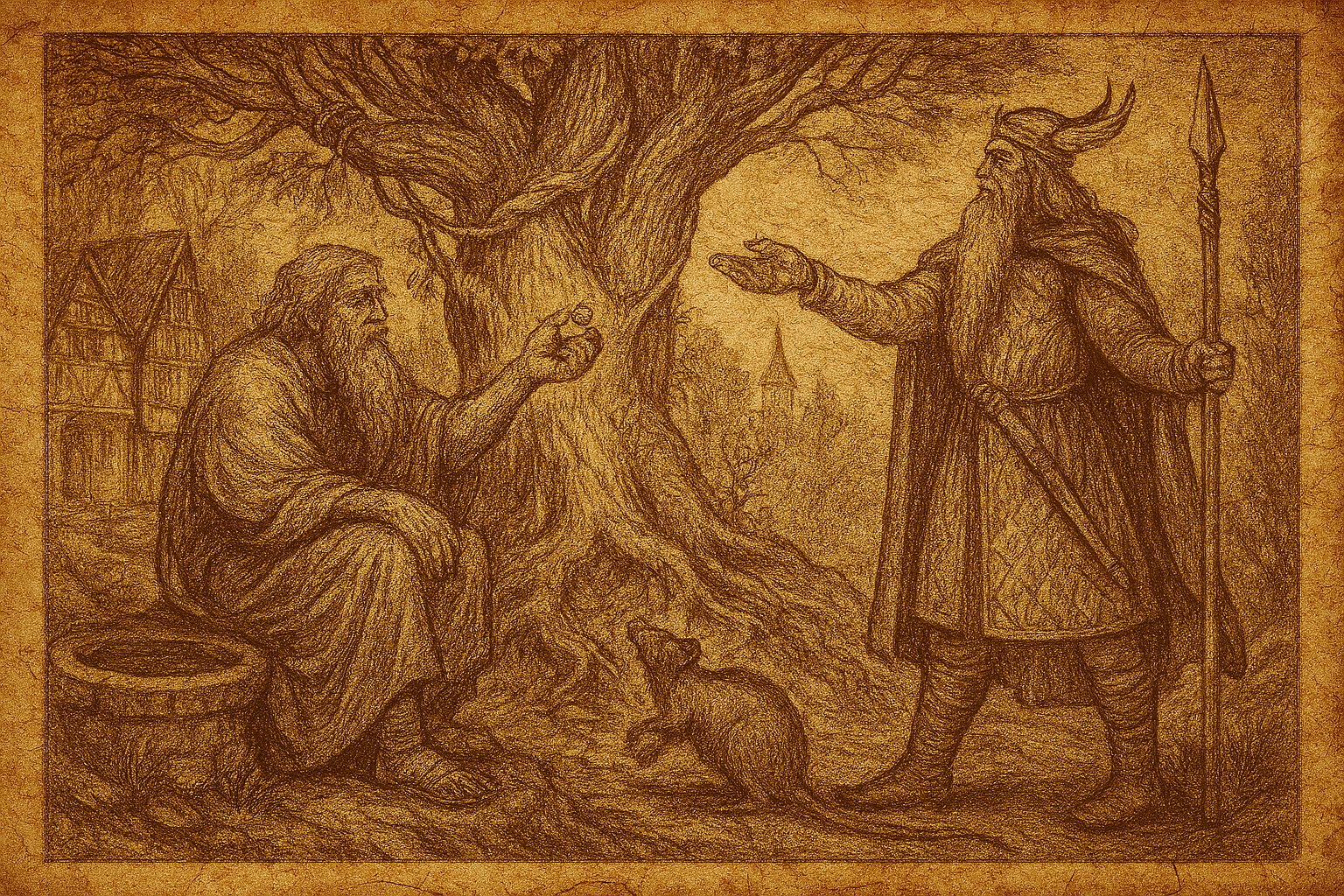
At the center of all existence grew Yggdrasil, the World Tree an immense ash whose roots delved into the underworld, whose trunk supported the realm of gods and men, and whose branches reached into the heavens themselves. At its base lay Mimir’s Well, whose waters contained all the wisdom of the cosmos. Mimir, the wise being who guarded it, would grant no one a drink without payment. Odin came before him and asked the price.
“An eye,” Mimir replied. “Wisdom for sight.”
Without hesitation, Odin tore out his own eye and cast it into the well’s depths. The pain was excruciating, but in exchange, he drank deeply of knowledge seeing past, present, and future swirling in the water’s reflection. From that day forward, Odin was known as the One-Eyed God, his sacrifice evident in his visage, his wisdom unmatched among all beings.
But this was not enough. Odin learned of the runes the ancient symbols that held the power to bind and unbind, to create and destroy, to speak the hidden language of fate itself. To unlock their secrets, he performed the ultimate sacrifice: he hanged himself from Yggdrasil’s branches, pierced his own side with his spear Gungnir, and hung there for nine days and nine nights without food or water, a god offering himself to himself.
On the ninth day, as he hung between life and death, the runes revealed themselves to him in a moment of terrible clarity. He screamed in triumph and agony, falling from the tree with the knowledge of eighteen powerful runes carved into his mind. Now Odin possessed the ability to heal, to curse, to see what was hidden, and to bind even the gods themselves with magical contracts.
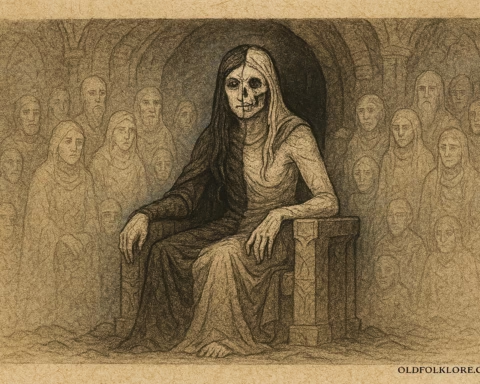
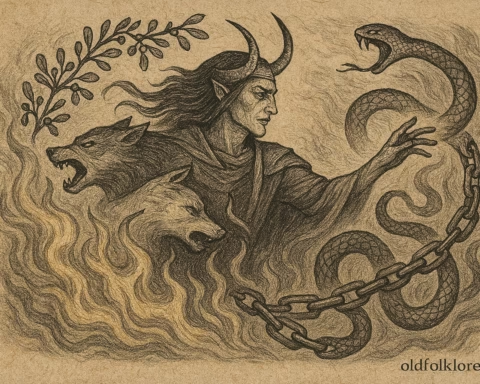
From his throne, Hlidskjalf, Odin could see into all nine realms. He saw Thor, his mighty son, wielding the hammer Mjolnir against the forces of chaos, protecting Asgard and Midgard with his strength and courage. He saw Loki, the trickster, blood-brother to Odin himself clever, charming, and dangerous, whose pranks and schemes grew darker with each passing age. Loki had fathered monstrous children: Fenrir, a wolf growing larger and more terrible each day; Jormungandr, the world serpent that encircled Midgard in the ocean’s depths; and Hel, who ruled the realm of the dead.
The gods tried to bind Fenrir with chains, fearing his growing power, but the wolf broke every fetter until the dwarves forged Gleipnir a magical ribbon made from impossible things: the sound of a cat’s footfall, the beard of a woman, the roots of a mountain, the sinews of a bear, the breath of a fish, and the spittle of a bird. Only by sacrificing the hand of brave Tyr did they manage to bind the monster.
Yet even with his vast knowledge, Odin could not change what he saw in the depths of fate. He consulted the völva, the ancient seeress who spoke prophecies from beyond the grave. She told him of Ragnarök the Twilight of the Gods, the final battle when everything would end. She spoke of the signs: three winters without summer, brother turning against brother, the breaking of all bonds. She prophesied that Loki would break free from his punishment and lead the giants against Asgard, that Fenrir would devour the sun and moon, that the world serpent would rise from the ocean, poisoning sky and sea.
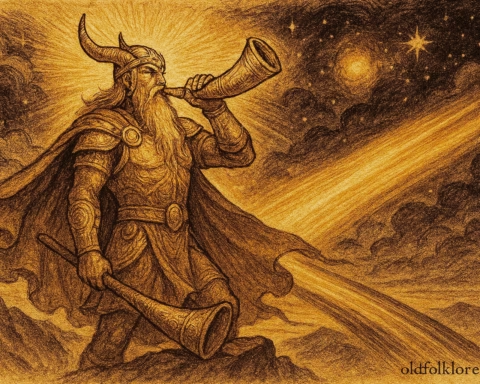
Odin gathered the bravest warriors who died in battle, the einherjar to Valhalla, his great hall, where they feasted and fought, preparing for the final day. He sent his valkyries to choose the slain from battlefields, building an army he knew in his heart could not prevent the inevitable. For this was the curse of his wisdom: to see the doom approaching and be powerless to stop it.
When Ragnarök finally came, it came as foretold. Loki broke his chains and sailed with the forces of chaos. The fire giants of Muspelheim marched across Bifrost, shattering the rainbow bridge. Fenrir broke free from Gleipnir, his jaws stretching from earth to sky. Jormungandr rose from the depths, thrashing and filling the air with venom. The sky split open, and Surtr’s flames consumed the heavens.
On the fields of Vigrid, the gods made their final stand. Thor faced Jormungandr, killing the serpent but dying from its poison nine steps later. Tyr fought Garm, the hound of Hel, and both perished. Heimdall and Loki slew each other in mortal combat. And Odin, the All-Father, who had given so much to understand this moment, was swallowed whole by Fenrir’s terrible jaws.
The world burned. Yggdrasil trembled. The stars fell from the sky, and the earth sank into the sea. Everything that Odin had built, all the wisdom he had gained, all the sacrifices he had made all were consumed in fire and darkness.
But this was not the end.
From the ashes and the depths, a new earth rose green and unspoiled, washed clean by the sea. Two humans, Líf and Lífthrasir, emerged from their hiding place in Yggdrasil’s branches, the seeds of a new humanity. Some of the gods’ children survived: Vidar and Vali, Modi and Magni, and Baldr returned from Hel’s realm. They gathered where Asgard once stood and spoke of the old world, finding the golden chess pieces the gods had once played with, relics of a vanished age.
The cycle would begin anew not identical to what came before, but similar, for such is the nature of existence. Destruction and creation, death and rebirth, the eternal wheel turning forever.
The Moral Lesson
Norse mythology teaches us that even the wisest and most powerful cannot escape fate, but courage lies in facing the inevitable with honor rather than fleeing from it. Odin’s pursuit of knowledge came at tremendous personal cost, yet he never wavered, understanding that wisdom is worth any sacrifice. The myth of Ragnarök reminds us that all things even gods and worlds must end, but from every ending comes a new beginning. It is not the permanence of our achievements that matters, but how we face the challenges and changes that define existence. In the Norse worldview, true heroism lies not in victory, but in standing against the darkness even when defeat is certain.
Knowledge Check
Q1: How was the world created in Norse mythology and what role did Ymir play? A: The world was created from the body of Ymir, the primordial giant, after Odin and his brothers Vili and Vé slew him. Ymir’s blood became the seas, his flesh the earth, his bones the mountains, his skull the heavens, his hair the forests, and his brains the clouds. This sacrifice transformed chaos into the ordered cosmos of Norse cosmology.
Q2: What sacrifices did Odin make to gain wisdom and why were they significant? A: Odin made two major sacrifices for wisdom: he tore out his own eye and cast it into Mimir’s Well to drink the waters of cosmic knowledge, and he hanged himself from Yggdrasil for nine days and nights, pierced by his own spear, to learn the secrets of the runes. These sacrifices demonstrated that true wisdom requires personal cost and suffering.
Q3: What is Yggdrasil and why is it important in Norse mythology? A: Yggdrasil is the World Tree, an immense ash tree that stands at the center of Norse cosmology. Its roots reach into the underworld, its trunk supports the realms of gods and humans, and its branches extend into the heavens. It connects all nine realms of existence and symbolizes the interconnected nature of all life and fate in Norse belief.
Q4: Who was Loki and what was his relationship with Odin and the gods? A: Loki was the trickster god and blood-brother to Odin, known for his cleverness, shape-shifting abilities, and increasingly dangerous schemes. Though initially allied with the gods, he fathered monstrous children (Fenrir, Jormungandr, and Hel) and ultimately betrayed the gods at Ragnarök, leading the forces of chaos against Asgard in the final battle.
Q5: What is Ragnarök and what events were prophesied to occur? A: Ragnarök, meaning “Twilight of the Gods,” is the prophesied apocalyptic battle that would end the age of gods. The prophecy foretold that Loki and the giants would attack Asgard, Fenrir would devour the sun and Odin himself, the world serpent would poison the sky, and fire would consume everything. Nearly all gods and the world itself would perish in this final conflict.
Q6: What does the Norse myth of rebirth after Ragnarök symbolize? A: The rebirth of a new, green earth after Ragnarök’s destruction symbolizes the Norse belief in cyclical existence that endings and beginnings are inseparable parts of reality. The survival of some gods’ children and two humans (Líf and Lífthrasir) represent hope, renewal, and the eternal nature of life that persists even through total destruction, reflecting the harsh yet resilient worldview of Scandinavian culture.
Source: Adapted from the Poetic Edda and Prose Edda by Snorri Sturluson
Cultural Origin: Norse/Viking mythology, Scandinavia (Iceland, Norway, Sweden, Denmark)