
In the days before memory fades into legend, there lived a man among the Syilx people whose spirit had become twisted by darkness. Evil thoughts consumed his waking hours, and malevolent voices whispered ceaselessly in his mind, urging him toward terrible deeds. His eyes burned with a wild, unsettling fire that made others turn away in fear. His words tumbled out in frenzied streams that no one could follow or understand. Slowly, inevitably, he became an outcast, a shadow moving at the edges of the village, shunned by all who had once known him.
The beautiful lake that stretched before his homeland sparkled under the sun, its waters clear and deep, cradling secrets in its darkest depths. Mountains rose majestically around its shores, and the Syilx people had lived in harmony with this sacred place for countless generations. But the demon-possessed man saw none of this beauty. He saw only through the lens of his torment.
One fateful day, as rage and anguish overwhelmed him completely, the troubled man encountered old Kan-He-Kan walking near the lakeshore. Kan-He-Kan was a venerable sage, beloved by all a keeper of wisdom, a healer of souls, a man who had guided the people through times of hardship with patience and compassion. But the demons screaming in the possessed man’s mind recognized only an enemy. In a fury beyond reason, he attacked the old wise man. The struggle was brief and brutal, and when it ended, Kan-He-Kan lay dead upon the rocky shore, his blood seeping into the earth beside the tranquil waters.
Horror flooded through the killer as the demon-rage receded. Realizing what he had done, he fled into the wilderness, terrified of the justice his people would surely deliver when they discovered his unspeakable crime.
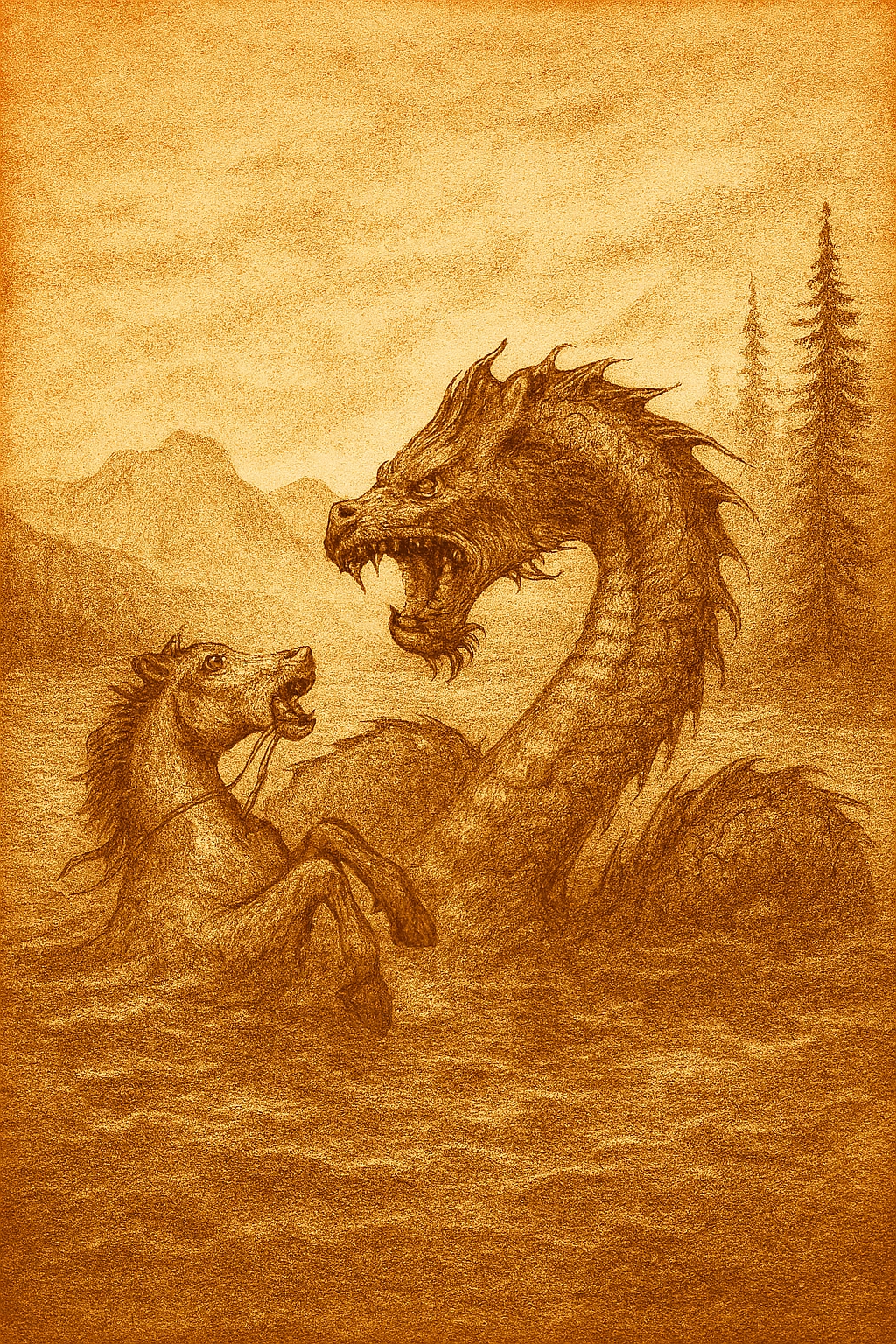
But the gods who watch over all things had witnessed the murder of the gentle Kan-He-Kan, and their anger shook the heavens. They pursued the fleeing murderer and seized him before he could escape their divine judgment. As punishment for destroying such a pure and soul, they transformed him into a monstrous serpent a creature as twisted in form as his spirit had become. His body elongated into powerful, undulating coils covered in dark green scales. His head became grotesque, shaped like that of a horse but filled with demonic malevolence. His eyes, once human, now gleamed with an otherworldly evil.
The gods cast this serpent into the very lake where the murder had occurred, condemning him to remain forever at the scene of his crime. The waters that had once reflected peace and beauty would now be his eternal prison. The Syilx people, learning of this divine punishment, named the creature “N’ha-A-Itk” the Lake Demon.
From that day forward, fear rippled through the communities surrounding the lake. Before launching their canoes or crossing the waters, people would offer sacrifices to N’ha-A-Itk, hoping to appease the cursed serpent and pass safely. They would leave gifts of small animals or precious items at the water’s edge, speaking prayers of protection. But the monster’s hunger was unpredictable, and the offerings did not always satisfy its rage.
Many times, without warning, fierce storms would suddenly descend upon the calm lake. Dark clouds would boil up from nowhere, and violent waves would crash against canoes. In the midst of these tempests, N’ha-A-Itk would rise from the roiling waters, its terrible form silhouetted against the lightning, and it would claim a life payment for the life its human form had stolen.
One summer afternoon, a man brought his horse to drink at the lake’s edge. As the animal lowered its head to the cool water, the surface suddenly exploded. N’ha-A-Itk burst forth with terrifying speed, its powerful jaws clamping around the screaming horse. Before the horrified owner could react, the serpent dragged the struggling animal beneath the waves. The water churned crimson, then stilled. The horse was never seen again.
Years passed, and eventually white settlers arrived in the Okanagan Valley. They heard the stories of N’ha-A-Itk from the Indigenous peoples, but they laughed and dismissed such tales as primitive superstition. The newcomers began harvesting timber from the forests surrounding the lake, cutting down ancient trees and floating the logs across the water to sawmills on the opposite shore.
One evening, as a lumberman worked on a raft of freshly sawn logs near the water’s edge, a strange sensation made him look up. What he saw froze his blood. Rising from the depths came a long serpentine form with a horse-shaped head and a green, undulating body that seemed to stretch endlessly beneath the surface. The creature lifted its head high out of the water and fixed its gaze directly upon him. Those eyes ancient, demonic, filled with malevolence bored into his soul. The man began shaking uncontrollably, his teeth chattering despite the warm summer air. He scrambled backward toward the shore, never taking his eyes off the monster. The creature watched him with those terrible eyes, and the man felt his sanity threatening to crack under that inhuman stare. Finally reaching solid ground, he turned and ran, not stopping until he reached the safety of the settlement.
Not long afterward, another settler prepared to cross the lake in his canoe, his two horses roped behind him to swim across. The crossing had begun peacefully, the horses moving steadily through the water. Then, without warning, the animals began screaming sounds of pure terror that no one who heard them would ever forget. They thrashed wildly, their eyes rolling white with fear. Then they simply vanished beneath the surface, dragged down by an unseen force. The canoe jerked backward violently as the weight pulled on the ropes. The man desperately sawed at the ropes with his knife, his hands shaking, the blade finally cutting through just as he felt himself being pulled into the murky depths. The severed ropes disappeared into the water. The horses were never seen again.
Thus did N’ha-A-Itk make itself known to the newcomers. Through the decades that followed, the creature was sighted many times. Often it appeared as a long, dark log floating on the surface until observers noticed it moving against the current, propelling itself with deliberate purpose. Swimmers vanished without trace. Boats were attacked by sudden, powerful swells that seemed to come from beneath. Witnesses reported seeing the monster rise up and snatch low-flying birds from the air with frightening speed.
In 1942, someone gave the creature a new name inspired by a humorous line in a popular British music hall song”Ogopogo.” The lighthearted name stuck, though those who had seen the creature’s demonic eyes knew there was nothing amusing about the Lake Demon. The serpent continues to haunt the waters of Lake Okanagan to this day, an eternal punishment for an ancient crime, a reminder that some transgressions echo through the ages.
Click to read all Myths & Legends – timeless stories of creation, fate, and the divine across every culture and continent
The Moral Lesson
The legend of Ogopogo teaches us that violence against the innocent, especially gainst those who are wise and, carries consequences that extend far beyond the immediate act. The demon-possessed man’s murder of Kan-He-Kan brought not only divine punishment upon himself but also created lasting suffering for the entire community that must now live in fear of the monster. The story reminds us that our darkest impulses, when given free rein, can transform us into something monstrous and that the scenes of our greatest crimes may become our eternal prisons. It also speaks to the importance of mental and spiritual balance, showing how darkness unchecked can lead to irreversible tragedy.
Knowledge Check
Q1: Who was Kan-He-Kan in the Ogopogo legend? A: Kan-He-Kan was a venerable wise man and sage who was beloved by the Syilx people. He was a keeper of wisdom and a spiritual guide who helped his community through difficult times. His murder by the demon-possessed man was the crime that led to the creation of the Lake Demon, N’ha-A-Itk.
Q2: What does the name “N’ha-A-Itk” mean and why was it given to the creature? A: “N’ha-A-Itk” means “Lake Demon” in the Syilx language. The Indigenous peoples of the Okanagan Valley gave this name to the serpent because it was a cursed being created as divine punishment for murder, condemned to haunt the lake where the crime occurred and to terrorize those who traveled its waters.
Q3: Why did the Syilx people offer sacrifices before crossing Lake Okanagan? A: The Syilx people offered sacrifices of small animals and precious items to N’ha-A-Itk in hopes of appeasing the monster and ensuring safe passage across the lake. However, these offerings were not always successful, and the creature would sometimes attack despite them, especially during sudden storms.
Q4: How did white settlers first react to the legend of the Lake Demon? A: White settlers initially dismissed the story of N’ha-A-Itk as primitive superstition and laughed at the warnings from Indigenous peoples. However, they soon had their own terrifying encounters with the creature, including a lumberman who saw it rise from the water and a settler whose horses were dragged beneath the waves.
Q5: What physical description is given of Ogopogo in the legend? A: Ogopogo is described as a long serpent with a horse-shaped head and a green, undulating body. It has demonic, malevolent eyes that can strike terror into those who meet its gaze. The creature sometimes appears like a floating log but moves against the current, and it is powerful enough to drag horses and swimmers beneath the water.
Q6: What is the cultural significance of the Ogopogo legend to the Syilx people? A: For the Syilx people, the Ogopogo legend serves as a powerful teaching story about the consequences of violence, the importance of respecting wise elders, and the dangers of allowing darkness to consume one’s spirit. The monster represents divine justice and eternal punishment, while also explaining real dangers of the lake and reinforcing respectful behavior toward sacred waters.
Source: Adapted from Indigenous oral traditions of the Syilx (Okanagan) people
Cultural Origin: Syilx (Okanagan) First Nations, Okanagan Valley, British Columbia, Canada






