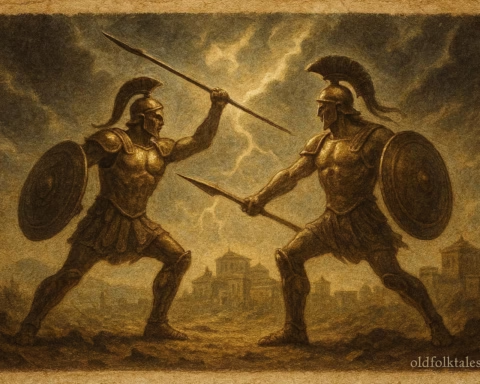
In the dawn of time, when the spirits of water and sky still conversed with humankind, the land of Orua was a realm of warriors and kings. Among them was Ozidi, a name that would echo through the waters and forests of the delta for generations. Its people, the Ijo, lived between the shimmering delta waters and the endless forest, where gods walked unseen. Yet beneath this beauty festered treachery. The elders had grown corrupt, and envy, that ancient serpent, coiled around the heart of the land.
There was once a man named Ozidi the Elder, a champion of Orua, whose strength was unmatched and whose justice was swift. He was the pillar of the people, a warrior blessed by the sea gods. But greatness invites jealousy, and among the council of chiefs rose his own kinsmen who feared his rising fame. During a sacred festival meant to honor the ancestors, they conspired, and before the eyes of the community, they struck him down, his lifeblood staining the earth that had once blessed him.
His wife, Orea, fled with her unborn child into exile. The gods, hearing her wails, took pity. They sent the spirit of her slain husband to comfort her in dreams, promising that the son she carried would bear his name and avenge his death. That child would be Ozidi the Younger, the one conceived for vengeance, born for retribution, and destined for renewal.
Years passed. Orea lived in the shadow of sorrow, raising her boy in secrecy. Yet fate cannot be hidden. When Ozidi grew to manhood, his spirit burned with a fire that frightened even his mother. He possessed the strength of ten men and eyes that gleamed like lightning in a storm. He could hear the whispers of spirits in the river and see through the hearts of deceitful men. Orea feared what he might become, but destiny had already written its tale.
One night, in the heart of thunder, his grandmother, an old enchantress named Ofe, came to him. She had long served the gods as a seer and sorceress. Her eyes glowed with ancestral power. “Grandson,” she said, “the blood of your father cries from the ground. The earth waits for cleansing. The serpents who killed him still feast in the halls of Orua. Rise, Ozidi, and take up your father’s cause.”
Under her guidance, Ozidi was reborn, not by womb but by ritual. Ofe called upon the seven winds of the Delta, upon the spirits of the river and the sword. She bathed him in palm oil and river water, invoking divine fire. The sky cracked open, and a hawk descended, a messenger of the gods, perching upon his shoulder. From that night onward, he was no longer a mortal youth but a spirit-warrior, a vessel of divine vengeance.
With Ofe’s charms and a sword forged by lightning, Ozidi set forth toward Orua. The people trembled when they saw him, for his stride echoed like thunder and his presence carried the scent of judgment. One by one, he sought out the conspirators who had slain his father. Against Ofe’s counsel, his wrath grew terrible. In the village square, he struck down his father’s murderers, their screams rising like incense to the gods. He spared none who stood in deceit, and the earth drank deeply of their blood.
But vengeance is a double-edged blade. Each battle fed his rage until it burned hotter than reason. When the last of his father’s killers fell, the warrior did not rest. He turned his sword upon those who had stood by in silence, and even upon the innocent who reminded him of cowardice. The gods watched, uneasy. What had begun as divine justice had become divine fury.
Ofe, his grandmother, saw that the spirit of vengeance had begun to consume him. She called him forth to the sacred grove and spoke, “My child, you have avenged your father, but at what cost? The land bleeds still, not from treachery now, but from your hand. You were sent to cleanse corruption, not to sow death without measure. Remember, justice without mercy is tyranny.”
But Ozidi, still aflame with wrath, could not hear her. The gods themselves intervened. From the heavens descended the spirit of his father, robed in light. “My son,” the elder Ozidi said, “the dead are avenged. Let peace be reborn.” Only then did the young warrior fall to his knees, his sword trembling in the soil. The storm within him broke, and the hawk that had shadowed his journey flew heavenward, carrying away his anger.
In repentance, Ozidi performed the purification rites. He planted his sword in the heart of Orua’s square, declaring, “Let no hand wield this blade until the world needs cleansing again.” Then he vanished into the mist, said to have returned to the realm of spirits, neither dead nor living, but waiting. The people of Orua rebuilt, purified by fire and sorrow. Each year, they told his story, not as a warning only, but as a remembrance, that justice must walk hand in hand with mercy, and vengeance, though divine, must always return to peace.
Author’s Note
The Ozidi Saga stands among the grand oral epics of Africa, performed for centuries by Ijo bards with chant, drum, and dance. Ozidi embodies the eternal struggle between justice and excess, between rightful vengeance and the corruption of wrath. His story reminds the Ijo that the hero’s duty is not only to destroy evil but to restore harmony. In J. P. Clark’s recording, the tale serves as both myth and moral mirror, showing how divine power can purify or consume, depending on the heart that wields it.
Knowledge Check
-
Who was Ozidi the Elder, and what led to his death?
-
How did Orea and her unborn son survive after Ozidi the Elder’s murder?
-
What role did the grandmother, Ofe, play in Ozidi’s transformation?
-
Why did Ozidi’s vengeance become a moral danger to himself and his people?
-
How did the gods and the spirit of his father restore balance at the end of the story?
-
What lesson about justice and mercy does The Ozidi Saga ultimately teach?
Cultural Origin: Ijaw/Ijo, Niger Delta, Nigeria
Source: The Ozidi Saga by J. P. Clark (Oxford University Press, 1977)