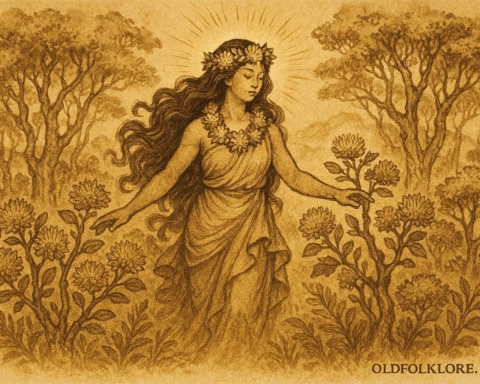
Papahānaumoku is the revered Earth Mother in Hawaiian cosmology, source of islands, life, and genealogical connection. Her domain encompasses the land, fertility, natural abundance, and the sacred bond between people and the earth.
Paired with Wākea (Sky Father), Papahānaumoku generates the Hawaiian Islands, each island embodying a child of this divine union. Through these creations, she anchors the kumulipo, the genealogical framework linking chiefs (ali‘i) and humans to the land. Her nurturing yet powerful presence is reflected in Hawaiian customs such as mālama ‘āina, caring for the land as a living ancestor.
Temples, sacred places, and chants honor her, emphasizing both her creative power and the moral responsibility she imparts: humans must protect the land, honor ancestry, and respect the cycles of life.
Mythic Story
In the beginning, before the islands rose from the vast Pacific, there was only Wākea, the Sky Father, and Papahānaumoku, the Earth Mother. From their union flowed the living earth and fertile lands, each new island a child of this divine couple. Hawai‘i, Maui, O‘ahu, Kaua‘i, all emerged as sacred beings, endowed with life, spiritual essence, and guardianship over all that walks, swims, or grows upon them.
Papahānaumoku’s embrace of Wākea was both tender and purposeful. Through their intimate connection, mountains rose, valleys formed, and rivers traced their courses across each new island. Forests, fields, and the first humans followed, inheriting the vitality of her life-giving essence. Each creation carried her spirit: fertile soil, abundant food, and the potential for generations to thrive.
The kumulipo, the great Hawaiian genealogical chant, preserves this sacred lineage, linking the ali‘i directly to the divine parentage of Papahānaumoku and Wākea. Chiefs were not mere rulers; they were living embodiments of the islands themselves, charged with protecting the land and sustaining the harmony she imbued in all creation.
Papahānaumoku’s care extended beyond mere formation. She taught her children, both human and divine, the principles of stewardship, ensuring that the delicate balance between life and the earth endured. Her presence is eternal: the islands breathe with her essence, the forests whisper her guidance, and the oceans reflect the sky she partners with in cosmic creation.
Some traditions tell of earlier unions Papahānaumoku held with other deities, shaping smaller islands, forests, or natural features before Wākea’s more widely celebrated union. These variations highlight her enduring role as Earth Mother, adaptive, fertile, and intimately involved with the world’s formation and ongoing life cycles.
Her narrative embodies the Hawaiian principle that humans are inseparable from their environment. The land is not property but ancestor, and to disrespect it is to disrupt the sacred web of life. Papahānaumoku’s story continues to inspire Hawaiians to honor the earth, cultivate abundance, and live in balance with nature and the cosmos.
Discover the gods, goddesses, and divine spirits who ruled the heavens and shaped human fate
Author’s Note
Papahānaumoku’s myth teaches that creation is inseparable from responsibility. Through her, we learn that humans are not above nature but part of an ongoing genealogy of life. Her story reminds us that the earth is living, sacred, and interconnected, calling for respect, care, and reverence in all actions.
Knowledge Check
Q1: Who is Papahānaumoku’s consort?
A: Wākea, the Sky Father.
Q2: What is Papahānaumoku’s primary domain?
A: The earth, landforms, fertility, and genealogy.
Q3: How are the Hawaiian Islands related to Papahānaumoku?
A: Each island is considered a child of her union with Wākea.
Q4: What is the kumulipo?
A: A genealogical chant linking humans, chiefs, and islands to Papahānaumoku and Wākea.
Q5: What moral or principle does Papahānaumoku’s story convey?
A: Humans must care for the land and respect the sacred connection between people and nature.
Q6: How does Papahānaumoku’s presence influence Hawaiian culture today?
A: Through practices like mālama ‘āina, fostering stewardship, sustainability, and spiritual connection to the land.
Source: Hawaiian Oral Traditions and the Kumulipo, Hawai‘i
Source Origin: Hawaiian, Hawai‘i