In the high Andean dawn, when the sun-god Inti sent his first golden lance across the snow-crowned peaks, a child was born beneath a radiant omen. The shepherds who witnessed it spoke of a shimmering figure, neither entirely mortal nor entirely divine, standing at the threshold between mountain and sky. From this figure came the infant who would one day be known as Patasola’s Hunter-Hero, guardian of valleys, slayer of abominations, and defender of humankind against the monstrous spirits that prowled the cloud forests.
His mother, Chaska of the Dawn Mist, was a mortal healer who carried the scent of wild herbs and early morning rain in her hair. His father was whispered to be Apu Illapa, the thunder deity who hurled lightning from the mountain crests. The child’s first cry was accompanied by a stormbolt that split a boulder nearby, a sign that his destiny would be carved between worlds.
From childhood he walked with uncanny purpose. He heard voices in the wind that others could not: whispers of roots, warnings of spirits, the lamentations of rivers whose waters remembered ancient battles. The elders taught him the rituals of protection and the use of the champi, the bronze-edged axe of the Andean warrior. But the spirits taught him the rest, how to listen to the shifting breath of the forest, how to track a creature that left no prints, how to steady the heart when staring into the jaws of the unknown.
When he reached manhood, the mountains stirred with unrest. Travelers vanished on the forested slopes; hunters returned with nightmares etched deep into their eyes. The name Patasola drifted between villages like a shroud of dread.
Patasola, the One-Footed She-Devil.
The devourer of wanderers.
The spirit who leapt from tree to tree with a single powerful limb, her face a mask of beauty and terror.
Once, they said, she had been a woman wronged and cast aside, her form twisted by vengeance and forest magic. Now she hunted with a hunger that no offering could tame.
The Hunter-Hero knew the time had come.
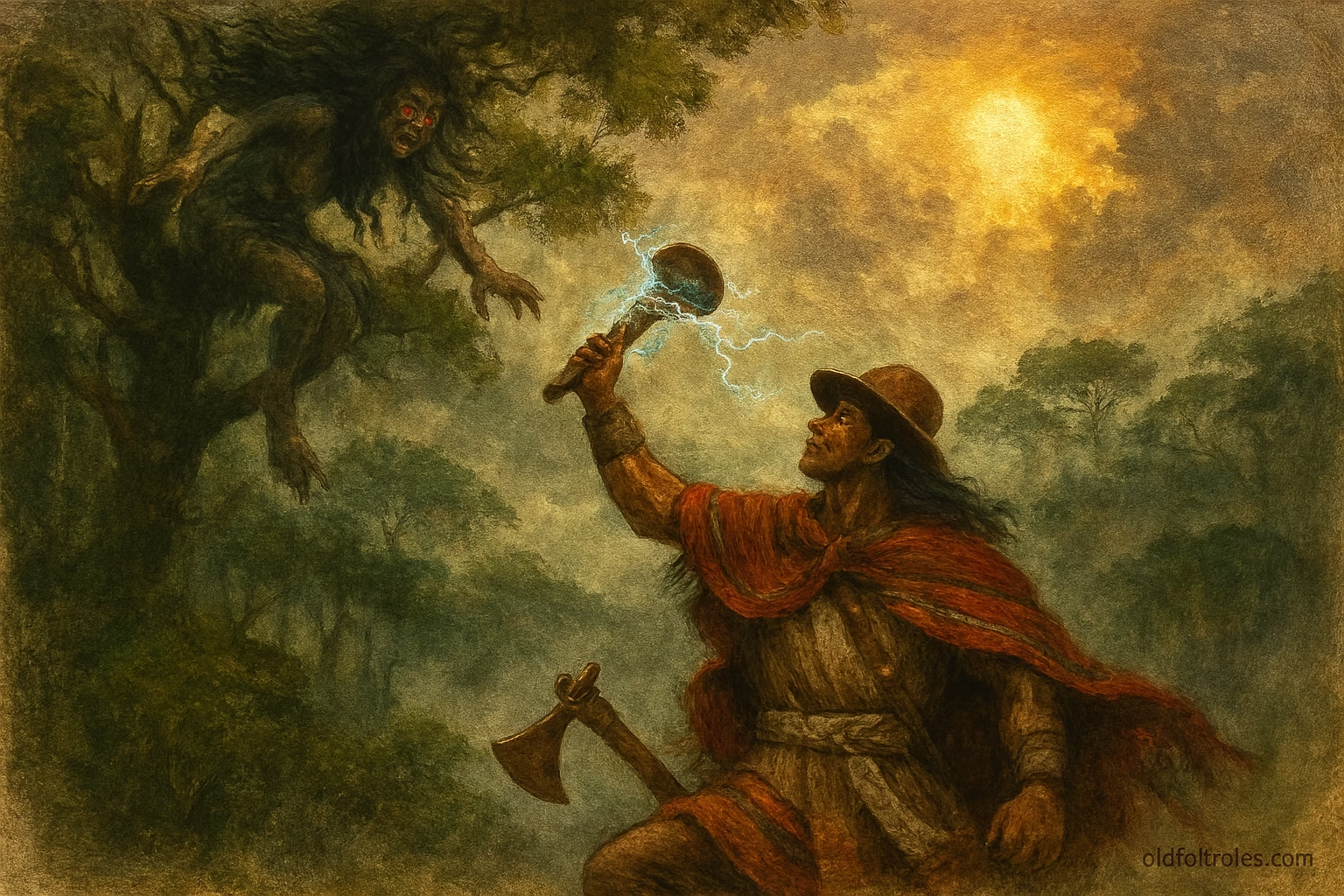
He journeyed into the cloud-wreathed forest, where orchids trembled like living lanterns and lichens wrapped the ancient trees in pale veils. Each step deeper felt like entering the lung of a sleeping giant, humid, pulsing, alive. He set down no traps, for traps could not catch a spirit. Instead he invoked the rites of his father’s thunder, calling crackling sparks to coil around his champi.
Days blurred into nights. He found bones arranged in strange spirals. He heard laughter drifting on the mist, a sound both seductive and venomous. He followed it until the forest opened into a clearing hung with vines like skeletal ribs.
There she stood.
Patasola’s single leg was corded with impossible strength, the muscles rippling like pumas beneath her skin. Her upper body shimmered with deceptive beauty, hair black as volcanic obsidian, eyes gentle as mountain pools. But when she smiled, her mouth revealed rows of jagged teeth meant for rending.
“You seek me, child of thunder,” she purred. “Why defend those who would fear you as they fear me?”
This was the heart of his moral struggle. For he knew she spoke a twisted truth: humans distrusted anything not entirely mortal. If they discovered his parentage, they too might cast him out, just as Patasola had once been cast out and broken.
“Because they still hope,” he replied slowly. “Because even in their fear, they build, they plant, they protect their children. You protect only your hunger.”
Her beautified face cracked like drying clay, revealing the monstrous form beneath. Snarling, she bounded toward him with a speed that defied sight. The forest roared with the collision of immortal wills, thunderlight meeting claw, sacred chants meeting shrieks of rage.
She leapt from branch to branch, descending upon him from impossible angles. He countered with lightning arcs that slashed the air like radiant serpents. She caught his arm in her talons, tearing his flesh. He staggered, blood seeping down his side.
But he remembered his mother’s teachings: courage was not the absence of fear but the mastery of it. He waited, listening to the wind-spirit’s whisper, and when Patasola lunged for the finishing strike, he pivoted, driving his champi into her chest.
Thunder cracked.
Light exploded.
Patasola’s scream shook the canopy.
Her body dissolved into a storm of leaves, which spiraled upward and vanished into the mist. The threat was ended, but the forest grieved, for even monsters had stories rooted in sorrow.
The Hunter-Hero stood alone in the stillness, breathing hard, his wound throbbing. He whispered a prayer for the broken spirit he had slain, an acknowledgment that even the wicked had once been whole. Then he began the long walk home, guided by the fire of dawn breaking above the peaks.
From that day onward, the people of the Andes honored him not only as a slayer of monsters but as a reminder that good and evil are paths shaped by the choices one makes when standing at the edge of despair.
And though he remained only half mortal, they welcomed him as wholly theirs.
Author’s Note
Patasola’s Hunter-Hero represents the Andean ideal of courageous stewardship, protecting the harmony between human communities and the vast living world around them. His legacy endures as a symbol of vigilance, compassion, and the cost of confronting inner and outer darkness.
Knowledge Check
-
What divine sign accompanied the hero’s birth?
-
Who were his mortal and divine parents?
-
Why did Patasola become a feared forest spirit?
-
What moral dilemma did the Hunter-Hero face?
-
How did he ultimately defeat Patasola?
-
What symbolic message does the hero’s story convey?
Cultural Origin: Andean Indigenous mythology, highlands of Peru, Ecuador, and Colombia.
Source: Adapted from themes in Andean myth cycles as documented by John Murra (1978).