In the age when shadows walked beside men and the breath of God shimmered upon the hills of Cymru, a child was born beneath a sky of pale gold. This was Peredur ap Efrawg, last son of a noble line shattered by war. His father fell by treachery, and his brothers by the blades of rival chieftains. Fearing fate’s hunger, his widowed mother hid him deep in the wild forests of the North, where no knight’s trumpet nor spear’s cry could reach him. Yet destiny is not so easily evaded, for divine purpose stirs even in silence.
Peredur grew beneath the tutelage of the forest itself, learning the whispers of rivers, the patience of mountains, the keen watchfulness of hawks. His mother forbade him knowledge of arms or courts, but the boy’s spirit shone with something older than any mortal decree. For it was said his blood carried a spark of heaven’s fire, and God, who shapes kings from shepherds and prophets from wanderers, watched him closely.
One day, a band of knights rode through the forest, helms gleaming like suns, shields bright with heraldic thunder. Peredur, struck by wonder, believed them to be angels. From that moment, he felt the stir of calling. Against his mother’s tears and warnings, he set out toward the life meant for him, armed only with innocence and a heart unmarred by malice.
He came first to the court of King Arthur, where his raw courage and strange manners provoked both laughter and awe. Yet beneath his rustic simplicity lay a fearless soul. When a venom-tongued knight insulted Arthur’s honor, Peredur struck him down with the blunt shaft of a hunting spear. Thus began his journey not merely into knighthood, but toward a revelation that would shake the foundations of his being.
Wandering across the land, he faced sorcerers cloaked in illusions, warriors twisted by pride, giants who fed on despair, and maidens who tested virtue with riddles of heart and faith. Each trial sharpened his spirit. But the greatest trial awaited him in the Hall of the Wounded King.
There, across a chamber heavy with incense and sorrow, sat a king upon a couch, pierced by a wound that refused to heal. Around him servants carried a gleaming spear dripping blood, and a grail, mysterious, radiant, whose inner fire pulsed like the breath of God. Peredur, remembering his mother’s command never to question too boldly, held his tongue. Yet silence can be a chain. For by failing to ask the meaning of the Grail and the Spear, he allowed the king’s torment to continue and the land around him to wither.
Shame followed him like a winter wind. He sought hermits in the mountains, saints in their stone cells, and mystics who whispered of divine insight. Through prayer, penance, and the shedding of ignorance, he learned the truth: that spiritual sight demands courage deeper than any battle cry.
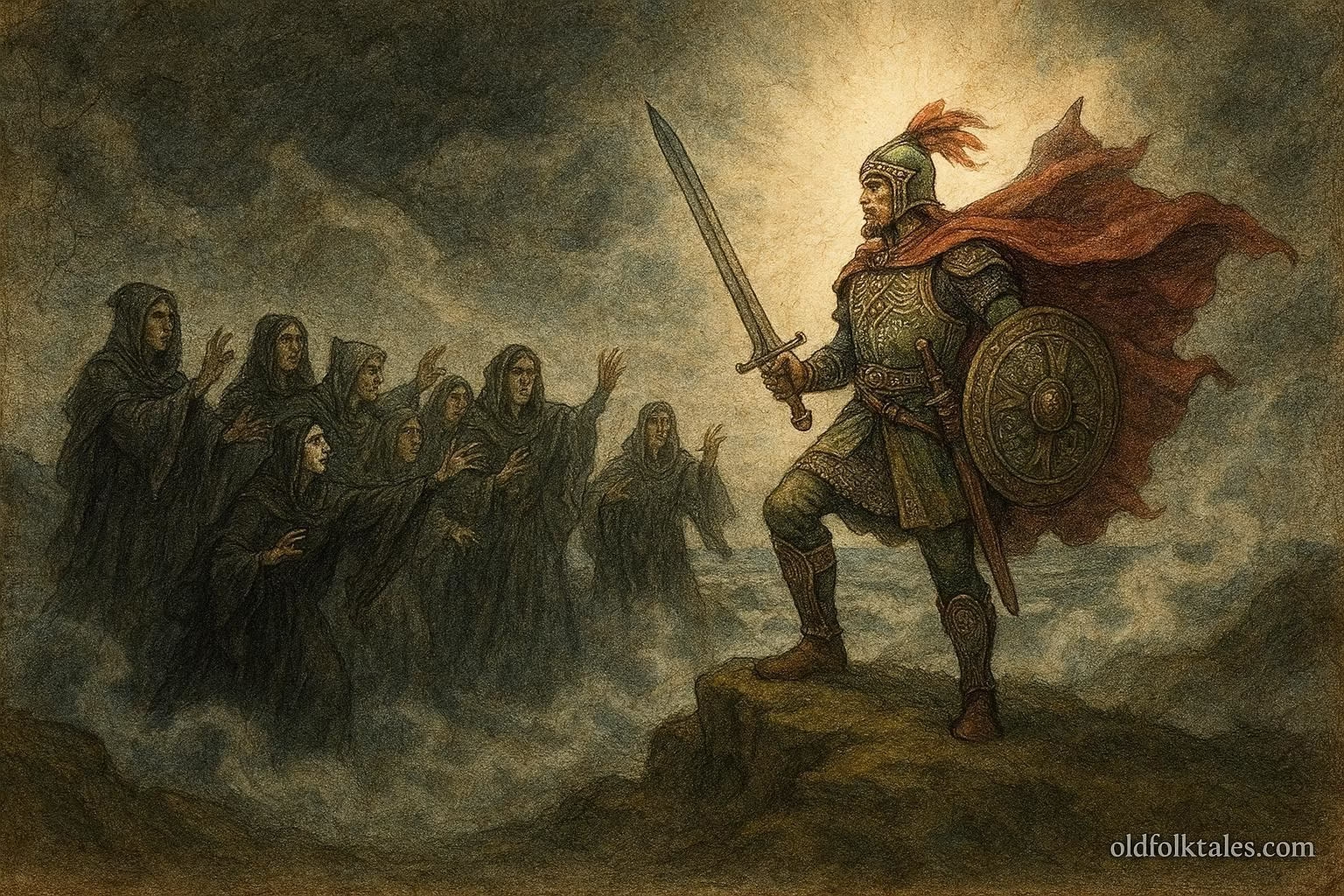
Renewed, Peredur returned to confront the forces that had cursed the king. They were nine sorceresses, daughters of shadow, who wove spells from the crushed hopes of men. Upon a storm-torn headland he faced them. The wind howled like demons in flight; waves crashed as though the sea itself recoiled. But Peredur, armed with faith rather than fury, broke their enchantments. One by one the sorceresses fell, their illusions dissolving into mist.
When the final shadow was vanquished, a great silence spread across the land. Peredur felt a warmth move through him, as if heaven itself breathed approval. Returning to the Hall, he asked the questions he once feared: “What is the Grail? What is the Spear? Who suffers, and why?” In the speaking of these words, the enchantment shattered. The Wounded King rose healed, and the land flourished once more.
Peredur had passed from innocence into wisdom, from wanderer into sainted warrior. The Grail’s light touched him, not as a possession but as a transformation. For in seeking to understand suffering, he learned compassion. In confronting darkness, he learned humility. And in embracing divine mystery, he discovered his true purpose.
Thus Peredur ap Efrawg became a beacon in Welsh lore, a hero not merely of strength, but of holy awakening. And though many tales would later mingle his path with those of other Grail knights, the bards of Cymru remember him as the first: the seeker whose heart was a doorway through which God’s grace entered the world.
AUTHOR’S NOTE
Peredur stands as one of the most spiritually charged heroes in medieval Welsh tradition. His tale preserves older Celtic motifs while reflecting the Christianization of Britain, offering a rare portrait of a warrior whose greatest victory is enlightenment. His legacy endures as a bridge between mythic valor and sacred understanding.
KNOWLEDGE CHECK
-
Why did Peredur’s mother hide him in the wilderness?
-
What sparked Peredur’s desire to become a knight?
-
What major mistake did he make in the Hall of the Wounded King?
-
Who were the primary antagonists Peredur eventually confronted?
-
What transformed Peredur’s understanding of his quest?
-
How did Peredur ultimately heal the king and the land?
CULTURAL ORIGIN: Medieval Welsh tradition; part of the Mabinogion cycle, blending Celtic heroic motifs with early Christian symbolism.
SOURCE: The Mabinogion, compiled from medieval Welsh manuscripts including the Red Book of Hergest (c. 14th century).