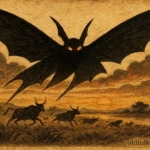
The Pisadeira is one of the most unsettling beings in Portuguese folklore, a skeletal, long-fingered hag who lurks in the shadows of the household at night, waiting for sleepers to drift into a vulnerable state between dreaming and wakefulness. Her name comes from the verb pisar, “to step” or “to tread,” and her defining act is precisely that: she climbs upon a person’s chest, pressing down with her sharp, bony feet until the victim wakes in terror, paralyzed, breathless, and unable to speak or scream.
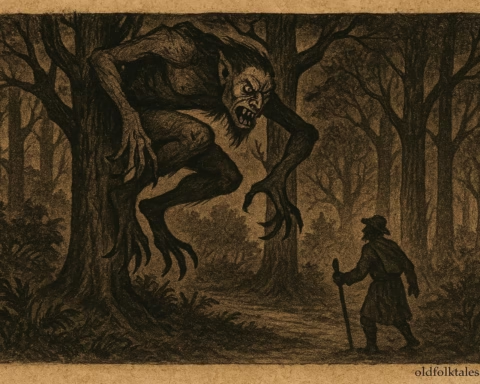
Accounts recorded in the 19th and early 20th centuries describe her as extremely thin, with greasy hair, tattered clothing, and disproportionately long nails. Her face is gaunt, with deep-set eyes that gleam like embers in the dark. Although she is often invisible, many rural testimonies insisted that the sudden weight on the chest, the inability to move, and the sense of a presence staring down were proof that the Pisadeira had visited.
Explore the shadows of world mythology, where demons test the soul and spirits watch over mankind
Unlike demonic entities in Christian demonology, the Pisadeira is not inherently evil, she is opportunistic and bound to the rhythms of human habits. She appears when someone goes to bed overly full or sleeps in a disorderly house. She preys on heavy sleepers, especially those who fall asleep on their backs. In some villages, people warned that leaving unfinished chores, unwashed dishes, scattered grain, or unswept floors, invited the Pisadeira to wander the home.
Her movements are described as eerily light and deliberate. She does not lumber like a monster; she glides, crouches, and steps with the precision of a starving creature hunting a weakened animal. When she presses on a person’s chest, her feet are said to feel icy, and her long nails brush the victim’s throat as though testing whether to silence their breath entirely.
This folklore aligns strongly with the universal human experience of sleep paralysis. The Pisadeira gave tangible form to a mysterious physical event, embedding it within the rhythms of Portuguese domestic life. She is not merely a nightmare figure, she is a moral reminder and a domestic guardian whose presence enforces propriety and respect for household order.
Cultural Role
A Personification of Sleep Paralysis: In pre-scientific societies, sleep paralysis was terrifying and inexplicable. The sense of being awake yet unable to move, combined with pressure on the chest and visual hallucinations, demanded a supernatural explanation. Pisadeira became that explanation, offering a culturally coherent narrative for bizarre nighttime sensations.
A Guardian of Domestic Order: In many rural Portuguese communities, household tidiness was woven into moral duty. A messy home indicated laziness or neglect, especially on the part of the woman of the house. Thus the Pisadeira punished disorder, not with physical harm, but with agonizing nighttime fear. She enforced:
- regular cleaning
- the proper timing of meals
- disciplined sleeping habits
- respect for household routines
A Warning Against Gluttony: A major trigger for the Pisadeira was going to bed immediately after a heavy meal. This served as a moral and practical warning: overeating before sleep was unhealthy and disruptive. In this sense, the Pisadeira is also a folk tutor of bodily discipline.
A Night Hag with European Roots: The Pisadeira belongs to a larger family of European sleep-hag figures such as the English “Old Hag,” the German “Alpdrücke,” and Scandinavian “Mara,” the root of the English word nightmare. All represent a cultural convergence: a spectral woman pressuring a sleeper’s chest, symbolizing both real biological phenomena and social anxieties.
Portugal’s Pisadeira, however, is distinctive for her thinness, her sharp nails, and her connection to domestic behavior, traits seldom emphasized in other traditions.
Symbolism
Moral symbolism: household discipline, moderation, and the consequences of neglecting routine.
Natural symbolism: the boundary between waking and dreaming, the invisible forces acting on the human body at night.
Psychological symbolism: fear of vulnerability, guilt, anxiety, and the oppressive weight of unspoken social expectations.
The Pisadeira is a creature of liminality, neither fully physical nor fully spiritual. She is invoked to explain what happens when the mind wakes before the body, when dreams spill into waking awareness, and when guilt or disorder manifests as terror.
Author’s Note
The Pisadeira is an extraordinary example of how folklore becomes a vessel for everyday human fears. Studying her legend reveals how communities interpreted sleep, morality, and bodily weakness long before modern science explained them. What makes the Pisadeira so compelling is her dual nature: she embodies a real physiological experience, yet also acts as a symbolic enforcer of cultural norms. She is not simply a monster, she is the dark whisper behind a mother’s warning, the reason children learn to tidy before bed, and the night-hag that generations of Portuguese families feared but accepted as part of the world’s rhythm. Understanding her gives us a window into the emotional and domestic life of historical Portugal.
Knowledge Check
- What is the Pisadeira’s primary action?
She steps on a sleeper’s chest, causing paralysis and breathlessness. - Why is she associated with untidy homes?
Folklore teaches that disorder invites her, reinforcing domestic discipline. - What physical experience does the Pisadeira explain?
Sleep paralysis, a state where the mind wakes before the body. - Why does gluttony relate to the Pisadeira?
Sleeping after overeating was believed to draw her to one’s chest. - Which folklorist provides early documentation?
José Leite de Vasconcelos in 19th-century Portuguese ethnographic works. - How does the Pisadeira differ from other European night hags?
She is unusually thin, long-nailed, and tied strongly to household tidiness.
Source: 19th-century Portuguese folklore dictionaries; José Leite de Vasconcelos, Etnografia Portuguesa
Origin: Northern & Central Portugal (pre-modern European nightmare traditions)