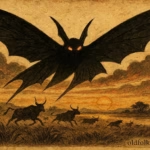
The Ponaturi occupy a distinctive place in Māori cosmology: hostile, sea-dwelling, goblin-like beings who fear sunlight and thrive in the liminal hours of night. Their stories weave together themes of danger, secrecy, and the boundary between the human world and the supernatural realm. Though often grouped with “spirits” or “goblins,” the Ponaturi are not mere monsters, they are a complex people with their own rituals, chants, and communal structures.
Appearance
Descriptions of their appearance vary across iwi, but several elements are consistent:
- Pale, almost greyish skin, like deep-sea creatures unused to the sun
- Slightly hunched or sinewy bodies, more human-shaped than beastlike
- Large, shadow-adapted eyes suited to darkness
- Hair dripping with seawater or textured like kelp
- Thin, long limbs allowing them to move swiftly through shallow waters
- A cold aura, as if the ocean depths cling to them
Some traditions portray them as almost skeletal, while others emphasize a damp, slippery sheen to their skin, a reminder of their underwater origins and their aversion to warmth and daylight.
Habitat & Realm
The Ponaturi live beneath the sea by day, emerging only after sunset. Their underwater dwellings are sometimes described as stone or coral-like caves, lit by eerie blue luminescence or filled with strange sea voices. These are not peaceful abodes, they are places of enchantment, chanting, magical objects, and dark rituals.
At night, they creep onto land to perform ceremonies, to hunt, or to traverse sacred spaces hidden from human eyes. The boundary between sea and shore is therefore their natural domain: the place of tides, the place of uncertainty.
Powers & Abilities
Their mythology grants them a range of supernatural abilities:
- Sunlight Vulnerability: The most defining trait. Direct sunlight kills them instantly or turns them to stone.
- Magical Incantations (Karakia): Many Ponaturi possess knowledge of powerful chants. In some stories, human heroes learn these incantations from them.
- Stealth & Night Travel: They move silently, slipping through forests and along the shoreline unnoticed.
- Communal Sorcery: They chant together in large groups, creating ritual power amplified by their numbers.
- Luring or Capturing Humans: Though not always explicitly predatory, they can kidnap or ambush humans if provoked or if the narrative requires it.
Behavior
Ponaturi are typically portrayed as hostile or dangerous, but not mindlessly so. Their actions are governed by their collective identity and by ancient enmities.
They act in large groups, often living in tightly coordinated communities. Their rituals are strict: they gather before dawn to return to their underwater homes before fatal sunlight reaches them. This fear creates suspense in their stories, the dread of sunrise hangs over them like a death sentence.
Major Myth Traditions Involving Ponaturi
- The Story of Tāwhaki and Hemā: In one of the most prominent traditions, the Ponaturi capture or kill Hemā, father of the hero Tāwhaki. They hold Hemā’s body in their underwater house, using it as part of their ritual or as a trophy of victory. When Tāwhaki seeks revenge, he and his family deceive the Ponaturi by trapping them in a house and abruptly opening it to the rising sun. Most of the Ponaturi perish instantly, highlighting the central motif of sunlight destruction.
Some iwi versions portray Tāwhaki as a divine or semi-divine hero who uses cunning rather than brute force. His manipulation of dawn reflects deep Māori symbolism about light overpowering darkness and the triumph of knowledge over secrecy.
- Rātā and the Hidden Incantations: In the stories of Rātā, the Ponaturi appear differently. Instead of killing a family member, they become unwilling sources of magical knowledge. Rātā learns some of their karakia, either by stealth or by listening to them chant during their night rituals. This version highlights human cleverness and the importance of listening, adaptability, and courage.
In some tellings, Rātā also fights them, using the very incantations they taught (or revealed) to him, a reversal in which the oppressed outwit the oppressor.
Symbolism & Interpretation
The Ponaturi symbolize several interconnected ideas in Māori thought:
- The Danger of Liminal Spaces: seas, shorelines, and nighttime landscapes are not merely physical zones but spiritual thresholds where other beings roam.
- Light vs. Darkness: their destruction by sunlight is not just physical but symbolic, representing revelation, truth, and order overwhelming secrecy and chaos.
- Knowledge with a Cost: their magical chants represent esoteric wisdom guarded fiercely by non-human beings; humans gain such knowledge only with risk, bravery, or cunning.
- Collective Vulnerability: their communal nature stresses the fragility of groups entirely dependent on environmental patterns (like returning underwater before dawn).
- The Unknown Beneath the Sea: the ocean, in Māori worldview, is an ancestral realm full of gods and beings; the Ponaturi are one reminder that beneath the waves lie powers beyond human understanding.
The Ponaturi are not the only night-creatures or sea-beings in Māori tradition, but their combination of hostility, magical skill, and fatal vulnerability makes them especially memorable.
Cultural Role
The Ponaturi serve as mythic warnings, guardians of forbidden knowledge, embodiments of nocturnal danger, and symbols of realms where humans are not meant to wander carelessly. Their stories remind listeners of:
- the importance of dawn as protection
- the rhythms of nature that must be respected
- the idea that some knowledge is retrieved only through ordeal
- the power of preparation, timing, and cleverness
Their presence reinforces community caution: avoid certain areas at night, respect the sea and its unseen inhabitants, and be wary of the unknown.
Explore the mysterious creatures of legend, from guardians of the sacred to bringers of chaos
Author’s Note
Ponaturi narratives vary widely between iwi and even between individual manuscripts in early ethnographic collections. Their core traits, however, night-dwelling, sea-linked, vulnerable to sunlight, remain stable across versions. As with many Māori supernatural beings, they are neither simple monsters nor allegories but part of a rich cosmological landscape that entwines environment, morality, and ancestral memory.
Knowledge Check
- Where do the Ponaturi live during the day?
Underwater, in hidden sea dwellings. - What destroys them instantly?
Direct sunlight. - Which hero avenges his father Hemā against them?
Tāwhaki. - What kind of knowledge do the Ponaturi possess?
Powerful magical chants (karakia) and ritual knowledge. - Are they solitary or communal beings?
Communal, they act in large coordinated groups. - What key cultural concept do they symbolize?
The danger of liminal spaces and the triumph of light/knowledge over secrecy/darkness.
Source: Classical Māori myth collections (Tregear; White; Craig)
Origin: Māori (Aotearoa New Zealand), traditional oral traditions