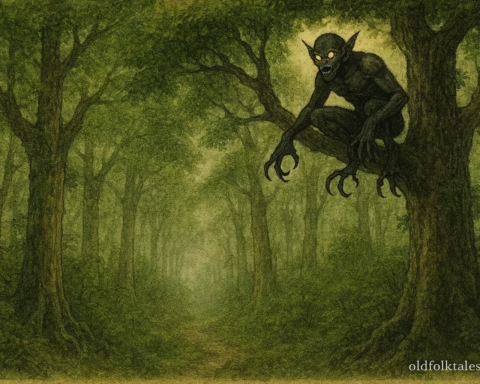
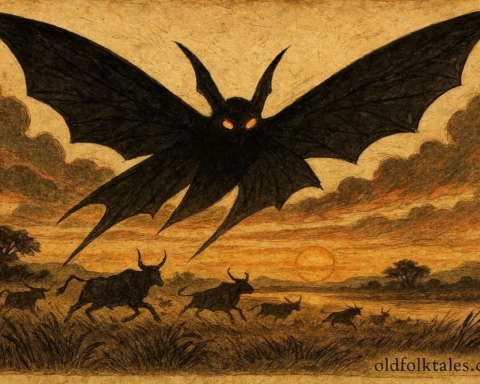
On the islands of Zanzibar, where the sea breeze carries stories older than memory, people speak in quiet tones of the Popobawa. It is a shadow spirit, a being that attaches itself to communities rather than individuals, emerging only when dishonesty festers or when people hide their fears instead of confronting them. Some say it first appeared during a season of political unrest, when mistrust ran deep and neighbors whispered behind closed doors. Others believe it is much older, born from ancient Swahili spirits that protect truth and harmony.
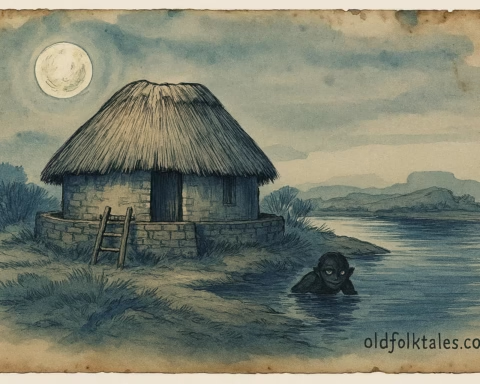
Long ago in a small coastal village on Pemba Island, fishermen returned each night with strange tales. They claimed that when the moon hung low and red, they heard a fluttering sound above the trees. It was not the wings of a bird nor the wind moving through the thatch roofs. It was something heavier, something that carried intention. The elders warned that it was the Popobawa searching for those who lived with lies in their hearts.
One night, a man named Juma returned home from the sea looking troubled. He had been arguing with his brothers over the division of their daily catch. In anger, he took more than his share and lied when confronted. He told them the sea had pulled his net thin and that he had barely caught enough to feed his family. His words rang false, but his brothers were too tired to argue and simply walked away with disappointment heavy in their eyes.
Explore the mysterious creatures of legend, from guardians of the sacred to bringers of chaos
That night, before sleep took him, Juma felt the air grow thick and cold. Shadows on the walls stretched longer than they should have, twisting like dark fingers searching for a pulse. Then came the sound he had only heard in stories, a rustling mixed with a deep churning breath. He sat upright, heart pounding, as the Popobawa slipped into his home like smoke squeezing through a narrow gap.
It did not appear as a beast or a monster but as a shape without fixed form. A shifting shadow, wide and then narrow, tall and then short. Two glowing points, like the faintest embers, hovered where its eyes might have been. Juma felt an immense pressure on his chest, not painful, but heavy with truth. The spirit was not there to harm him. It was there to confront the lie he had allowed to grow in his heart.
Juma tried to speak but no words came. The Popobawa whispered not with a voice but with a sensation that filled the room. Confess. Clear your heart. Fear only grows in darkness. Juma trembled and finally bowed his head, realizing that the spirit fed not on flesh but on the shadows of the human spirit. The more a person hid from the truth, the stronger it became.
In the morning, Juma stood before his brothers and confessed everything. He returned what he had taken and asked for forgiveness. To his surprise, they embraced him warmly. Their unity returned, and the tension that had weighed upon their family lifted like mist burned away by the rising sun. That night, the village remained peaceful. No rustling, no shifting shadows, no heavy breath sliding under the door. The Popobawa had moved on.
Yet the spirit appeared again months later when another villager spread harmful rumors that divided neighbors. Searching for someone to blame for his own misfortunes, he accused a widowed woman of casting curses upon the village. Fear spread quickly. People locked their doors and whispered behind walls. When the Popobawa arrived, it came with a force greater than before, for the lie had wounded many hearts.
The villagers gathered in the central square, candles trembling in their hands. An elder named Mama Zahara raised her voice, calling for truth. Let each person speak honestly, she said. Let no fear hide among us. Slowly, one by one, the villagers confronted their own roles in the false accusations. Tears flowed, apologies were offered, and the community regained its unity.
The shadows retreated. The Popobawa faded into the night wind. Peace returned.
To this day, elders in Zanzibar teach children that the Popobawa thrives on dishonesty, fear, and division. It does not torment those who live truthfully and stand together. Instead, it acts as a reminder that communities survive only through honesty and courage. When people choose transparency over secrecy and unity over suspicion, the shadow has no home to settle in.
Author’s Note
The tale of the Popobawa is less about a terrifying night spirit and more about the moral fabric of community life. In many Swahili teachings, truth is a spiritual duty, and collective harmony is a shield against invisible dangers. The Popobawa reminds listeners that fear grows when lies remain hidden, but clarity dissolves darkness. Whether seen as spirit or symbol, it teaches that honesty is a communal responsibility.
Knowledge Check
-
What triggers the appearance of the Popobawa in a community?
Dishonesty, fear, and hidden conflicts. -
What did Juma lie about in the story?
He lied about the amount of fish he had caught and kept more than his share. -
How does the Popobawa communicate its message?
Through sensation and pressure rather than human speech. -
What helped the villagers dispel the Popobawa later in the story?
Collective truth telling and community unity. -
What does the Popobawa symbolize in Swahili culture?
The importance of honesty and confronting hidden fears. -
Why did the Popobawa stop disturbing the village after Juma confessed?
Because the truth restored harmony and removed the spirit’s source of power.