In the dawn before memory, when the Fifth Sun had not yet risen, the gods gathered in Teotihuacan, the City of the Gods, to decide who would rekindle the heavens. Among them was Quetzalcoatl, the Feathered Serpent, born of the union of Coatlicue, Mother of Earth, and the wind that whispers between stars. His feathers shimmered with every hue of the heavens, and his serpent form bound the sky to the earth. He was wisdom clothed in motion, a god who walked among men to teach them to dream, to build, and to remember.
From the high mountains of Tollan, the city of jade and obsidian, Quetzalcoatl ruled not with sword or smoke, but with reason and song. He brought maize from the sacred mountain and taught humankind to spin cotton, craft gold, and study the stars. Under his reign, the temples were clean, the people clothed, and the air unspoiled by the stench of sacrifice. He forbade the spilling of human blood, saying, “The gods gave us life not to consume, but to kindle. Offer flowers, offer your heart’s breath, not the heart’s blood.”
But peace, in the realm of gods and men, is a flame easily shadowed. Watching from the abyss was Tezcatlipoca, the Smoking Mirror, the god of night, of chaos, of illusions. He despised the order Quetzalcoatl wove, for where light reigns, shadow withers. From his obsidian mirror, Tezcatlipoca whispered into dreams, sowing doubt and hunger in the hearts of men. “The Feathered Serpent grows proud,” he told them. “He keeps the offerings for himself and denies the gods their due.”
At first, Quetzalcoatl ignored these murmurs, tending his temples and the sacred books. But Tezcatlipoca’s deceit grew serpentine. One night, he descended to Tollan in the form of a dark priest, bearing a mirror wrapped in cloth. He came before Quetzalcoatl and said, “Great Lord, look upon your true self, that you may know the measure of your divinity.”
Quetzalcoatl hesitated, for he knew the mirror was Tezcatlipoca’s weapon. Yet his desire for truth overcame caution. When he gazed into the mirror, he saw not his radiant form, but a weary being, half god, half man, wrinkled and stained by the sorrows of rule. In that moment, shame and despair coiled around his heart. Tezcatlipoca smiled and offered him a cup of pulque, the drink of forgetfulness. “Sip, and the burden will fade.”
Quetzalcoatl drank. The world blurred into silver haze. His temples burned with laughter and wine, his priests danced wildly, and by dawn, Tollan’s order had crumbled. When the sun rose, Quetzalcoatl awoke among the ruins of his virtue. The people whispered that their god-king had fallen.
Ashamed, Quetzalcoatl laid down his crown of quetzal feathers and spoke: “My reign of light has ended. I shall walk east to the sea and await the day when purity returns.” He gathered his sacred emblems, the shell mask, the serpent staff, the emerald mirror, and began his journey. The wind followed him, whispering laments through the reeds.
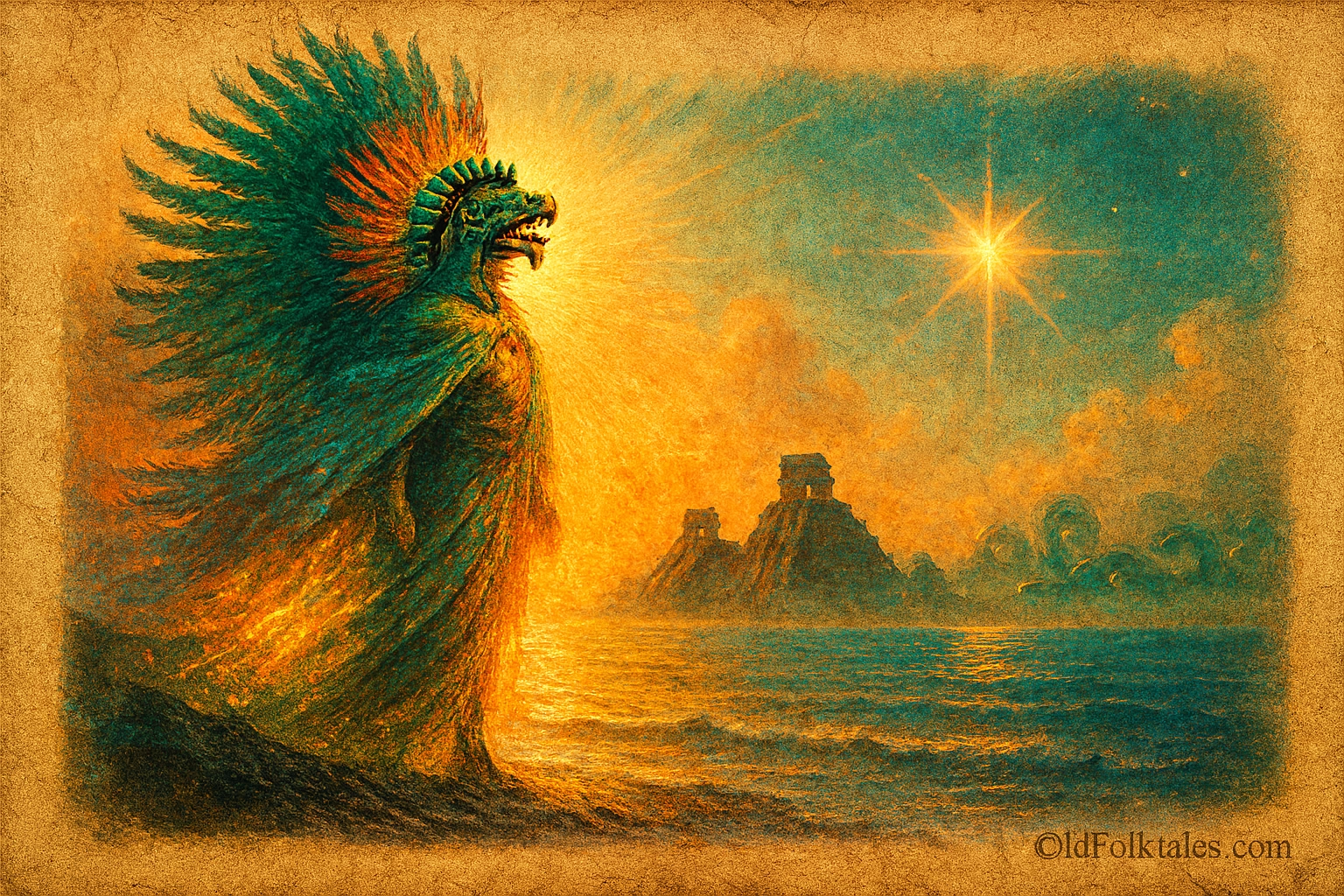
He crossed mountains and jungles, each step shedding a piece of his divinity. The jaguars watched in silence; the birds wept soft feathers into the rivers. At the shores of the eastern sea, he built a pyre of serpents and jade. He cast himself into the flames, and from the smoke rose a great morning star, Tlahuizcalpantecuhtli, the Lord of the Dawn.
But the people of Tollan said he did not die. They said he drifted across the sea upon a raft of serpents, vowing to return when the world had forgotten cruelty. In his absence, the temples once more filled with human cries, and the sun demanded blood to rise. Yet always, between night and day, the morning star shone, a promise of his return.
And so the legend endured: that one day, when the hearts of men are pure and the sky again trembles with song, Quetzalcoatl will come from the east, crowned in light and clad in feathers, to renew the Fifth Sun and cleanse the shadow of sacrifice.
Author’s Note
The epic of Quetzalcoatl endures as one of Mesoamerica’s most profound moral allegories. Unlike the many warrior gods of the Aztec pantheon, Quetzalcoatl embodied creation over destruction, wisdom over domination. His story is a divine reflection on leadership, humility, and the corrupting nature of pride.
The Toltec and later the Aztec peoples revered him not only as a deity but as a symbol of ideal kingship and spiritual renewal. His exile represents the eternal struggle between light and darkness within the soul of every ruler, and indeed, every person.
His transformation into the morning star was no death, but a rebirth, an eternal reminder that enlightenment and virtue, though exiled, can never truly perish. Across centuries, the prophecy of his return became a guiding myth of hope and cosmic justice, even influencing historical encounters and imperial beliefs in later ages.
In Quetzalcoatl, the Feathered Serpent, we see the perfect union of heaven and earth, knowledge and spirit, mortal fallibility and divine redemption.
Knowledge Check
-
What virtues did Quetzalcoatl promote during his reign in Tollan?
-
Who was Quetzalcoatl’s chief rival, and what methods did he use to bring about the god’s downfall?
-
What symbolic act marked Quetzalcoatl’s departure from Tollan?
-
How does the transformation into the morning star represent rebirth and renewal?
-
In what way does Quetzalcoatl’s story differ from other Mesoamerican deities’ myths regarding sacrifice?
-
What lasting moral or philosophical lesson does Quetzalcoatl’s exile teach about leadership and human nature?
Source:
Codex Chimalpopoca (Postclassic Nahua text)
Bernardino de Sahagún, Florentine Codex, Book 10 (1577)
Cultural Origin: Toltec/Aztec Mythology, Mesoamerica