Quetzalcóatl, the “Feathered Serpent” (from Nahuatl quetzal, the resplendent bird, and cóatl, serpent), is one of the most influential deities of Mesoamerican cosmology. Revered across the Aztec (Mexica), Toltec, and Teotihuacan traditions, he embodies wind, wisdom, priesthood, learning, fertility, and the morning star. He is both a cosmic force and a culture hero who taught humans agriculture, writing, the calendar, and sacred rituals.
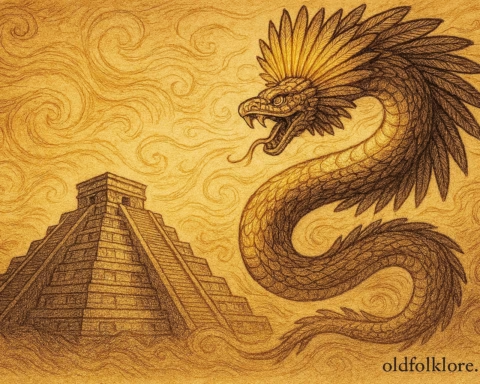
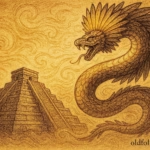
Quetzalcóatl is often depicted as a sinuous serpent adorned with quetzal feathers, symbolizing the union of earth (serpent) and sky (feathers). His sacred colors are green and gold, associated with vitality and divine light. The Temple of the Feathered Serpent at Teotihuacan (Pyramid of Quetzalcóatl) stands as a monumental testimony to his veneration. Priestly cults celebrated him through ritual offerings, songs, and feathered ceremonial garb.
Among the pantheon, Quetzalcóatl is sometimes paired with his rival Tezcatlipoca, a god of night, destiny, and sorcery, whose contests with Quetzalcóatl shape the cycles of creation, moral trial, and renewal. In some narratives, he appears as Ce Acatl Topiltzin, a semi-historical Toltec priest-king whose life intertwines with mythic transcendence.
Mythic Story: The Flight of the Feathered Serpent
Long ago, when the sun had only begun its journey across the sky, the world was young and men were without law, without maize, and without the knowledge that sustains life. The gods, in their celestial council, chose Quetzalcóatl to descend among mortals to teach them wisdom.
He arrived cloaked in feathers and gold, his serpent form coiling through the air and weaving through the mountains. With gentle voice and careful hands, he taught the planting of maize, the construction of homes, and the use of sacred calendars to honor the cycles of the sun and moon. Men learned the arts of weaving, astronomy, and the making of incense. Quetzalcóatl was a benefactor who brought civilization to humankind, blending divinity and human stewardship.
Yet peace is rarely eternal. His rival, Tezcatlipoca, envious of Quetzalcóatl’s favor among humans, sought to corrupt him. In some accounts, Tezcatlipoca tricked Quetzalcóatl into indulgence, into drinking pulque, succumbing to pride, or violating his own moral precepts. In others, Quetzalcóatl became disillusioned by human failings and the violence of earthly rulers. Whatever the cause, he abandoned the city of Tollan (Tula), promising he would return one day across the eastern horizon.
As he departed, he burned himself in a ceremonial chest, and through this act of transformation, he ascended to the heavens, shedding his mortal form. His body became wind and stars; his essence entered the sky as the morning star, heralding new beginnings and cycles of time. Some tellings emphasize the ritual of self-immolation as a form of rebirth, connecting the god’s departure with the regenerative forces of the cosmos.
Quetzalcóatl’s duality, as both a guiding light and a flawed, mortal figure—imbues his myth with lessons of morality, humility, and the impermanence of worldly power. Even in exile, he continues to influence humans: the wind that carries seeds, the knowledge of sacred arts, and the promise of renewal after misfortune.
This myth also aligns with the Legend of the Suns in the Codex Chimalpopoca: Quetzalcóatl’s sacrifices and actions participate in the cosmic ordering of worlds, the creation of humankind, and the moral alignment of society. His departure into the east symbolizes both hope and the recognition that divine aid may withdraw when humans stray from righteousness.
“Quetzalcóatl, shamed and drunk by Tezcatlipoca, burned himself in a chest and was transformed…”
– Codex Chimalpopoca, translated summary
Learn the ancient stories behind deities of light, storm, and shadow from cultures across the world
Author’s Note
Quetzalcóatl embodies the intersection of divinity, learning, and human responsibility. His myths teach that knowledge, culture, and moral discipline are gifts requiring care. Even the most benevolent gods are vulnerable to corruption, and the withdrawal of divine favor reminds humans to act with integrity. His story emphasizes that civilization, its laws, arts, and rituals, is both a sacred inheritance and a responsibility. The Feathered Serpent endures as a symbol of transformation, hope, and the eternal dialogue between heaven and earth.
Knowledge Check
Q1. Title: Who is Quetzalcóatl?
A: A major Mesoamerican deity and culture hero associated with wind, learning, priesthood, and the morning star.
Q2. Title: What are the main symbols of Quetzalcóatl?
A: The feathered serpent, quetzal feathers, wind, the morning star, and sacred colors green and gold.
Q3. Title: How did Quetzalcóatl benefit humanity?
A: He taught agriculture, writing, astronomy, ritual practices, and other civilizing arts.
Q4. Title: Why did Quetzalcóatl leave Tollan?
A: Because of moral corruption, trickery by Tezcatlipoca, or disillusionment with human failings, depending on the variant.
Q5. Title: How is Quetzalcóatl’s departure described?
A: He burned himself in a ceremonial chest and transformed, ascending to the heavens as wind and the morning star.
Q6. Title: What is the moral lesson of Quetzalcóatl’s myth?
A: Knowledge, culture, and civilization are sacred gifts that require integrity; divine aid may withdraw if humans falter.
Source: Codex Chimalpopoca & Diego Durán, History of the Indies of New Spain, Mexico.
Cultural Origin: Mesoamerican / Aztec and Toltec traditions