In the time when gods still walked the breadth of the sea and mountains breathed with hidden spirits, the child Rata was born beneath a sky veiled by portentous clouds. His mother whispered that his father, Vahieroa, had been taken by the demon king Puna and dragged into the abyss of the deep. Thus the infant carried grief before he could speak and destiny before he could stand. Yet it was said that Rata’s lineage was watched by Taʻaroa, the creator, and that no child of such blood could live an ordinary life.
As Rata grew, the forest itself seemed to watch him. The trees bowed when he entered, and the waves stilled when he approached the shore. His strength came early and his courage earlier still, but he felt the weight of an absence, a silent name that lived in the pauses between his thoughts: Father.
One night, as moonlight glittered like fish scales on the lagoon, Rata dreamt of a great canoe. Its prow was carved with the face of a god, its hull glowing with power. A voice, deep as volcanic stone, rumbled through the dream:
“Build what you see, Rata. The path to vengeance and justice begins with the tree that shelters the spirits.”
Rata awoke knowing the command was divine. At dawn, he took his axe and strode into the sacred forest. He found the tallest of the great uru trees, ancient, towering, a pillar of the world. Yet as he raised his axe, the forest whispered warnings. For this was the tree protected by the Tiʻi forest guardians, spirits who suffered no mortal hand upon their chosen places.
But Rata’s purpose was unshakable. Blow after blow, the uru tree fell. The earth trembled; the air screamed. Exhausted, Rata slept beside his labor.
When he awoke, the tree stood upright once more. The wood he had shaped was gone. The forest was whole, as if his toil were only a dream.
Fury flared, and Rata cried out, “Who defies me?”
The spirits appeared: small beings with bright, fierce eyes and bodies of shimmering bark. “You cut down our tree without prayer or offering,” they said. “The forest is sacred.”
Rata knelt, ashamed. “I seek only to avenge my father and fulfill the gods’ command.”
The Tiʻi whispered among themselves. At length they said, “If your vow is true, we will help you.” That night the spirits labored, shaping the uru tree into a magnificent canoe, sleek as a sea serpent, strong as coral stone. At sunrise they presented the masterpiece to Rata, who thanked them with reverence.
“I will name her Vaihiria, the path between worlds,” he declared.
Rata chose his warriors and pushed into the open sea. The voyage was long, and the horizon never ended. They met storms that rose like gods of wind, but Rata’s voice held firm as he steered with divine certainty. They faced sea-monsters whose eyes glowed like twin moons beneath the waves, but Rata’s spear sang with the fire of courage. Each battle forged his purpose sharper, like stone struck in ritual flame.
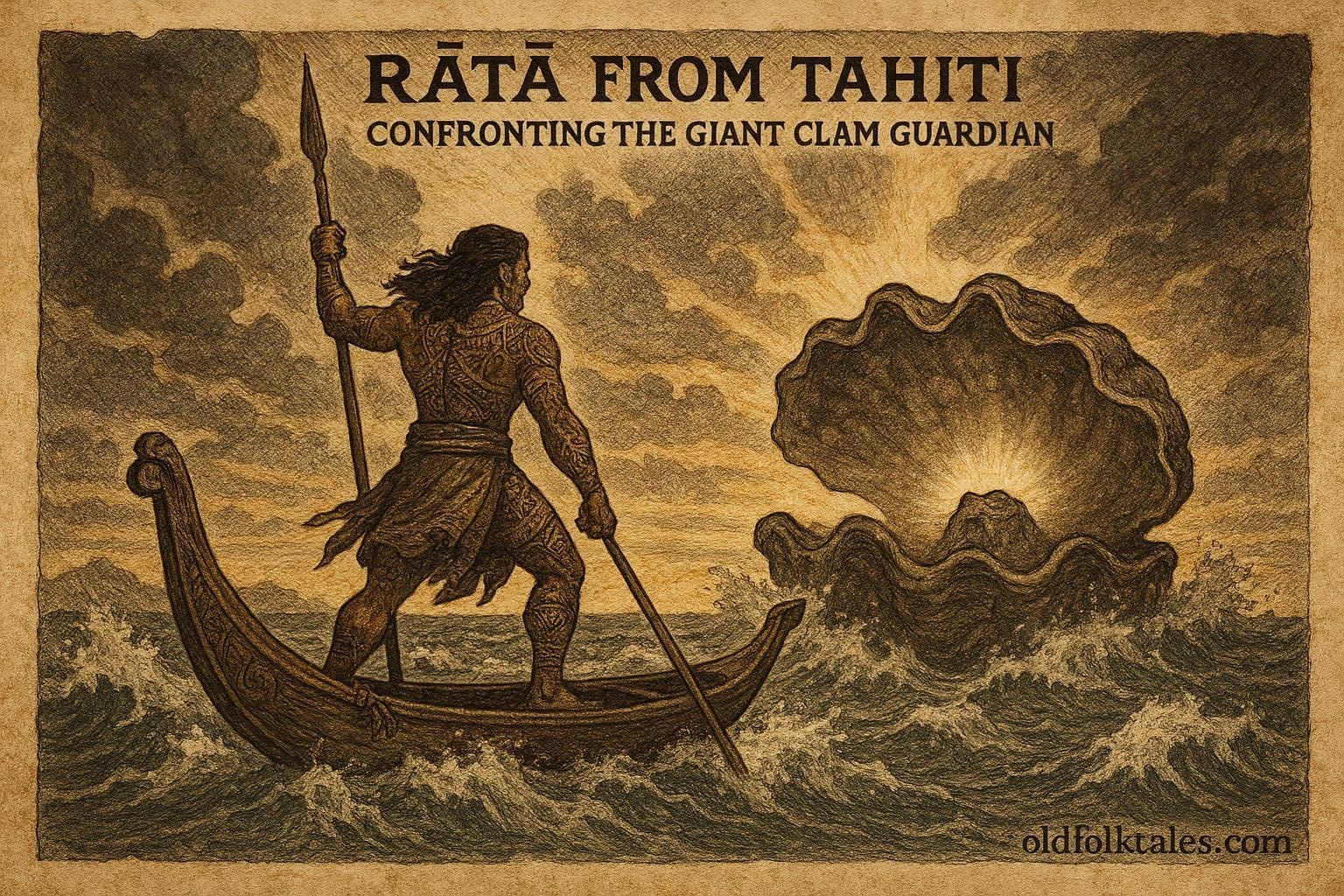
At last they reached the waters of Puna, the demon king. Here, the sea grew still and the sky darkened. The coral reefs were jagged like teeth. A monstrous guardian rose, a giant clam, its shell towering, its mouth wide enough to swallow a canoe whole. Legends said this beast was the very creature that had devoured Vahieroa.
Rata’s heart thundered. He saw not just an enemy but the weight of years, the grief of childhood, the wound of an unfinished story.
“Open,” Rata commanded, raising his spear. “For I am come to reclaim what you have stolen.”
The monster surged, snapping its colossal jaws. Rata leapt upon its shell, driving his spear into its hinge. The warriors shouted as the sea boiled from the struggle. With a cry that split the air, Rata forced the shell apart.
Inside, among the shifting shadows and crushed remnants of countless victims, he found what he sought: the remains of his father, wrapped in the sacred cloth of their lineage. Rata retrieved him with solemn reverence.
But Puna himself rose then, a creature of the deep, horned and scaled, wielding tides like weapons. The sea heaved with his wrath.
Rata stood tall in Vaihiria. “Your time ends,” he declared. “For justice travels farther than fear.”
Their battle raged across sea and sky. Rata fought with divine strength gifted by Taʻaroa, his spear glowing, his canoe guided by ancestral spirits. At last he struck Puna through the heart, and the demon king dissolved into the waves like smoke into wind.
The sea calmed. The sky brightened. Rata placed his father’s spirit upon the canoe, whispering farewell as the ancestors carried Vahieroa to the realm beyond.
When Rata returned to Tahiti, the people welcomed him as both avenger and bridge between mortal and divine. He rebuilt his land, taught the knowledge he had gained, and safeguarded the sacred ways of forest and ocean.
Thus his name endures, not merely as a voyager, but as the hero who learned that true strength grows only when guided by respect, justice, and the voices of the unseen world.
Author’s Note
The tale of Rata stands among the central Polynesian hero-voyager epics, embodying the sacred bond between humans, ancestors, and the living environment. His story teaches that destiny is shaped not only by bravery but by humility, respect for the gods, spirits, and natural world that sustain life.
Knowledge Check
-
What divine message first compels Rata to begin his quest?
-
Why do the forest guardians undo Rata’s initial work on the uru tree?
-
What name does Rata give to his sacred canoe?
-
Who is the monstrous guardian connected to his father’s disappearance?
-
What moral transformation does Rata undergo in the sacred forest?
-
What final symbolic act completes Rata’s heroic journey?
Cultural Origin: Tahitian and wider Polynesian mythology, rooted in ancestral canoe-voyaging traditions and sacred forest lore.
Source: Teuira Henry, Ancient Tahiti (1928).