In the days when gods walked among mortals and the boundary between the seen and unseen worlds was as thin as morning mist, there lived a young warrior named Rāta. His heart burned with a singular purpose to avenge the death of his beloved father, who enemies across the vast ocean had slain. But to reach those distant shores, Rāta would need a vessel worthy of such a perilous journey: a great war canoe carved from the mightiest tree in the forest.
Rāta was strong and skilled with the adze, the sacred tool used for carving. He was also proud, as young warriors often are, and believed his strength and determination were all he needed to accomplish his goal. One dawn, as the sun painted the sky in shades of crimson and gold, he ventured deep into the sacred forest where the ancient trees stood like pillars holding up the heavens themselves.
Click to read all Myths & Legends – timeless stories of creation, fate, and the divine across every culture and continent
There, among the towering giants, Rāta found what he sought a magnificent tree with a trunk so straight and true it seemed to pierce the clouds. Its bark was smooth as polished stone, and its branches spread like the arms of a welcoming ancestor. Without hesitation, without prayer, and without the customary offerings, Rāta raised his adze and began to cut.
The sound of stone striking wood echoed through the forest like thunder. Chips of pale wood flew through the air as Rāta worked with fierce intensity, sweat glistening on his brow. By the time the sun reached its zenith, the great tree groaned and swayed. By afternoon, it crashed to the earth with a sound that shook the very ground beneath Rāta’s feet.
Exhausted but satisfied, Rāta began the work of shaping the fallen giant into a canoe. He stripped away the branches, carved out the interior, and shaped the hull with careful precision. As darkness descended and the stars emerged like distant cooking fires in the sky, Rāta stepped back to admire his day’s work. The canoe was taking shape beautifully. Tomorrow, he would complete it, and soon he would sail forth to fulfill his vow.
But when Rāta returned at first light, his blood ran cold. Where his partially carved canoe should have been, the great tree stood whole and living once more, its branches reaching skyward as if it had never been touched. The ground showed no sign of the previous day’s labor no chips of wood, no marks of the adze, nothing.
Rāta’s jaw clenched with frustration. Perhaps he had been mistaken about which tree he had felled? No he knew this forest, knew this very spot. Shaking his head, he raised his adze once more and repeated the previous day’s work. Again, the tree fell, again he shaped it, and again he left as darkness claimed the land.
And again, at dawn, the tree stood whole.
On the third day, Rāta’s confusion turned to determination. This time, he would not leave. As twilight deepened and shadows grew long, he concealed himself among the ferns and waited, watching his half-formed canoe with unwavering attention.
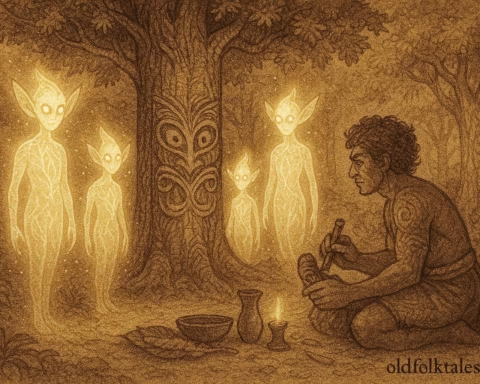
As the moon rose, bathing the forest in silver light, Rāta witnessed something that made his warrior’s heart tremble. From between the trees emerged countless beings the Hakuturi, the forest spirits, guardians of the trees and all growing things. They were small but numerous, moving with purpose and ancient grace. Some resembled tiny people wreathed in leaves and moss, while others seemed to be made of living wood itself, their bodies gnarled and twisted like ancient roots.
The Hakuturi surrounded the fallen tree, and with voices like wind through branches, they began to chant. Their words were in the old tongue, the language of creation itself. As they sang, the wood began to shift and move. Splinters flew back into place, carved sections filled and smoothed, and the tree reassembled itself. Before Rāta’s astonished eyes, the canoe transformed back into the living tree, which then rose and planted itself firmly in the earth once more.
Unable to contain himself, Rāta burst from his hiding place. “Stop!” he commanded, his voice ringing with authority. “Why do you undo my work? I need this canoe to avenge my father!”
The forest spirits ceased their song and turned to face him. Though small in stature, their presence filled the clearing with an ancient power that made Rāta’s skin prickle. The eldest among them, whose bark-like skin was covered in luminous moss, stepped forward.
“Young warrior,” the spirit said in a voice like wind through canyon walls, “you have taken without asking. You have cut without honoring. This tree has stood for generations beyond counting, providing shelter for birds, shade for the weary, and fruit for the hungry. Its roots hold the earth together, its branches touch the realm of the gods. Did you think such a being could be taken without respect, without ritual, without reciprocity?”
Shame washed over Rāta like a cold wave. In his grief and anger, he had forgotten the old ways his grandfather had taught him. He had forgotten that every tree, every stone, every creature possessed mana spiritual power and life force. To take without proper ceremony was not only disrespectful; it was dangerous, disrupting the delicate balance between the human world and the realm of spirits.
Rāta lowered his adze and bowed his head. “You speak truth, wise ones. My grief blinded me to the sacred laws. Tell me what I must do to make this right.”
The eldest Hakuturi regarded him with eyes like deep forest pools. “You must perform the proper rituals. Make offerings to the tree’s spirit. Recite the karakia the prayers of asking and thanksgiving. Explain your need and ask permission. Only then may you take what you require, and only then will we help you rather than hinder you.”
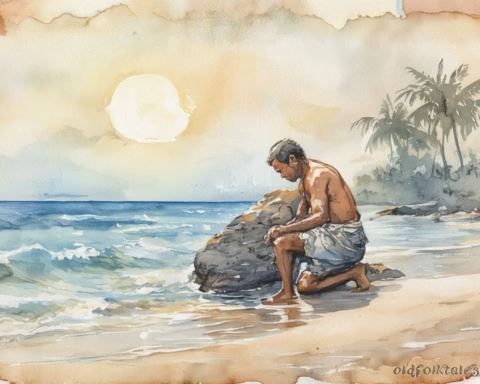
And so Rāta learned humility. He gathered the finest offerings he could find fragrant flowers, precious herbs, and sacred water from the hidden spring. He approached the tree with reverence, placing his offerings at its base. He recited the ancient karakia his grandfather had taught him, words that acknowledged the tree’s sacrifice, honored its spirit, and explained his need to cross the ocean to fulfill his duty to his father.
As he spoke the final words of the prayer, a great peace settled over the forest. The tree seemed to shimmer in the moonlight, and Rāta felt, deep in his soul, that his petition had been accepted.
The Hakuturi emerged once more, but this time their faces held no anger, only approval. “Now you understand,” the eldest said. “Now you are ready.”
That night, Rāta slept beside the tree, and in his dreams, he felt its spirit speak to him, offering its wood willingly for his noble purpose. When he awoke, the tree had fallen naturally, and the Hakuturi were there, not to hinder him, but to help.
With their guidance and blessing, Rāta crafted the finest war canoe ever seen. The forest spirits taught him secret techniques passed down since the days of the first ancestors. They showed him how to shape the wood to cut through waves like a flying fish, how to carve patterns that would invoke the protection of sea gods, and how to seal it with resins that made it strong and watertight.
When the canoe was complete, it was a masterpiece swift, strong, and beautiful. Rāta launched it upon the ocean, and with the blessings of the forest spirits upon him, he succeeded in his quest, avenging his father and returning home with honor.
But Rāta never forgot the lesson the Hakuturi had taught him. For the rest of his days, he taught others the importance of respect, ritual, and reciprocity. He ensured that all who entered the forest did so with humility, and that none took from nature without first giving thanks and making proper offerings.
The Moral Lesson
This ancient legend teaches us that we are not separate from nature but deeply interconnected with all living things. Every element of the natural world possesses its own mana, its own spiritual significance, and deserves our respect. We cannot simply take what we need without acknowledgment, gratitude, and proper ceremony. True strength lies not in domination over nature, but in understanding our reciprocal relationship with it. When we honor the earth and all its beings, we honor ourselves and ensure balance and harmony for future generations. Rāta’s story reminds us that humility, respect, and following sacred protocols are essential to maintaining the delicate balance between humanity and the natural world.
Knowledge Check
Q1: Who was Rāta and what was his primary motivation in the story? A1: Rāta was a young Polynesian warrior whose primary motivation was to avenge his father’s death. To accomplish this quest, he needed to build a war canoe to travel across the ocean to reach his father’s enemies.
Q2: What were the Hakuturi and what was their role in the legend? A2: The Hakuturi were forest spirits and guardians of trees and all growing things in Polynesian mythology. Their role was to protect the sacred trees by undoing Rāta’s work each night until he learned to show proper respect and perform the necessary rituals before taking from the forest.
Q3: What mistake did Rāta make when he first attempted to build his canoe? A3: Rāta’s crucial mistake was cutting down the sacred tree without performing proper rituals, making offerings, or asking permission from the tree’s spirit. He took from nature without showing respect or following the sacred protocols required by Polynesian tradition.
Q4: What is the significance of mana in this Polynesian legend? A4: Mana represents the spiritual power and life force that exists in all things trees, stones, creatures, and people. The story emphasizes that because everything possesses mana, all elements of nature must be treated with respect and cannot be taken without proper ceremony and reciprocity.
Q5: How did the relationship between Rāta and the Hakuturi change throughout the story? A5: Initially, the Hakuturi were adversaries who undid Rāta’s work each night because he showed disrespect. After Rāta learned humility, performed proper rituals, and made appropriate offerings, the Hakuturi became his helpers and teachers, guiding him to create the finest war canoe and blessing his journey.
Q6: What does this legend teach about the Polynesian worldview regarding nature and humanity? A6: The legend illustrates the Polynesian belief in the interconnectedness of all life and the importance of maintaining balance between humanity and nature. It teaches that humans are not above nature but part of it, and that reciprocity, respect, and proper ritual observance are essential to maintaining harmony with the natural and spiritual worlds.
Source: Polynesian Mythology and Ancient Traditional History of the New Zealand Race by Sir George Grey
Cultural Origin: Māori and broader Polynesian cultures, primarily Aotearoa (New Zealand) and the Pacific Islands region