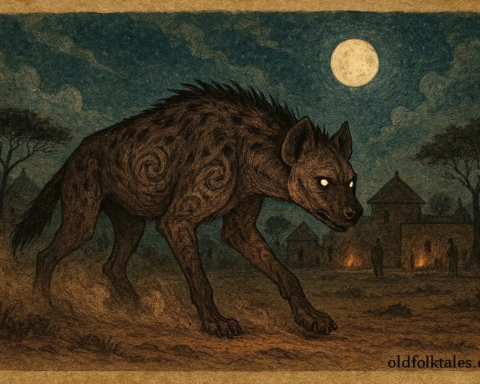
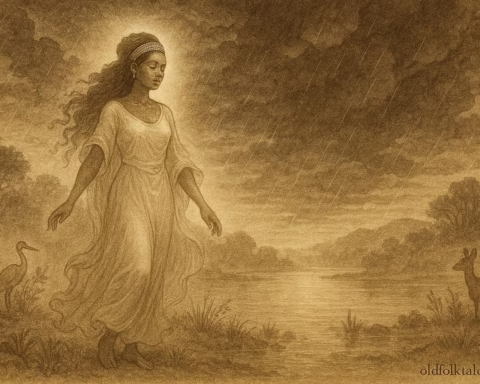
In the sun-scorched lands of KwaZulu, where the rolling hills kissed the heavens and the rivers whispered secrets of the ancestors, a child was born under a sky streaked with omens. His name was Shaka, son of Senzangakhona, king of the Zulu, and Nandi, whose own blood carried the sacred fire of the spirits. From the moment he first drew breath, it was said that the winds spoke his destiny and the spirits marked him as semi-divine, a being born between earth and sky, with a heart tempered for war and a mind destined to shape nations.
As he grew, Shaka walked a path both luminous and shadowed. He was small in stature but vast in courage; his eyes burned with the fire of insight, and his steps seemed guided by unseen hands. The clans around him were fragmented, their rivalries deep, and their warriors skilled yet scattered. Shaka, observing the weakness of disunity, dreamed of forging one people into a single, mighty force. But to rise as king, he first had to wrest power from his own kin and face the shadows of doubt that whispered of pride and cruelty.
The hero’s first great challenge was survival itself. Banished from his father’s court in youth, he wandered with his mother through hostile lands, enduring hunger, mockery, and the threat of death. Yet every trial honed his spirit. It is said that in those years, he received visions in dreams, spirits of ancient warriors, ancestors, and animals of prey. They whispered the laws of strategy, the rhythm of battle, and the sacred rites of leadership. In the quiet of night, Shaka’s mind grew sharp, his resolve hardened, and his heart learned the weight of justice and the sting of vengeance.
Returning to the land of his birth, Shaka sought to claim leadership, but the path was not simply through bloodline, it demanded ingenuity. Observing the movements of enemies, he forged new methods of warfare: the iklwa, a short stabbing spear for close combat; the large cowhide shield to protect and dominate; disciplined regiments that moved as one living organism across the plains. Under his command, warriors became instruments of precision and might. His strategies were said to be guided by divine foresight, he could read the sky, the ground, and the intentions of men, predicting outcomes that seemed impossible to ordinary mortals.
Yet even as Shaka’s fame grew, so too did his moral struggles. The semi-divine king wrestled with the temptations of absolute power. Was strength to serve the people, or the glory of a single man? He faced choices where mercy might have softened the land, yet justice, or vengeance, demanded severity. Tales speak of entire clans spared when Shaka’s honor was invoked, and of others cast into chaos when betrayal stained the air. He was a figure of paradox: both a protector and a destroyer, both beloved and feared.
The apex of Shaka’s journey came when he united the scattered Zulu clans into a single nation. From the hills of the Drakensberg to the fertile valleys below, his warriors, inspired and disciplined, forged a new identity. The Zulu were no longer a collection of families, they became a people with a soul, a people with destiny. And yet, Shaka’s life was never free from sorrow; the hero who had conquered foes on every side now faced the betrayals within his own court. In his final days, the same vision that had guided him seemed to dim, and he was struck down by the hands of those closest to him.
Still, Shaka’s legacy was immortal. His life, a mosaic of divinity and humanity, reshaped the world of his people. He demonstrated that a mortal could, through vision, courage, and discipline, reach heights touched by the divine. His battles became legend, his strategies studied for generations, and his name uttered with reverence across the hills of Zululand. In Shaka, the Zulu saw the embodiment of destiny itself, unyielding, ambitious, yet tethered to the earth and sky.
Author’s Note
Shaka Zulu remains a figure both historical and mythic. His story is one of extraordinary leadership and human complexity. Beyond his military genius, Shaka’s tale teaches lessons of resilience, vision, and the fine balance between justice and tyranny. While some accounts emphasize his cruelty, the epic framing of his life elevates him as a symbol of unity and divine purpose. He transformed a fragmented people into a formidable nation and became an enduring icon of African heroism.
Knowledge Check
-
What divine qualities were attributed to Shaka Zulu from birth?
-
How did Shaka’s early exile shape his future as a leader?
-
Name one military innovation introduced by Shaka.
-
What moral struggles did Shaka face as a semi-divine king?
-
How did Shaka unify the Zulu clans into a nation?
-
Why is Shaka remembered as both a historical and mythic figure?
Origin: Zulu oral epic/history, South Africa (early 19th century)
Source: E. J. Ritter, Shaka Zulu: The Rise and Fall of the Zulu Empire (1978)