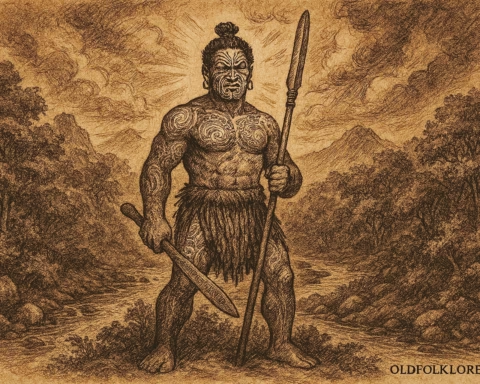
Tāne Mahuta is one of the central gods of Māori cosmology, revered as the god of forests, birds, and all living things. He is the son of Rangi (Sky Father) and Papa (Earth Mother), and his defining act is the separation of his parents, bringing light and space to the world. Tāne is also recognized as a teacher of humans, instructing them in the use of timber, hunting practices, and a reverent relationship with nature.
Symbolically, Tāne represents growth, vitality, and the interconnectedness of life. Forests, trees, and birds are sacred to him, and his presence is felt in the rustling of leaves, the songs of birds, and the quiet majesty of the wild. Rituals and carvings often depict Tāne with outstretched arms lifting the sky, and certain forests were considered tapu (sacred), places where humans could commune with the divine. Tāne’s acts emphasize harmony, respect, and the balance between human activity and natural order.
Mythic Story
In the beginning, there was only darkness. Rangi, the Sky Father, pressed tightly upon Papa, the Earth Mother, enveloping the world in shadow. Their children, trapped between the sky and earth, lived in cramped gloom, longing for space, light, and life. Among them, Tāne Mahuta, the strongest and most determined, felt the stirrings of destiny. He dreamed of lifting the weight of the sky and letting the world breathe.
Tāne first consulted with his siblings. Some advised war against their parents; others hesitated, fearing the wrath of the heavens. But Tāne knew the act must be both gentle and forceful, a balance of strength and care. He approached Rangi and Papa with reverence, acknowledging their love and sacrifice, and yet he was resolute. The earth below and the sky above were meant to be separate, so that life might flourish.
With great effort, Tāne positioned his arms against the sky. He strained upward, muscles taut, breath steady, until the heavens lifted just enough to let a thin shaft of light enter the world. Birds stirred in the newly revealed canopy; ferns unfurled; and the first whispers of wind carried through the trees. Slowly, light strengthened, and darkness retreated, revealing the beauty of forests, mountains, and rivers.
Tāne’s siblings aided him in different ways. Tū, the god of war, provided courage; Tangaroa, the god of the sea, blessed the waters; Rongo, god of cultivated food, ensured the land could sustain life. Yet it was Tāne who planted the first forests, shaping groves of towering trees, vines, and sacred plants. He populated the sky with birds, assigning each its call and song, teaching them to harmonize with the world below. Their flight and song became a living testament to his wisdom and care.
Humans came next. Tāne taught them to use timber for shelter and canoes, to understand the patterns of birds and the rhythms of the forest, and to respect life in all its forms. Hunting was not merely survival but a sacred act, to be undertaken with mindfulness and gratitude. Tāne’s teachings ensured that humans did not dominate the earth recklessly, but lived in partnership with the forests, birds, and rivers.
Despite his triumph, Tāne’s work was not free of sorrow. He grieved for the closeness of his parents and the pain of separation. Yet he understood that this separation, though difficult, allowed creation to breathe and life to flourish. In Māori belief, the balance between light and dark, sky and earth, life and death, remains central to the human and natural experience. Tāne’s act was a covenant: strength tempered with respect, growth harmonized with wisdom.
From that day forward, Tāne Mahuta became a guardian and guide. Forests were sacred, and birds were his messengers. Every leaf, every song, every rustle of branches reminded humans of his power, care, and teaching. Generations have recited the story of Tāne’s separation of the sky and earth, passing on lessons of courage, ingenuity, and respect for the world’s living tapestry.
Author’s Note
Tāne Mahuta’s myth highlights the interplay of strength and reverence. His act of separating sky and earth teaches that creation requires courage, balance, and a deep respect for the natural world. Humans are not conquerors but participants in a living system, where wisdom, observation, and care ensure harmony between life, environment, and the divine.
Knowledge Check
Q1: Who are Tāne Mahuta’s parents?
A: Rangi (Sky Father) and Papa (Earth Mother).
Q2: What was Tāne’s defining act in Māori mythology?
A: Separating his parents to bring light and space to the world.
Q3: Which domains does Tāne Mahuta govern?
A: Forests, birds, and all life.
Q4: How did Tāne teach humans?
A: By instructing them in timber use, hunting, and respect for nature.
Q5: What symbolic significance do birds hold in Tāne’s myth?
A: They are messengers and symbols of life, song, and harmony.
Q6: What moral lesson does Tāne Mahuta convey?
A: Courage, balance, and reverence for life are essential for creation and human coexistence with nature.
Source: Māori Oral Traditions, New Zealand.
Source Origin: Māori, New Zealand