
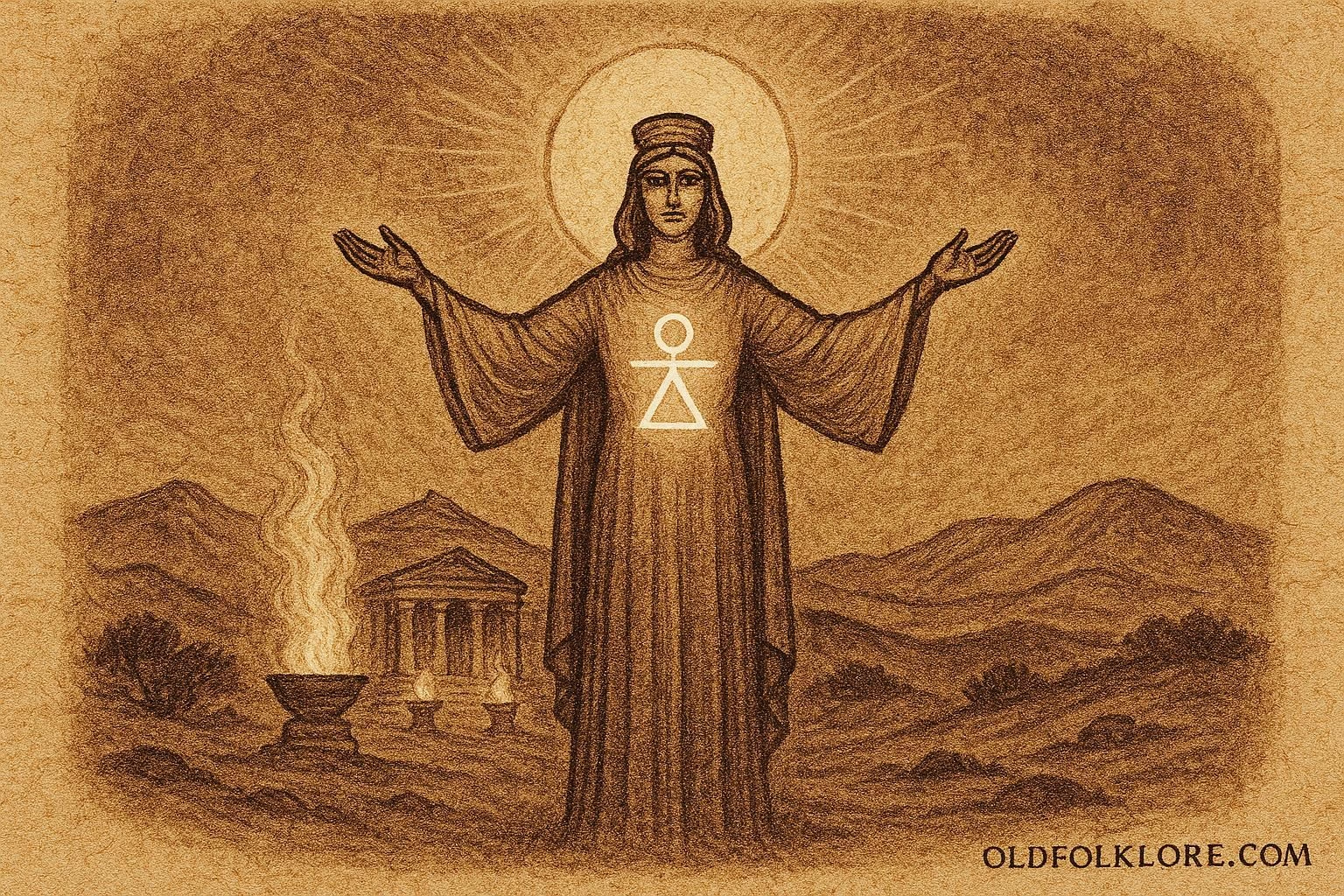
Tanit stands as the great protective goddess of ancient Carthage, a divine figure woven from Phoenician roots, shaped by Berber influence, and elevated into the highest maternal and martial power of the Punic world. She is called “Lady of the Sacred Place”, “Face of Baal,” and “Queen of Heaven.” Her symbol, a triangle body, a circle for the head, and uplifted arms, appears across stelae, tombs, temples, and shrines.
As a goddess of fertility, she governed the fruitfulness of the land, the well-being of families, and the prosperity of crops and herds. As a goddess of war, she was invoked during battles, sieges, and the desperate hours when Carthage faced destruction. Tanit was believed to watch from the sky, her power tied to the moon, which reflected her cycles of blessing, protection, and rebirth.
Tanit was worshipped in temples, high places, and sacred precincts such as the Tophet of Salammbô, where votive offerings, inscriptions, and stelae dedicated to her and Baal Hammon have been discovered. She was often paired with Baal Hammon, the chief Carthaginian god, though her independent cult grew immense, spreading across North Africa, Sardinia, Malta, and Iberia. Rituals varied by region: in some areas she resembled Astarte, while in others she emerged as a uniquely Punic guardian of life and victory.
MYTHIC STORY: Tanit Protects Carthage
In the centuries before Carthage fell to Rome, when its walls gleamed red in the fire-light of a thousand torches and its harbor swelled with cedar ships, the people believed that Tanit watched over them from the moonlit sky. Her light, soft yet commanding, fell upon the temples, the hills, and the great sea that carried their merchants to far-off lands. And when danger neared, they said the goddess stirred, the Queen of Heaven rising to shield her city.
One such tale survives in fragments, carved in stone and whispered in Punic inscriptions. It took place during a time of famine and war, when Carthage faced both an enemy army on its borders and the slow starvation of its people. Years of poor harvests had dried the fields, and the winds from the desert carried dust instead of rain. The generals feared that the gods were displeased, and the council sent for the priests of Tanit to interpret the signs.
The high priestess, veiled in white linen and crowned with a silver lunar disc, stood before the gathered citizens. She raised her hands toward the crescent moon and declared, “Tanit has not abandoned us. She waits for our devotion, and through devotion she will reveal her path.” That night, the temple precinct filled with incense, and stelae were raised, their carvings shining in the firelight, the triangle of the goddess, the circle of her celestial face, the arms lifted in blessing.
At dawn, messengers brought grim news: an enemy coalition had marched closer, seeking to break Carthage while it starved. Their numbers were many, and their commanders believed the city too weakened to resist. Panic spread, and the people turned again to Tanit, for only she could bless both land and shield.
A legend says the high priestess saw a vision then, the moon covered by a dark shape, then shining again with sudden brilliance. She proclaimed this a sign: Tanit would protect them, but the people must act with unity and courage. “Go forth,” she told the generals, “for the Lady of the Sacred Place walks with you.”
The army marched out at dusk. They carried banners marked with Tanit’s symbol, small silver amulets hung at their throats, and inscriptions invoking her shelter. As they crossed the plains, clouds gathered over the enemy camp. Soldiers later swore the moon glowed brighter that night than any they had seen, a pale shield hanging in the heavens.
When battle began the next morning, a strange wind rose from the sea. It blew dust toward the enemy lines, obscuring their vision. Carthaginian slingers and spearmen advanced under the swirling haze, moving as if guided. The enemy’s formations broke, confused and blinded, and soon their retreat became a frantic scattering across the fields. Carthage had won.
Yet victory alone could not save the starving city. The people returned to their withered fields, praying for Tanit to open the heavens. For weeks the sky remained empty. The earth cracked. The wells sank lower.
Then, on a night when despair weighed on the city like a final stone, the moon rose full and radiant. According to inscriptions, the high priestess dreamt of Tanit walking across the land, her feet touching the fields with silver light. Wherever she stepped, the soil glimmered and softened, as though stirred from sleep. The dream spread among the people, told by merchants, sailors, farmers, and soldiers who believed it meant rain was near.
At dawn, clouds gathered over Carthage. A single rumble echoed across the sky, followed by the cool scent of distant water. People rushed outdoors, lifting their hands as the first drops began to fall, gently at first, then in a cleansing downpour that soaked the soil and ran through the city streets. Children laughed, elders wept, and the temples opened their gates so worshippers could offer thanks.
The fields bloomed once more. The famine ended. Victory in war and renewal in the land came together, and both were attributed to Tanit. Carthage had survived not by strength alone, but by the grace of the goddess who watched from the moon and walked among the sacred places of the earth.
It is said that from that day forward, the people lit lamps on the temple steps during every full moon, believing that their glow joined the light of Tanit herself, a reminder that even in the darkest seasons, the Queen of Heaven remembered her city.
“Tanit, mistress of heaven, ensures fertility of the land and shields the city in battle.”, Cross, 1973
Learn the ancient stories behind deities of light, storm, and shadow from cultures across the world
Author’s Note
The enduring myth of Tanit reveals a people who saw no separation between the fertility of the earth and the survival of their city. She teaches that protection and nourishment are intertwined, that to guard a community is to sustain it. Tanit embodies resilience, cyclical renewal, and the quiet, luminous strength that rises again and again, like the moon she governs.
Knowledge Check
Q1: What culture worshipped Tanit?
A: The Carthaginian / Punic culture of North Africa.
Q2: What were Tanit’s primary domains?
A: Fertility, war, sky, and lunar symbolism.
Q3: What symbol is associated with Tanit?
A: A triangle body, circle head, and uplifted arms.
Q4: What crisis threatened Carthage in the myth?
A: Famine and an invading army.
Q5: How did Tanit aid Carthage in battle?
A: A windstorm obscured the enemy, enabling Carthaginian victory.
Q6: What sign marked the end of Carthage’s famine?
A: Rainfall after a full moon associated with Tanit’s blessing.
Source: Punic Mythology, Carthage (Tunisia).
Source Origin: Carthage (North Africa, modern Tunisia), Phoenician/Punic tradition






