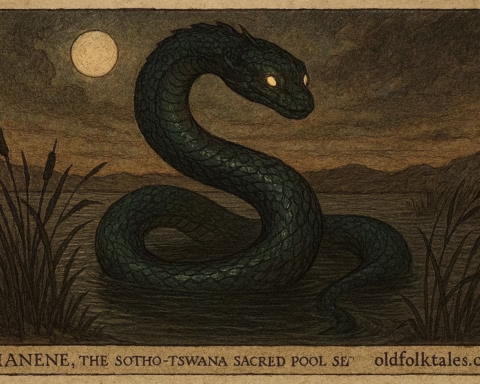
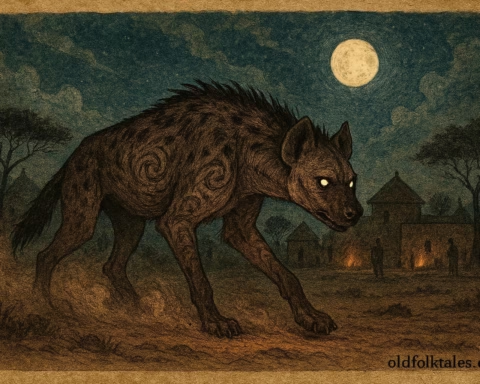
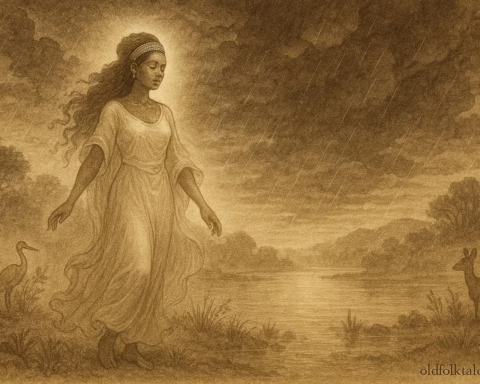
In Māori cosmology, taniwha are powerful supernatural beings that reside in the deep places of the natural world, rivers, lakes, ocean trenches, caverns, whirlpools, submerged caves, and forested ravines. Their forms vary dramatically by region and lineage: some appear as giant lizards, immense sharks, whale-like sea beings, scaled reptiles, or dragon-like creatures; others take more subtle shapes such as a moving log, wave surge, or whirlwind, hinting at an unseen presence rather than a visible monster. What unites all descriptions is their mana, a powerful spiritual force, and their intimate connection to specific places, families, and ancestral lines (whakapapa).
Elsdon Best, summarizing early Māori accounts, noted:
“As taniwha seem to have been the largest and most destructive of these mythical creatures…”
(Maori Religion and Mythology, 1924)
Relive the heroic sagas of every age – stories of triumph, tragedy, and timeless valor
Some taniwha are enormous, stretching across riverbanks or rising from the depths like a tidal mountain. Others are agile and predatory, lurking beneath dark water to watch over travelers or punish trespassers. Many stories emphasize that taniwha have extraordinary senses, detecting vibrations, breaches of tapu (sacred restrictions), or the spiritual state of people who enter their territory.
A taniwha may take human form when dealing with people of high mana, or even marry humans in certain traditions. However, these shapeshifting accounts are rare compared to the more common image of a formidable water-dweller, whose appearance alone signals profound spiritual authority.
Powers and Abilities
Taniwha exhibit powers that reflect the sacredness and danger of the environments they inhabit:
1. Shapeshifting: They may shift between animal, serpentine, or human forms, often to communicate, protect, or deceive.
2. Guardianship (Kaitiakitanga): Many taniwha act as kaitiaki, guardian spirits for particular iwi (tribes), hapū (sub-tribes), or geographic regions. They ensure the wellbeing of the people they protect, sometimes acting as guides or warning signs in times of danger.
3. Punitive Force: Dangerous taniwha enforce tapu, punish disrespect, and avenge wrongs. Those who disregard sacred restrictions, pollute waters, or ignore local protocols risk attack.
4. Territorial Mastery: Their presence defines the spiritual boundaries of places. Crossing a taniwha’s territory without proper ritual acknowledgment can lead to drowning, storms, or mysterious disappearance.
5. Command of Water and Weather: Some taniwha influence currents, tides, river floods, or whirlpools, embodying the unpredictable strength of the natural world.
6. Communication with Priests and Chiefs: Tohunga (experts, priests) may negotiate with taniwha through karakia (chants/prayers), establishing alliances or appeasing them when danger threatens.
Myths, Stories, and Beliefs
In traditional Māori storytelling, taniwha appear frequently, always tied to specific places and ancestral histories. Every iwi knows at least one taniwha story, and many geographic features bear their names.
Place-Bound Beings
Taniwha are uniquely local. They inhabit named waters, Waikato River, Lake Taupō, Lake Waikaremoana, Hokianga Harbour, Cook Strait, and numerous smaller rivers and caves. These beings are as much part of the landscape as cliffs and currents, woven into the very identity of the land.
Guardian Taniwha
Many stories describe taniwha who accompanied ancestral canoes (waka) on their voyages from Hawaiki. These guardians protected voyagers from storms and remained in New Zealand as protectors of the descendants of those crews.
Examples include:
- Tū-te-raki-whānoa’s creatures, who were placed throughout waterways to safeguard travellers.
- Maungarongo and other river guardians, remembered in local hapū genealogies.
Dangerous Taniwha
Other taniwha are feared for their ferocity. Some tales recount agreements between humans and taniwha, for example, leaving offerings, maintaining clean waters, or observing tapu days. When people break rules or ignore elders’ warnings, the taniwha becomes hostile, sometimes devouring or drowning offenders.
Negotiation and Ritual
Unlike Western dragon myths featuring straightforward monster-slaying, Māori stories emphasize relationship. Taniwha could be placated, reasoned with, or transformed through ritual actions performed by tohunga. The boundary between guardian and monster depended on human behavior, respect, and protocol.
Cultural Role & Symbolism
Taniwha are essential expressions of Māori cosmology and reflect the deep cultural embedding of the natural world in spiritual meaning.
1. Embodiments of the Deep and Hidden: Taniwha represent what lies beneath the surface, physically and spiritually. They remind people that rivers, caves, and oceans hold powers far greater than humans.
2. Enforcers of Tapu and Social Conduct: Their stories reinforce rules about behavior, respect for sacred places, and environmental stewardship. Taniwha stories taught children not to swim alone, pollute waters, or trespass on restricted lands.
3. Symbols of Kaitiakitanga (Guardianship): Some taniwha protect hapū, guiding or warning them during crises. They symbolize loyalty, protection, and ancestral presence.
4. Metaphors for Natural Forces: Taniwha often represent floods, tidal waves, whirlpools, sharks, or landslides. Their “attacks” encode local ecological knowledge, where not to swim, where currents are dangerous, or where caves are unstable.
5. Anchors of Whakapapa: Taniwha are part of genealogical narratives. A hapū’s taniwha is not an outsider, but a relative, a being to whom the community owes respect, acknowledgment, and reciprocity.
6. Warnings of Human Impact: In modern contexts, taniwha are invoked in discussions of land development, river redirection, and environmental change, reflecting Māori perspectives on the sanctity of land and water.
Encounter dragons, spirits, and beasts that roamed the myths of every civilization
Author’s Note
Taniwha stories demonstrate the depth of Māori ecological philosophy, where the natural world is alive, relational, and responsive. The variety in taniwha forms, shark, lizard, whale, dragon, or even animated log, reveals a sophisticated understanding of place-specific dangers and the spiritual principles that regulate human interaction with nature. Elsdon Best’s 1924 ethnographic material, although reflecting its colonial-era context, remains one of the most detailed public-domain sources for early recorded taniwha narratives, while modern scholarship (e.g., Te Ara) emphasizes the cultural, environmental, and genealogical importance of taniwha to Māori communities today.
Knowledge Check
- Where do taniwha typically dwell?
→ Deep rivers, lakes, seas, caves, or underwater caverns. - Are taniwha always dangerous?
→ No. Some are guardians (kaitiaki), while others punish breaches of tapu. - Which early ethnographer recorded taniwha stories in detail?
→ Elsdon Best (1924). - What concept connects guardian taniwha to Māori communities?
→ Kaitiakitanga (guardianship). - How are taniwha tied to specific landscapes?
→ Each taniwha belongs to a named place and ancestral lineage. - What natural phenomena do some taniwha symbolize?
→ Floods, strong currents, whirlpools, storms, dangerous waters.
Source: Elsdon Best, Maori Religion and Mythology (1924, public domain); Te Ara Encyclopedia of New Zealand
Origin: Aotearoa (New Zealand), Māori oral tradition; pre-European contact