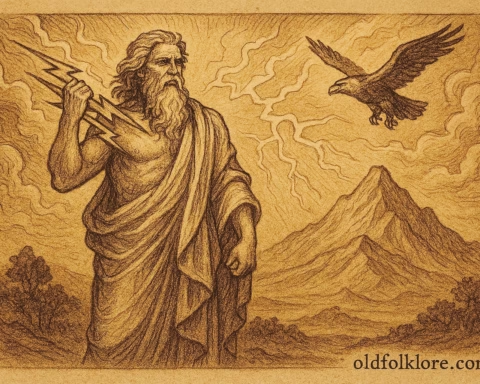
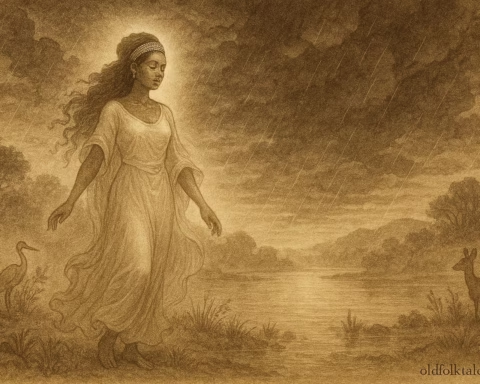
Taranis is a formidable deity of thunder, sky, law, and sovereignty. Revered across Gaulish territories, he symbolizes the raw power of nature tempered by the principles of justice and order. His primary attributes, the thunderbolt and the wheel, serve as cosmic symbols: the thunderbolt signifies sudden divine intervention, power, and protection, while the wheel represents cyclical time, law, and the eternal order of the universe.
In classical accounts, Taranis is often equated with Jupiter, the Roman god of sky and authority, reflecting syncretism as Celtic and Roman cultures intertwined. Sacred rituals for Taranis included offerings at groves, hilltops, or near flowing waters, aimed at ensuring divine favor, justice in society, and the protection of the community. Fire was also a central element, symbolizing purification and the presence of divine authority.
Taranis’s role as arbiter of law and order extended beyond human governance; he was believed to maintain cosmic balance, overseeing the cycles of nature and the seasons. His cult’s emblem, the wheel, underscores both literal and symbolic motion: the passage of time, the rolling of the heavens, and the enforcement of justice as a perpetual, omnipresent force.
Mythic Story: Taranis and the Divine Wheel
In the time before the written chronicles, when the forests of Gaul stretched unbroken and the rivers sang of the Earth’s deep heart, the people revered Taranis, the thunderer whose voice shook the skies and whose wheel turned the course of law and time. To behold him was to witness the raw power of both nature and justice intertwined, a force that could nurture or destroy, according to the deeds of men.
Taranis was said to dwell among the clouds, riding the storm winds, wielding the thunderbolt with sovereign authority. Whenever a king or chieftain ruled unjustly, the people believed that Taranis’s thunder would strike as both warning and reckoning. The wheel he carried was not mere ornament; it was a cosmic emblem, rolling ceaselessly to mark the cycles of the heavens and the turning of fate. Each rotation reminded mortals that law and order are eternal, and that divine justice, like the seasons, cannot be denied.
One of the most telling tales of Taranis unfolds on a midsummer’s eve. The villagers of a small Gaulish settlement had strayed from the ways of their ancestors, allowing greed and envy to cloud their judgment. They quarreled over boundaries and harvests, and the bonds of kinship frayed beneath the weight of suspicion. Seeing this disorder, Taranis descended in the form of a storm, the skies darkening as the wind tore through the trees. Lightning flashed, and the people trembled before the raw spectacle of divine authority.
At the storm’s apex, Taranis lifted his wheel high. It glimmered as if forged from sunlight itself, spinning with the eternal rhythm of the cosmos. The villagers, struck by awe, fell silent. The wheel’s turning was not destructive but instructive: it revealed the law woven into the world, the necessity of justice and fairness in both mortal and natural realms. Those who had wronged others saw their deeds mirrored in the swirling light, while those who had acted with integrity were illuminated, a testament to the rewards of virtue.
The thunderbolt, then, descended, but not to harm indiscriminately. It struck the boundaries of the fields, marking the lines that had been ignored or crossed. Crops were spared, but the lesson was clear: the divine law, like the rolling wheel, moves unceasingly and imparts justice in its own measure. The villagers, humbled and awed, renewed their oaths to fairness, to cooperation, and to the guidance of Taranis. From that day, they honored the wheel and the thunderer, offering gifts of fire, livestock, and libations at hilltops and groves.
Taranis’s influence extended beyond mortal disputes. Farmers looked to him for rain to nourish their fields, warriors invoked his protection before battle, and judges called upon his name to witness oaths. Each act of reverence reinforced the divine principle that law, justice, and order are inseparable from the power that sustains life itself.
The wheel also symbolized the seasonal cycle. As Taranis rolled it across the heavens, he ensured that life and death, growth and decay, would continue in harmonious rhythm. Festivals marked the solstices, when the wheel reached its turning points, reminding humans of their place within the vast unfolding of the cosmos. In this way, Taranis was not a distant deity but an intimate guardian of both the moral and natural order, his thunder a voice of vigilance, his wheel a compass of cosmic law.
Through generations, the worship of Taranis instilled a profound respect for the intertwined forces of nature, justice, and divine authority. To call upon him was to acknowledge that sovereignty carries responsibility, that power must serve order, and that the cycles of life are governed by principles beyond human contrivance. The myths of Taranis endure as a testament to a people attuned to the balance between the sky, the earth, and the moral structures that sustain society.
Author’s Note
Taranis exemplifies the integration of natural power and moral authority. His myths teach that justice is not merely a human construct but a cosmic principle, mirrored in the cycles of nature. Thunder, fire, and the wheel remind us that ethical integrity, fairness, and vigilance are essential for societal harmony, and that true sovereignty is inseparable from responsibility.
Knowledge Check
Q1: What domains is Taranis associated with?
A: Thunder, sky, law, and sovereignty.
Q2: What are Taranis’s primary symbols?
A: The thunderbolt and the wheel.
Q3: How did Taranis communicate justice to humans?
A: Through storms, thunder, and symbolic markings with his wheel.
Q4: What Roman god is Taranis often equated with?
A: Jupiter (Jupiter Taranis).
Q5: Where were rituals for Taranis commonly performed?
A: At sacred groves, hilltops, and near flowing water.
Q6: What lesson do Taranis’s myths convey?
A: True power is bound to justice, ethical conduct, and respect for cosmic order.
Source: Celtic Myths, Gaul / Continental Celtic.
Source Origin: Gaulish / Continental Celtic (Ancient Gaul, modern France, Austria, Switzerland)