They say that on the night Tecumseh was born, the sky above the Ohio Valley split with a white, flickering fire. It danced across the heavens like the blade of a celestial tomahawk, and the elders whispered that a great spirit had marked the child. “A leader is coming,” the Shawnee warned, “one who will speak with thunder and walk with purpose.” His mother, Methoataske, held the infant close, knowing his path would not be quiet nor simple. He had come during an age when rivers bled with conflict, when foreign settlers pressed into the old forests like a rising flood. But prophecy had a way of choosing its own children.
As Tecumseh grew, he did not merely listen to the stories of the ancestors, he felt them. When he watched a deer leap through shadow, he understood grace. When he saw a tree struck by lightning, he learned the cost of power. And when he walked the battlefield where Shawnee warriors had fallen resisting colonial expansion, he heard the murmured voices of the dead. Stand. Stand for all of us. The spirits’ cry echoed in him long before he spoke it to the world.
By the time he came of age, the Ohio Valley shook with upheaval. Settlers advanced, forts rose, forests fell, and tribal nations argued over whether to flee, endure, or resist. Tecumseh saw disunity as the deepest wound. “A single strand breaks,” he told his kin, “but a woven rope holds strong.” His voice bore the weight of thunder, measured, commanding, filled with more conviction than doubt. Yet within himself, he wrestled with the enormity of his vision. Could he truly unite dozens of nations, each with their own tongues, traditions, and wounds? Was he chosen, or merely dreaming beyond his reach?
His younger brother, Tenskwatawa, the Prophet, claimed divine revelation. Through dreams he saw a path for renewal, a return to ancestral ways, a cleansing from the influence of outsiders. Although Tecumseh had not been given visions in the same manner, he shared Tenskwatawa’s belief that the land itself held a sacred balance worth defending. Together, they became twin pillars of a rising movement: Tenskwatawa guiding the spirit, Tecumseh commanding the flesh.
When Tecumseh walked into neighboring villages, Wyandot, Delaware, Potawatomi, Kickapoo, eyes followed him with a mixture of awe and caution. He spoke not as a tribal chief but as something older, something the ancients had foretold: a leader not of one people but of many. “The land is our mother,” he proclaimed. “She was given to all her children, not to be carved like meat for hungry strangers.”
But unity demanded sacrifice. Some tribal leaders feared retaliation. Others distrusted distant nations. At night, when Tecumseh sat beside the embers of dying fires, he carried the weight of their doubts like stones tucked beneath his ribs. Was he forcing a dream upon people who wanted only to survive? Was he risking too much? He prayed often, softly, so the wind alone might hear. “Great Spirit, guide my steps. Let them be righteous, even if they lead me into darkness.”
The moment of greatest challenge came when Governor William Henry Harrison demanded that individual tribes sign treaties ceding land. Tecumseh saw the tactic clearly: divide them, weaken them, erase them. He confronted Harrison face-to-face, his presence like a storm held just at bay. “No single nation has the right to sell land,” he declared. “It belongs to all of us, or to none.” Harrison tried to diminish him, to reduce the divine mission to mere politics, but Tecumseh’s voice rang with ancestral fire. Even the soldiers nearby felt the air tighten, as if lightning contemplated whether to strike.
Still, prophecy is rarely smooth. While Tecumseh traveled the southern nations seeking broader alliance, Tenskwatawa, urged by fervent followers, acted too soon. The Battle of Tippecanoe broke the fragile momentum. Though not a decisive defeat, it fractured the unity Tecumseh had fought to build. When he returned, the smoke still clung to the land like a bitter omen. His heart clenched, not in anger toward his brother, but in grief. “A tree cannot stand when its roots are shaken,” he whispered.
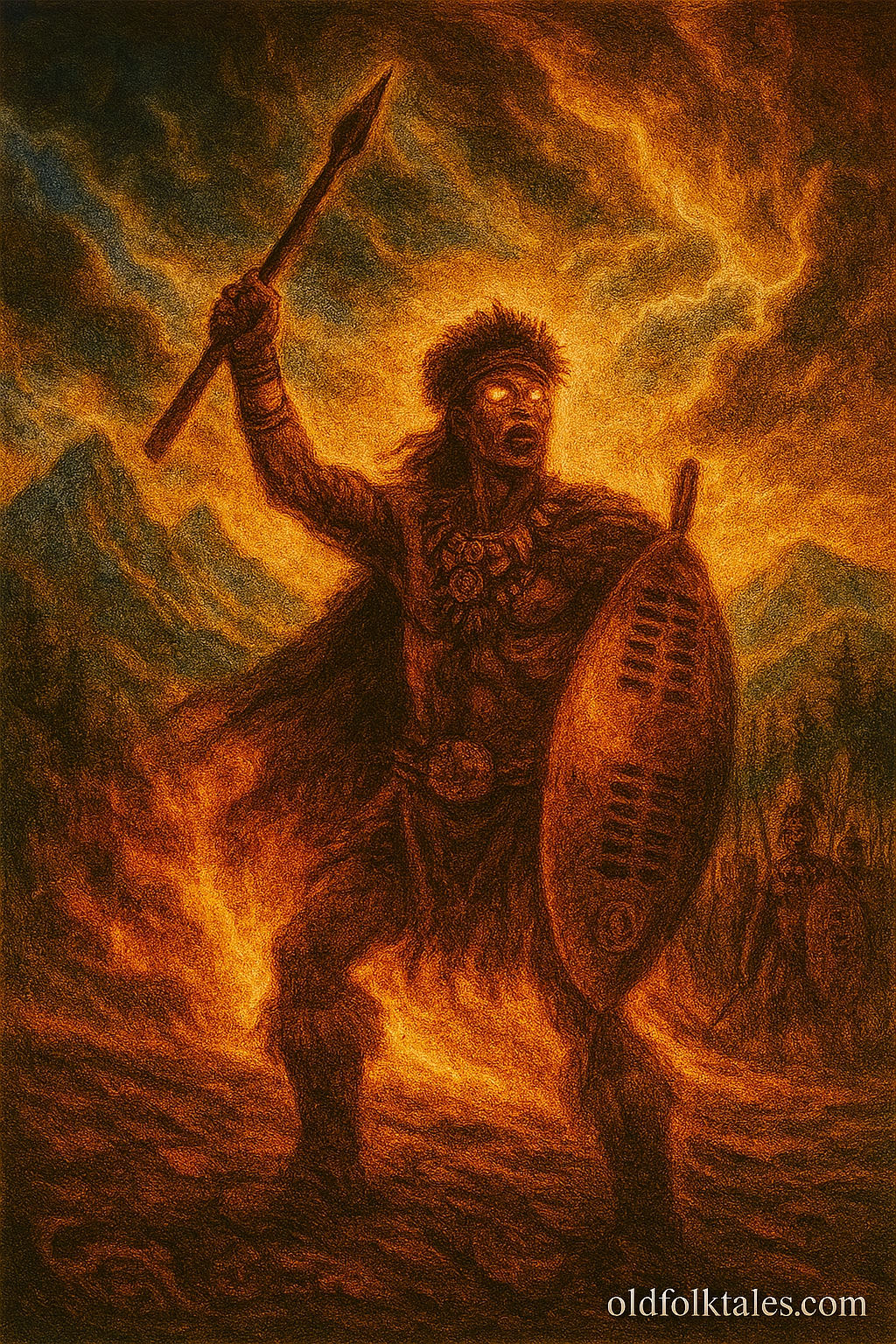
Yet even then, the warrior did not abandon his cause. As the War of 1812 ignited, Tecumseh allied with the British not out of love for empire but from necessity. His loyalty remained with the land, the rivers, the spirits of his ancestors. He fought with the strength of one who knew his destiny, who wielded purpose like a spear. Those who witnessed him in battle spoke of a power that felt more than mortal, a presence that seemed carved from wind and river, as if the land itself fought through him.
But destiny often demands blood. At the Battle of the Thames, Tecumseh faced his final moment. Surrounded, outnumbered, yet unbroken, he stood like an oak refusing to fall before the axe. His last cry was not one of fear but of defiance: a vow that his spirit would not be extinguished, that unity would someday rise again. When he fell, the forest fell silent. Even the birds paused their flight, as though honoring a warrior-prophet whose legacy would echo across centuries.
And in that stillness, the prophecy was fulfilled, not in victory, but in remembrance. For a hero’s greatest triumph is not survival, but the fire they leave burning in the hearts of those who follow.
Author’s Note
Tecumseh’s story blends historical fact with mythic resonance. Though mortal, he is remembered with the gravity of a prophet, one who sought unity, justice, and balance in a world shifting beneath his feet. His legacy endures as a symbol of indigenous resistance and moral leadership across North America.
Knowledge Check
-
What celestial event marked Tecumseh’s birth in the mythic retelling?
-
Why did Tecumseh believe unity among nations was essential?
-
What role did Tenskwatawa play in the movement?
-
What moral struggle did Tecumseh face at night by the fire?
-
Why did Tecumseh confront Governor Harrison?
-
How does the story portray Tecumseh’s symbolic outcome after death?
Cultural Origin: Shawnee, Ohio Valley (Late 18th – Early 19th Century)
Source: John Sugden, Tecumseh: A Life (1997).