Tales of the railways are whispered across Japan, especially in small towns where the tracks run close to neighborhoods and the humming of passing trains becomes part of daily life. Among these stories, none is more unsettling or more enduring than the tale of Teke Teke. It is said that when night falls and the rails grow cold, a spirit slips between the shadows, moving quickly with a soft scraping sound that echoes across empty platforms. Travelers who hear this sound often describe a chill that runs along their spine, as though the past itself were reaching toward them.
In the old days, before the cities grew tall and the trains became symbols of modern life, there was a young girl whose life was shaped by loneliness. She walked the railway path to school every day, her footsteps light and her dreams filled with hopes for the future. Yet her world held more hardship than kindness. Classmates mocked her, adults overlooked her, and home offered little comfort. The weight of this sorrow pressed on her until she felt invisible, like a shadow passing through the world without being seen.
One cold evening, as the sun dipped behind the distant hills, she lingered near the tracks. The rails glowed faintly with the reflection of the twilight sky. She sat quietly, listening to the hum of the distant train approaching. The world around her felt still, as though holding its breath. The reasons for what happened next were never fully understood, but the story says that her pain and isolation drew her toward the edge of the platform. The evening ended in tragedy, and the community found itself shaken, though few spoke openly about what had taken place.
Encounter dragons, spirits, and beasts that roamed the myths of every civilization
This silence became the soil from which the legend of Teke Teke grew. In the nights that followed, people passing the tracks long after dark claimed they heard the soft scraping sound of something moving swiftly along the ground. Some said they saw a fleeting silhouette shaped like the upper body of a girl, pale and drifting, her hands dragging lightly across the gravel. Her face, half hidden by her long hair, was said to hold an expression of longing mixed with sorrow, as though she were searching for something she had lost.
Those who claimed to see her often described an overwhelming feeling of regret, as though her presence forced them to confront memories they had tried to bury. Elders believed that she did not rise from malice alone but from the collective guilt of a community that had failed to protect one of its own. The sound of her movement, described as teke teke, echoed through the night like the tapping of distant metal. It marked her presence, a reminder of a soul left unresolved.
As years passed, the tale evolved. Some said Teke Teke appeared only to those who carried hidden pain, sensing emotions they concealed from others. Others claimed she followed travelers who walked alone, whispering their deepest fears into their minds. Her voice, faint yet persistent, could cause confusion or panic, leading them to run blindly from shadows that seemed to close in behind them.
Shamans and spiritual healers interpreted the legend differently. They taught that Teke Teke embodied the danger of ignoring suffering in others. In their view, spirits tied to tragic places were born not only from single events but from the silence that surrounded them. When a community fails to speak about its wounds, those wounds take shape in the world, haunting the paths where grief was never acknowledged.
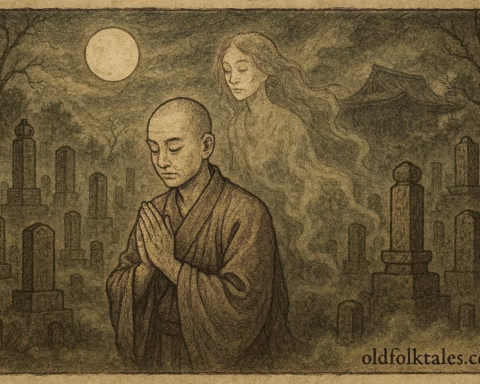
In some regions, ceremonies were created to bring peace to restless spirits like Teke Teke. Families would gather near the railway, offering flowers and prayers along with soft melodies played on flutes. The belief was that music could guide troubled souls toward calmness, reminding them that they were remembered rather than forgotten. These rituals were gentle, emphasizing compassion rather than fear.
Modern retellings of the legend transformed Teke Teke into a figure of warning. Students whispered the story to one another during late study nights, imagining her lingering near the school gates after sunset. Travelers on empty trains gazed at the dark windows, half expecting her form to appear reflected beside them. While many treated the story as entertainment, others recognized the deeper truth beneath it. Teke Teke represented the loneliness that can grow unnoticed and the responsibility communities bear for one another.
In many ways, the legend serves as a mirror. It reflects the consequences of leaving a person unheard, unseen, or unsupported. It invites listeners to remember that sorrow can shape the spirit just as much as joy does. Whether or not one believes in spirits, the tale of Teke Teke urges everyone to pay attention to the quiet cries of those around them, to step forward when they sense someone drifting toward despair, and to speak openly about grief rather than allowing it to hide in the shadows.
The image of Teke Teke, moving softly along moonlit tracks, remains powerful across generations. She is not only a figure of fear but a symbol of the wounds that linger when voices go unheard. Through her story, communities learn that healing begins with acknowledgment and that compassion has the power to quiet even the most restless spirits of the night.
Author’s Note
This story reminds us that legends arise not from terror alone but from the need to confront the emotions communities leave unspoken. Teke Teke stands as a symbol of the importance of support, communication, and empathy in preventing the isolation that can haunt both individuals and society.
Knowledge Check
1. What emotion is most associated with Teke Teke’s origin
Sorrow and isolation
2. Where is Teke Teke said to appear
Along quiet railway paths at night
3. What sound is linked to her presence
A soft scraping sound described as teke teke
4. What deeper message does her story teach
To acknowledge community suffering and emotional wounds
5. What ritual helps calm restless spirits in some regions
Offerings, flowers, and gentle music near the railway
6. Why does the legend remain powerful today
It warns against ignoring the pain of others