
In the remote villages nestled among Afghanistan’s towering mountains, where snow-capped peaks pierce the clouds and valleys hide ancient secrets, the elders have always known that the hours surrounding birth are sacred and dangerous. For generations, from the Tajik settlements in the north to the Hazara communities in the central highlands, and throughout the Pashtun villages of the south, families have whispered about the Al, a demon whose very name could make even the bravest warrior shudder.
The story begins on a winter night in a small village, where a young woman named Zarina is preparing to bring her first child into the world. Her husband, Karim, had traveled to the nearest town for supplies, leaving Zarina in the care of her mother-in-law, Bibi Gul, and the village midwife, a weathered woman named Mahjabin who had delivered three generations of children.
Click to read all Myths & Legends – timeless stories of creation, fate, and the divine across every culture and continent
As the labor pains began, Bibi Gul immediately set about the ancient protections. She placed an iron knife beneath Zarina’s mattress, its blade pointing toward the door. She burned wild rue seeds in a clay pot, letting the pungent smoke curl through every corner of the room. Around the doorway, she hung amulets inscribed with verses of protection, and she tied a red thread around Zarina’s wrist an old safeguard against invisible enemies.
“Why all this, grandmother?” asked Zarina’s younger sister, Parisa, who watched with curious eyes.
Mahjabin’s voice dropped to a whisper. “Because the Al walks tonight. I can feel it in my bones. When a woman brings life into this world, darkness always tries to steal it away.”
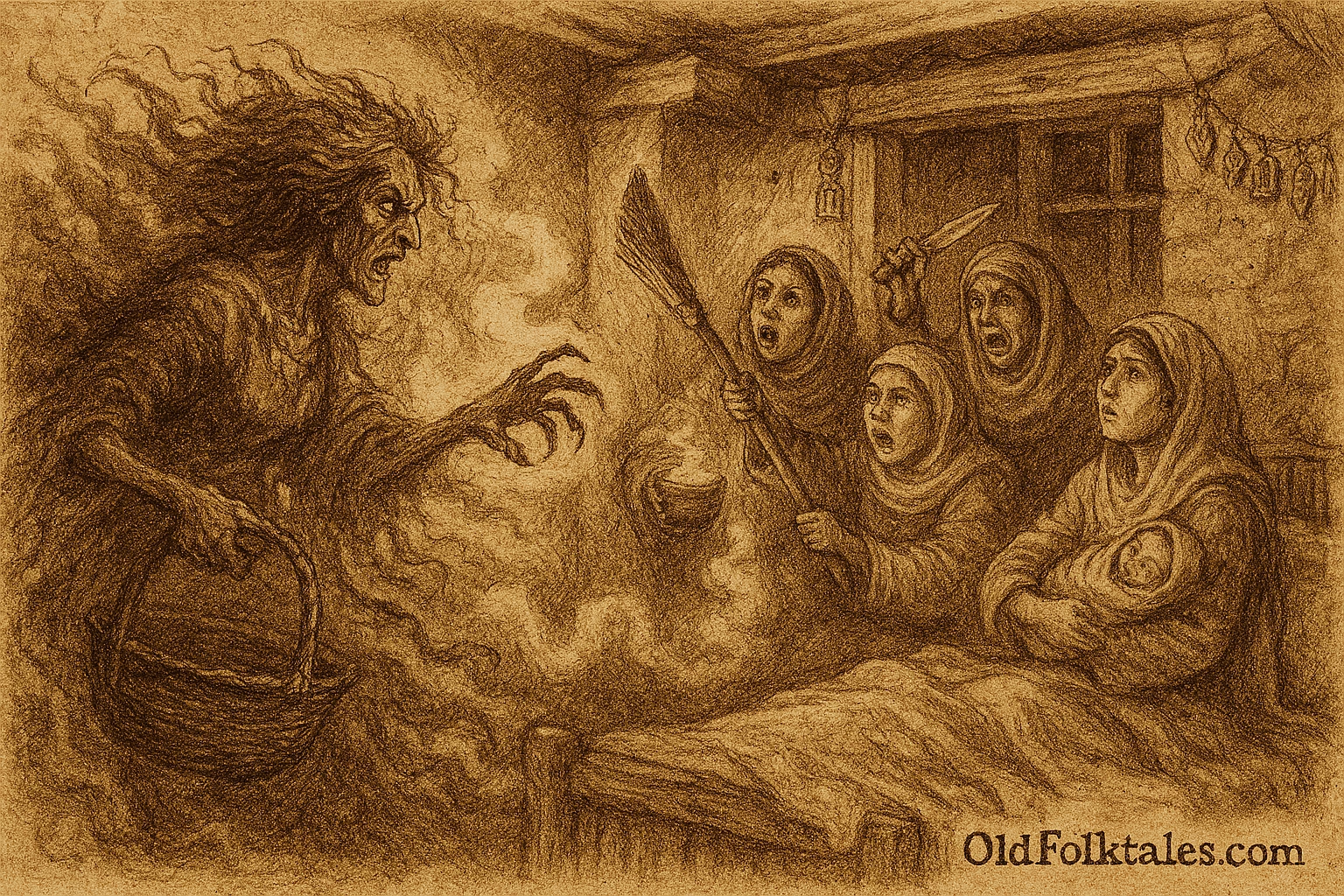
The Al, Mahjabin explained, was no ordinary demon. She appeared as a terrible woman with wild red hair that whipped around her gaunt face like flames. Her cheeks were hollow, sunken so deep they cast shadows across her skull-like features. Her fingernails were long and sharp as iron daggers, capable of tearing through flesh and bone. But most terrifying of all was her cloak woven not from wool or silk, but from smoke itself, shifting and curling with every movement, making her nearly invisible in the darkness.
The Al hunted with patience. She would lurk outside homes where childbirth was taking place, waiting for exhaustion to overcome the attendants, for prayers to falter, for vigilance to waver. In that single moment of weakness, she would slip through cracks in walls and gaps beneath doors, materializing from her smoke-cloak like a nightmare made flesh.
As midnight approached, Zarina’s labor intensified. The pain came in waves, each one stronger than the last. Mahjabin worked skillfully while Bibi Gul supported her daughter-in-law, whispering prayers and encouragement. Young Parisa kept the fire burning and the rue seeds smoking.
Then, just after the deepest hour of night, the baby came a healthy boy whose first cry rang out like a bell. Relief flooded the room. Mahjabin cleaned the infant while Bibi Gul tended to Zarina, who lay back exhausted, her face pale but peaceful.
“Stay awake, Zarina,” Mahjabin warned urgently. “You must not sleep yet. The danger is greatest now.”
But Zarina’s eyelids grew heavy. The pain had left her drained, and despite her efforts, sleep began to claim her. Bibi Gul, too, felt weariness creeping over her after the long night. Even Mahjabin’s ancient eyes began to close.
That’s when Parisa saw it.
Through the window, a figure moved in the darkness a woman-shape wrapped in what looked like fog or smoke. Red hair gleamed in the starlight. The shape drifted toward the door, and Parisa watched in horror as thin wisps of smoke began seeping beneath it.
“Mahjabin!” Parisa screamed, shaking the midwife. “The Al! She’s here!”
Mahjabin’s eyes flew open. In one swift motion, she grabbed the iron knife from beneath the mattress and began reciting prayers at the top of her voice. Bibi Gul snatched up the pot of burning rue and thrust it toward the door. Parisa, though terrified, grabbed the broom and began striking at the smoke, which had begun to coalesce into a horrible form gaunt face, hollow cheeks, reaching claws.
The Al shrieked, a sound like wind through mountain crevices. She lunged toward Zarina, her wicker basket appearing in her skeletal hands, ready to steal the new mother’s liver and lungs her very life force.
But the women stood firm. Iron, prayer, smoke, and courage formed a barrier the demon could not cross. Mahjabin thrust the knife toward the creature while never ceasing her prayers. The blessed words struck the Al like physical blows, and the iron blade glowed with an inner light.
The demon thrashed and wailed, her smoke-cloak unraveling. Unable to breach the women’s defenses, unable to claim her prize, the Al finally retreated, dissolving into mist and fleeing through the cracks in the walls, back into the mountain darkness from which she came.
As dawn light touched the peaks, Karim returned to find his wife, child, and family safe. When they told him what had happened, he embraced each woman in turn, understanding that their vigilance had saved everything he held dear.
From that night forward, Parisa became a midwife herself, learning all the old protections from Mahjabin. She taught them to the next generation, ensuring that the knowledge would never be lost that mothers and babies would always have guardians standing between them and the darkness.
The Moral Lesson
This ancient Afghan legend teaches us that life’s most precious moments like childbirth are also the most vulnerable to harm. Protection requires vigilance, knowledge passed between generations, and the courage to stand against fear when it matters most. The story reminds us of that community strength, traditional wisdom, and unity can overcome even the darkest threats. It also honors the role of women as protectors and keepers of sacred knowledge, showing that what may seem like superstition often contains profound truths about staying alert during life’s critical passages.
Knowledge Check
Q1: What is the Al in Afghan folklore and what does she look like?
A: The Al is a female demon from Afghan folklore characterized by blazing red hair, hollow sunken cheeks, long iron-sharp fingernails, and a cloak woven from smoke. She is one of the most feared beings in traditional Afghan mythology, particularly associated with childbirth.
Q2: Why does the Al target women during childbirth in Afghan tradition?
A: According to Afghan folklore, the Al attacks mothers during or immediately after childbirth when they are at their most vulnerable and exhausted. She attempts to steal the mother’s vital organs specifically the liver or lungs which would result in the mother’s death within hours.
Q3: What traditional Afghan protections were used against the Al?
A: Traditional Afghan protections against the Al included placing iron tools (especially knives) near the birthing mother, burning wild rue seeds or incense, reciting prayers continuously, hanging protective amulets inscribed with verses at doorways, and maintaining constant vigilance without allowing attendants to fall asleep.
Q4: Which Afghan ethnic communities traditionally told stories about the Al?
A: The Al demon legend is shared across multiple Afghan ethnic communities including the Tajik people in northern Afghanistan, the Hazara communities in the central highlands, and Pashtun villages in the southern regions. The story has been passed down through generations in all these cultures.
Q5: What symbolic meaning does iron have in the Al legend?
A: In the Al demon legend, iron represents a powerful spiritual barrier against evil. Iron tools, particularly knives and blades, are believed to repel supernatural entities and create protection that demons cannot cross. This reflects ancient beliefs across many cultures about iron’s protective properties against malevolent spirits.
Q6: What lesson about childbirth does the Al legend teach Afghan communities?
A: The Al demon legend teaches that childbirth is a sacred but dangerous time requiring community protection, vigilance, and the preservation of traditional knowledge. It emphasizes the importance of never leaving a new mother unguarded, respecting the wisdom of midwives and elders, and understanding that bringing life into the world requires both physical and spiritual safeguards.
Source: Adapted from Afghan and Central Asian folklore documentation on the Al , as recorded in oral traditions and ethnographic studies of Tajik, Hazara, and Pashtun communities.
Cultural Origin: Traditional Afghan Folklore Tajik, Hazara, and Pashtun Communities of Afghanistan (Central Asian Region)






