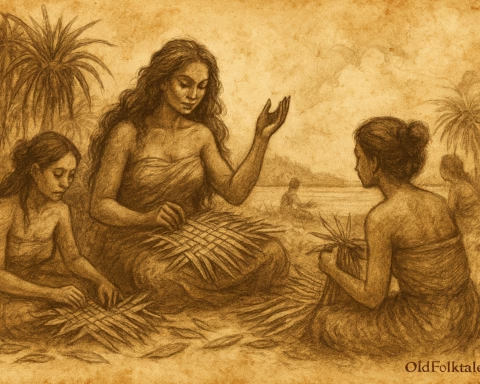
Long before the waters rose to their current boundaries and the islands took their present shape, there lived a great ancestor named Tebuana among the people of the Gilbert Islands. He was not merely a chief or a warrior, though he possessed both courage and authority. Tebuana was something more a keeper of sacred knowledge, a reader of signs, a man who understood the language spoken between earth and heaven.
The Gilbert Islands where Tebuana walked stretched across the equator like a string of pearls cast upon the endless blue of the Pacific. These low coral atolls, barely rising above the waves, were places of profound beautywhite sand beaches encircling turquoise lagoons, coconut palms bending gracefully in the trade winds, and skies so vast and clear that the stars at night seemed close enough to touch. Here, surrounded by ocean on all sides, the people lived in intimate connection with both sea and sky, understanding that their existence depended on respecting the balance of natural and supernatural forces.
Tebuana carried within him a vision that had visited him in dreams a vision of connection, of bridging the gap between the world of the living and the realm where the spirits of ancestors dwelt. The spirits had entrusted him with a seed, unlike any that grew naturally in the islands. This seed pulsed with an inner light, warm to the touch, and when Tebuana held it, he could hear distant voices singing songs from the time before time.
One morning, as the sun broke free from the ocean’s embrace and painted the sky in shades of pink and gold, Tebuana walked to the center of his island. He chose a spot where the land seemed to hum with power, where the coral foundation felt somehow thinner, as if the barrier between worlds was more permeable there. With ceremony and reverence, he dug into the coral sand and planted the sacred seed.
He spoke ancient words over it words his grandfather had taught him, words that his grandfather’s grandfather had known, reaching back through generations to the first people who had understood how to speak with spirits. He poured water from a shell, blessed by the full moon, and as the liquid touched the earth, the seed began to stir.
What emerged was a wonder beyond imagination. The seedling that pushed through the sand was already as thick as a man’s wrist. Within a single day, it had grown to the height of a child. Within a week, it towered above the tallest palms. The tree’s growth was not natural but magical, propelled by forces that belonged to a realm beyond ordinary understanding.
The trunk grew massive and strong, its bark bearing patterns that seemed to shift and change when you weren’t looking directly at them. The wood was harder than any known timber, yet when you touched it, it felt warm and somehow alive in a way that made your heart beat faster. Most remarkably, the tree did not stop growing upward. It continued rising, day after day, its branches stretching toward the sky with single-minded determination, as though answering a call from above.
People from across the atolls came to witness this miracle. They watched in awe as the tree climbed higher than any bird could fly, higher than the clouds themselves, until its uppermost branches disappeared into the heavens and could no longer be seen from the ground. The trunk was so wide that it would take many men holding hands to circle it, and its bark formed natural ridges and grooves that looked almost like a ladder carved by divine hands.
One brave young man, driven by curiosity and faith, decided to climb the tree to see where it led. Hand over hand, he pulled himself upward, climbing through the lower branches, then higher still, until he passed through the clouds and emerged into a realm of golden light. When he returned hours later but feeling as if only moments had passed he told an astonishing tale.
High above the mortal world, he said, the tree’s branches opened into the upper realm, the dwelling place of the ancestors. There, the spirits of the departed lived in peace and plenty, their forms glowing with gentle radiance. They welcomed him with joy, embracing him as family welcomes family, and sent messages of love to their descendants below.
Word spread like wildfire across the islands. The tree that Tebuana had planted was not merely a tree it was a bridge, a connection between the living and the dead, a pathway to the ancestral realm. Soon, people were making pilgrimages from distant atolls to climb the sacred tree. Families reunited with lost loved ones. Children met grandparents who had died before they were born. Warriors received blessings from heroes of old. The tree became the center of spiritual life, a living testament to Tebuana’s wisdom and the generosity of the spirits.
For a time, harmony prevailed. People approached the tree with reverence, climbing only as high as they needed to reach the ancestor realm, always showing proper respect for the sacred nature of their journey. Tebuana watched over the tree with pride and vigilance, knowing that such a gift required careful stewardship.
But children, in their innocence and boundless curiosity, do not always understand the limits that must be observed. A group of young ones, perhaps six or seven in number, began to treat the tree as an adventure rather than a sacred trust. They would race each other up the trunk, laughing and shouting, turning the solemn climb into a game.
One day, emboldened by repeated climbs and growing confidence, these children decided to go higher than anyone had gone before. They passed through the ancestor realm without stopping, ignoring the gentle voices that called for them to pause and visit. Higher and higher they climbed, into regions where the air grew thin and strange, where the light took on colors that seemed to come from everywhere and nowhere at once.
They were approaching the very heights of heaven itself, the domain of the sky spirits powerful, ancient beings who had existed since the world’s first breath. These spirits had tolerated the tree’s presence and the respectful visits of humans to their ancestors. But they had never intended for mortals to reach the uppermost levels of the celestial realm, the sacred spaces where cosmic forces dwelled in their pure form.
When the sky spirits heard the laughter and shouts of the children echoing through the highest branches, alarm rippled through their ranks. They gathered in council, their voices like distant thunder, and debated what must be done. If humans could climb so high, what would prevent them from claiming the heavens themselves? What if the separation between mortal and divine collapsed entirely? The cosmic order that had existed since creation itself was under threat.
With heavy hearts but firm resolve, the sky spirits decided that the tree must fall. It was too dangerous, too powerful, too much of a temptation for human ambition. The boundary between earth and sky had to be restored.
The greatest of the sky spirits reached down and grasped the topmost branches of Tebuana’s tree. With terrible strength, they shook the tree violently, and the entire structure trembled from root to crown. The children, clinging desperately to the branches, felt the world spinning around them as they were torn loose and sent tumbling through the air.
Down they fell, screaming in terror, plummeting through the heavens, through the ancestor realm, through the clouds, down toward the hard earth far below. But the sky spirits, though stern, were not cruel. They guided the children’s fall, cushioning their descent with winds and directing them toward the soft waters of the lagoon rather than the unforgiving coral shore. The children splashed into the turquoise water, bruised and frightened but alive.
The tree was not so fortunate. The violent shaking had fractured its mighty trunk in a thousand places. Cracks spread along its length, and from these fissures, light poured out the accumulated magic of years spilling forth like liquid gold. With a sound that echoed across every island in the group, a sound that some say could be heard as far away as the horizon itself, the great tree of Tebuana collapsed.
The trunk shattered into countless fragments, each piece still glowing with residual magic. These fragments were caught by the wind and scattered across all the islands of what would become Kiribati. Wherever a piece of the sacred tree landed, it buried itself in the coral sand and began, slowly, to transform.
Tebuana watched the destruction with tears streaming down his weathered face, but in his wisdom, he understood what had happened and why. The tree had been a beautiful dream, a gift too powerful for the world to safely hold. Some bridges between realms were meant to exist only briefly, as lessons and blessings rather than permanent structures.
From each fragment of the fallen tree, a new kind of tree began to grow. These were smaller, humbler, but perfectly suited to sustain human life. The first coconut palms emerged from the scattered pieces of Tebuana’s sky bridge, and they spread across every island in the Gilbert chain.
The people recognized these coconut palms as sacred gifts from their great ancestor. Every part of the tree served them the trunk provided timber for their canoes and houses, the fronds thatched their roofs, the fiber made rope and cloth, the meat nourished their bodies, and the water quenched their thirst. The coconut palm became the tree of life for the people of Kiribati, a constant reminder of Tebuana’s wisdom and the sacrifice that had been made.
Even now, when the trade winds blow through the coconut groves and the fronds rustle and whisper, the old people say you can hear echoes of the ancestor realm, soft voices carrying messages from those who have gone before. And when you drink the sweet water from a young coconut, you taste something of the magic that once flowed through the great tree that connected heaven and earth a blessing transformed but never lost, a gift that endures.
Click to read all Myths & Legends – timeless stories of creation, fate, and the divine across every culture and continent
The Moral Lesson
The legend of Tebuana’s tree teaches us profound lessons about boundaries, respect, and the transformation of gifts. While the desire to connect with the divine and our ancestors is noble, we must approach sacred things with humility and restraint rather than reckless curiosity. The children’s thoughtless climbing demonstrates how even innocent actions can violate necessary boundaries and bring loss to an entire community. The story reminds us that some separations exist for cosmic reasons between earth and heaven, mortal and divine and attempting to breach these limits without wisdom can result in losing even legitimate access we once enjoyed.
Knowledge Check
Q1: Who was Tebuana and what was his role in Gilbert Islands culture? A: Tebuana was a great ancestor of the Gilbert Islands who served as more than just a chief or warrior. He was a keeper of sacred knowledge, a reader of signs between earth and heaven, and a spiritual leader who understood how to communicate with supernatural forces. He was entrusted by spirits with a magical seed that would bridge the mortal and ancestral realms.
Q2: What made Tebuana’s tree magical and different from ordinary trees? A: The tree grew with supernatural speed and never stopped growing upward reaching from earth through the clouds and into the celestial realm. It had bark with shifting patterns, felt warm and alive to the touch, and formed natural handholds for climbing. Most importantly, its branches extended into the upper world where ancestral spirits dwelled, creating a physical bridge between the living and the dead.
Q3: How did people use the tree before its destruction? A: People made pilgrimages from across the atolls to climb the tree and visit the ancestral realm in the heavens. Families reunited with deceased loved ones, children met grandparents who had died before their birth, warriors received blessings from ancient heroes, and the living could communicate directly with their ancestors. The tree became the center of spiritual life for the islands.
Q4: Why did the sky spirits decide to destroy Tebuana’s tree? A: When curious children climbed recklessly beyond the ancestor realm toward the uppermost heights of heaven itself, the sky spirits became alarmed. They feared that humans would claim the celestial realm and that the cosmic separation between mortal and divine would collapse entirely, threatening the fundamental order of existence. The tree had become too dangerous to preserve.
Q5: What happened to the children who climbed too high, and how did the tree fall? A: The sky spirits shook the tree violently, causing the children to fall from the branches. Though they plummeted through the heavens in terror, the spirits guided their descent with winds and directed them into the soft lagoon waters rather than onto hard coral, so they survived with only bruises. The shaking fractured the tree’s trunk, causing it to collapse and shatter into countless fragments.
Q6: What is the sacred significance of coconut palms in Kiribati according to this legend? A: Coconut palms are considered sacred gifts from ancestor Tebuana because they grew from the magical fragments of his fallen sky tree. Each coconut palm represents a transformed piece of the original bridge between heaven and earth. The trees provide essential resources for survival timber, thatch, rope, food, and water and the rustling of their fronds is said to carry whispers from the ancestor realm, maintaining a subtle connection to the spiritual world.
Source: Adapted from Kiribati Folklore Collection
Cultural Origin: Republic of Kiribati (Gilbert Islands), Central Pacific, Micronesia