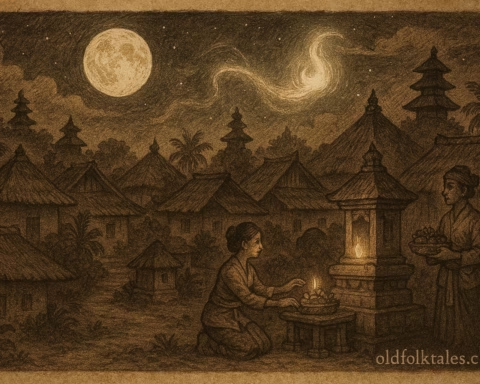
In the islands of the Philippines, where the winds whisper through banana leaves and moonlight paints the bamboo walls of village homes, people speak in hushed tones of a creature that walks among them unseen. It is called the Aswang, a shapeshifting spirit that lives by deceit and feeds upon human life. During the day, it appears perfectly ordinary, blending among the villagers as a quiet woman or man, often kind and helpful. But when night falls and the crickets begin their mournful song, the creature reveals its true form a winged monster with glowing eyes and a hunger for flesh and blood.
The Aswang is not just a tale to frighten children but a reflection of ancient fears, faith, and vigilance. The people of the Visayas region tell of one particular story, known in many villages as The Aswang in the Barrio. It is said that long ago, in a peaceful barrio surrounded by coconut palms and rice fields, there lived a young couple expecting their first child. The woman, named Amalia, was gentle and kind, often helping her neighbors and tending to her small garden behind the house. Her husband, Mateo, was a fisherman who spent nights on the water and returned each morning with his catch.
Among their neighbors was an older woman named Lira who always seemed to appear unexpectedly. She smiled often, spoke softly, and brought food to Amalia during her pregnancy. Yet when the dog barked or the rooster crowed at her presence, people whispered among themselves. For Lira never seemed to age, and her shadow sometimes moved even when she stood still.
Journey through the world’s most powerful legends, where gods, mortals, and destiny intertwine
As Amalia’s time drew near, strange things began to happen. Chickens were found drained of blood. Cats vanished without a trace. And at night, she heard faint scratching sounds on the roof above her bed. The old midwife, Nanay Pilar, who had delivered countless babies in the barrio, grew concerned. She whispered to Mateo, “There is an Aswang near. Protect your wife. Do not let her sleep alone and keep garlic, salt, and holy oil beside her bed.”
Mateo followed the advice. That night, he stayed awake with a bolo knife by his side. The moon hung bright and cold above the palm trees. Around midnight, he heard the faint flutter of wings and a soft rustling sound like a bird landing upon the roof. Then came a strange wet sound—like something pressing through bamboo.
Unseen above the sleeping Amalia, a long, thin tongue began to slip through the thatched roof. It stretched impossibly far, glistening like a thread of darkness. The tongue moved toward the woman’s swollen belly, guided by an unholy hunger. The Aswang had come to feed.
But before the creature could reach her, Mateo threw salt into the air and struck the roof with his blade. The cry that followed shook the house, a shriek that was neither human nor beast. A dark shape burst into the night sky, its leathery wings flapping with fury. Mateo ran outside and saw the creature silhouetted against the moon, its glowing eyes staring down with rage before it vanished into the trees.
The next day, the villagers gathered at dawn. They followed the trail of blood and found Lira lying in her hut, her side burned where the salt had struck her. She no longer hid behind human guise. Her skin was pale and cold, her teeth long and sharp. When the priest arrived, he prayed over her and blessed the home. Lira vanished from the barrio soon after, and no one ever saw her again.
From that day, the villagers strengthened their nightly prayers. They hung garlic by their doors and kept blessed oil near their windows. Mothers whispered protective words over their sleeping children. The people learned that faith, vigilance, and unity could stand against even the darkest of spirits. The Aswang remained a warning that evil often wears a friendly face and that spiritual neglect opens the way for darkness to enter.
Though centuries have passed, the tale of the Aswang endures in the islands. Travelers are told not to wander alone at night and not to speak carelessly of things unseen. The creature’s story has spread across the Philippines, taking many forms sometimes a vampire, sometimes a witch, sometimes a ghoul but always a deceiver that preys upon weakness and isolation.
For the Visayan people, it is more than a horror story. It is a moral compass disguised as myth, a call to protect the innocent, to guard one’s faith, and to recognize that evil does not always announce itself. The Aswang reminds listeners that danger may live next door, wearing a kind smile by day and waiting with wings at night.
And so, when the night winds blow across the coconut groves and the dogs begin to bark without reason, elders still whisper the same words: “Be watchful. Pray. Keep your light burning.” The Aswang fears faith, for faith exposes deception.
Author’s Note
The legend of the Aswang embodies the Filipino struggle between faith and fear, community and deceit. In Visayan belief, it teaches that evil often hides behind familiarity, testing the strength of spiritual discipline and human vigilance. The myth continues to protect the culture’s moral heart, reminding generations that faith and watchfulness guard not just the body but the soul.
Knowledge Check
1. What does the Aswang represent in Filipino mythology?
It represents deception, hidden evil, and spiritual corruption disguised as humanity.
2. How does the Aswang appear during the day?
It takes the form of an ordinary person, often friendly and unthreatening.
3. What event exposes the true identity of the Aswang in this story?
The attack on Amalia’s home when its tongue slips through the roof at night.
4. What items are used to protect against the Aswang?
Garlic, salt, and holy oil are traditional protections.
5. What moral lesson does the story teach?
That faith, vigilance, and community are defenses against deceit and evil.
6. Why do the people still tell this legend today?
It preserves cultural values of faith, moral awareness, and the power of collective protection.
Source:
Adapted from the Visayan folktale “The Aswang in the Barrio” in Creatures of Philippine Lower Mythology, by Maximo D. Ramos (1971), Quezon City: University of the Philippines Press.
Cultural Origin:
Philippines