
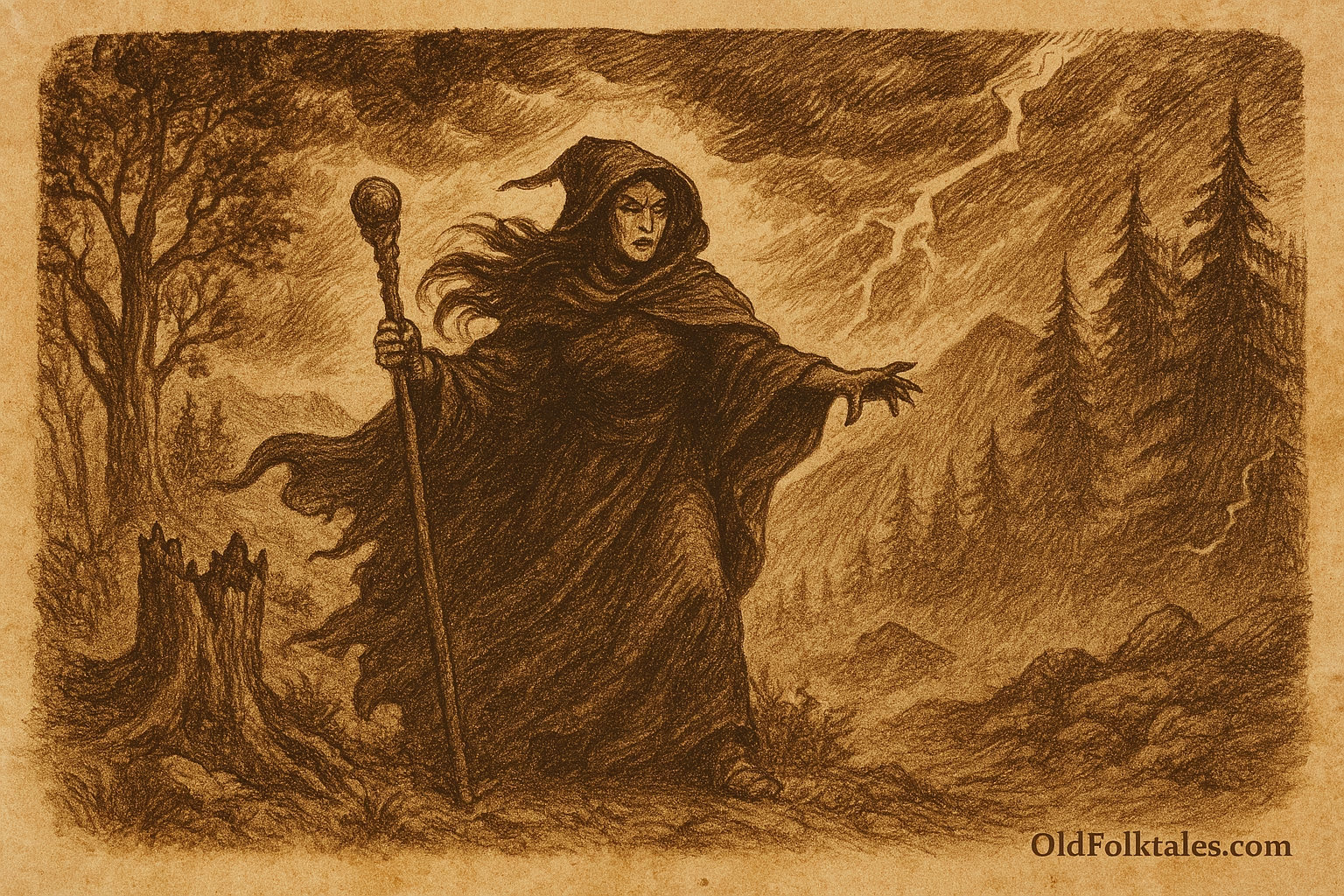
High above the city of Zagreb, where the peaks of Medvednica Mountain pierce the clouds and ancient forests cling to rocky slopes, there dwells a figure of terrible beauty and awesome power. She is known throughout Croatia as the Black Queen Crna Kraljica a sorceress-queen whose legend has echoed through the mountain valleys for centuries uncounted.
The Black Queen is a being of two faces, as changeable as the mountain weather itself. Those who have glimpsed her speak of a woman of extraordinary presence, tall and regal, with eyes that seem to hold the depth of mountain lakes. Sometimes she appears as a vision of dark elegance, dressed in flowing robes as black as a moonless night, her bearing noble and commanding. Her beauty in these moments is said to steal the breath from those who behold her a beauty not soft or gentle, but sharp and magnificent, like the mountain peaks themselves.
Click to read all Myths & Legends – timeless stories of creation, fate, and the divine across every culture and continent
Yet this is only one aspect of the Black Queen. At other times, particularly when her anger is roused, she transforms into something far more terrifying. Her beautiful features twist into those of a fearsome witch, her black robes becoming tattered and wild, whipping around her in winds that seem to answer her fury alone. In this form, she embodies the raw, untamed power of nature itself unpredictable, dangerous, and absolutely unforgiving to those who have earned her wrath.
But the Black Queen is no mere monster haunting the mountains to frighten travelers. Her presence serves a sacred purpose, one that the mountain folk understand in their bones. She is the protector of Medvednica, the guardian of its ancient forests and the defender of those who cannot defend themselves. Her power, immense though it may be, is wielded with a fierce sense of justice.
The poor and downtrodden know the Black Queen as their champion. When harsh winters threatened to starve mountain villages, she has been known to guide hunters to game that would otherwise remain hidden. When sickness swept through humble cottages, healers would find rare herbs growing near their doors herbs that had not been there the night before, left by unseen hands. Those who treat the mountain and its creatures with respect, who take only what they need and give thanks for what they receive, have nothing to fear from the Black Queen. Indeed, they may find themselves blessed by her mysterious patronage.
But those who come to Medvednica with greed in their hearts and destruction in their plans they learn to fear the mountain’s dark guardian.
The story that mountain folk tell most often, passing it from grandparent to grandchild around crackling fires, concerns a group of wealthy lords from the lowlands. These men, bloated with power and drunk on their own importance, cast their greedy eyes upon Medvednica’s ancient oak forests. They saw not sacred groves that had stood for a thousand years, not homes to countless creatures, not the living heart of the mountain itself. They saw only profit timber to be sold, land to be cleared, gold to be counted.
They came with their servants and their axes, their carts and their saws, setting up a great camp at the forest’s edge. They spoke loudly of their plans, boasting how they would fell the mightiest oaks, how their wealth would multiply, how none could stop them. After all, they were powerful men, accustomed to having their way in all things. What was a mountain forest compared to their will?
The ancient oaks trembled at the first bite of steel, and somewhere deep in the mountain’s heart, the Black Queen stirred.
She appeared before them on the second day, materializing from the morning mist as if she had always been there. In that moment, she wore her aspect of terrible beauty the dark queen in her midnight robes, staff in hand, eyes burning with cold fire. The lords, surprised but not yet afraid, demanded to know who dared challenge their right to cut the trees.
The Black Queen’s answer was to strike her staff upon the ground.
The sound that rang out was not the simple tap of wood on stone, but a thunderclap that seemed to shake the very bones of the mountain. The sky, which had been clear and bright moments before, suddenly boiled with black clouds that rolled down from the peaks like an avalanche. The wind rose from a whisper to a shriek in mere heartbeats, tearing at the lords’ fine clothes and sending their servants stumbling.
Then the storm truly began.
Lightning cracked across the sky in brilliant, terrible forks, striking so close that the lords could smell the sharp scent of it in the air. Thunder roared like a living thing, echoing and re-echoing among the peaks until it seemed the entire world was filled with its fury. Rain fell in sheets so thick that men could barely see their hands before their faces, turning the camp into a sea of mud and chaos.
Trees that the lords had planned to fell swayed and groaned, their branches reaching down like grasping hands. Tent stakes pulled free from the saturated earth, sending pavilions tumbling across the mountainside. Carts overturned, tools scattered, horses screamed and broke their tethers in panic. And through it all, when lightning flashed, the lords could see her the Black Queen, standing unmoved in the heart of the tempest, her staff raised high, her face transformed now into the aspect of the fearsome witch, wild and terrible and utterly implacable.
The lords fled. They ran stumbling and terrified down the mountain paths, abandoning their camp, their tools, their grand plans of profit and destruction. They did not stop running until they reached the safety of the city far below, and they never returned to Medvednica. Some say that the experience drove them to change their ways, while others claim they simply found easier victims elsewhere. But all agree that they never again spoke of cutting the ancient oaks.
The Black Queen returned the forest to silence, and the mountain to peace.
Even now, in modern times, the legend of the Black Queen lives on. Hikers who venture into Medvednica’s forests on misty evenings when the light grows dim and uncertain, when shadows pool between the ancient trees report strange experiences. They hear footsteps that are not their own, steady and deliberate, pacing through the undergrowth. Sometimes they glimpse a figure in black moving between the trees, always at the edge of vision, never quite clear enough to see fully. The mountain folk smile knowingly at such tales. The Black Queen still walks her domain, they say, still keeping watch over the forests and creatures under her protection, still guarding the sacred mountain against those who would do it harm.
The Moral Lesson
The legend of the Black Queen teaches us that nature has its defenders, and that power should be used to protect the vulnerable rather than to exploit them for profit. Those who show respect for the natural world and compassion for those in need will find unexpected allies, while those who approach with greed and destructive intent will face consequences beyond their imagining. True power lies not in domination, but in guardianship and justice.
Knowledge Check
Q1: Who is the Black Queen in Croatian mythology? A: The Black Queen (Crna Kraljica) is a legendary sorceress-queen who dwells in Medvednica Mountain above Zagreb. She possesses immense magical power and can appear either as a beautiful woman dressed in black robes or as a fearsome witch, depending on circumstances and her mood.
Q2: What role does the Black Queen serve in the mountains? A: The Black Queen serves as the protector of Medvednica’s forests and defender of the poor and vulnerable. She aids those who respect nature and treats the mountain with reverence, while punishing those who destroy the environment or abuse their power for selfish gain.
Q3: What happened when the greedy lords tried to cut down the ancient oaks? A: When wealthy lords came to cut Medvednica’s ancient oaks for profit, the Black Queen appeared and struck her staff on the ground. She summoned a massive storm with lightning, thunder, and torrential rain that destroyed their camp and forced them to flee the mountain in terror, never to return.
Q4: How does the Black Queen help the poor and vulnerable? A: The Black Queen aids the poor by guiding hunters to game during harsh winters, leaving rare medicinal herbs for healers when sickness strikes villages, and protecting those who treat the mountain with respect. She uses her power to defend those who cannot defend themselves.
Q5: What do modern hikers report experiencing on Medvednica Mountain? A: Contemporary hikers on misty evenings report hearing mysterious footsteps in the forest, glimpsing a figure in black moving between trees, and sensing an unseen presence. Mountain folk interpret these experiences as evidence that the Black Queen still guards her domain.
Q6: What does the Black Queen symbolize in Croatian folklore? A: The Black Queen symbolizes nature’s power to defend itself against exploitation and represents the principle that true authority should be used to protect the vulnerable and preserve the sacred. She embodies both the nurturing and fierce aspects of the natural world.
Source: Adapted from traditional Croatian folklore and legends of Medvednica Mountain
Cultural Origin: Croatia, Medvednica Mountain near Zagreb, Balkan Peninsula, Southeastern Europe






