The hills of the Balkans are places of great beauty. Their forests glow in silver moonlight and their rivers travel from mountain to valley carrying the whispered memories of generations. Yet beneath this beauty lies an ancient truth understood by villages for centuries. Those who leave the dead without proper rites invite the Drekavac, the restless spirit born from neglect and sorrow.
Long ago in the village of Dvorane there lived a poor family that struggled from season to season. The father worked the fields. The mother mended clothing for neighbors. Their little boy, Petar, was born during a harsh winter and fell ill before he had completed his first year. When he died, the family’s grief was heavy, but their poverty was greater. They lacked the means for the full burial rites, the long prayers, and the carved wooden markers meant to guide a child’s soul into the realm of peace.
“We will lay him to rest ourselves,” the father whispered. “The earth will understand our sorrow.”
They buried the boy on the edge of the forest. But no priest came. No ritual song was sung. No candle burned beside the grave. The family believed their love alone would reach him. They did not know that a child so young needed guidance through the shadowed paths of the afterworld.
Discover the ceremonies and sacred festivals that honored gods and balanced nature’s powers
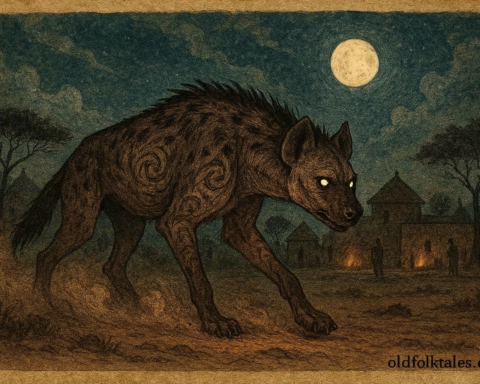
When spring came, strange things began to happen in Dvorane. At first the villagers heard faint cries at dusk. Mothers would hush their children thinking it was only the wind. Shepherds returning with their flocks felt a chill settle between the trees. Dogs howled at night facing the forest as if warning the living not to cross into the realm of wandering souls.
One night a shepherd named Marko walked home later than usual. The moon was thin and pale. The air was cold. As he passed the forest edge he heard a cry that did not belong to man or beast. It was the voice of a child who had never learned to speak. A cry of longing mixed with anger. A cry of one who wanted to be remembered.
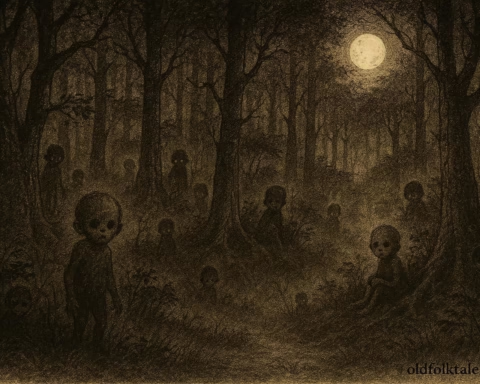
Marko froze. The sound grew louder. Then something stepped from the shadows. The Drekavac appeared not as a body but as a trembling shape of pale light. Its form stretched and shifted as if it were still searching for its own shape. Its eyes were large and sorrowful. Its small mouth opened in a wail that made the trees bend.
“Who left you without peace little one,” Marko whispered.
The spirit cried again. A cry that reached beyond the world of the living and shook the shepherd’s heart. Marko ran to the village and gathered the elders. When he finished speaking, silence filled the room.
The elders knew the stories. They knew that a child without proper rites becomes lost between the worlds. It becomes a Drekavac, a being that wanders with cries that disturb the night and send warnings to all who hear.
Marko led the elders to the forest edge where the cries echoed. They searched until they reached the unmarked grave. The mother and father of little Petar trembled when they saw the gathering.
“We meant no disrespect,” the father said. “We had no coin for the rites.”
“It is not coin the child needs,” the eldest woman replied. “It is remembrance. It is blessing. It is the light that guides him.”
The villagers worked through the night. They cleaned the gravesite. They lit candles and placed them in a circle around the mound. The priest arrived with sacred words that rose like warm smoke into the air. The mother placed a tiny wooden toy that she had carved for her son. The father placed a small stone he had kept from the riverbank where they had once walked as a family.
As the final prayer ended a wind moved through the trees. Gentle and warm. The Drekavac appeared once more. Its wailing softened into a quiet breath. Its form glowed brighter and then slowly dissolved into a delicate shimmer rising upward like mist touched by morning light.
“He has found the path,” the priest said.
From that night onward the villagers never neglected the dead. Even the poorest graves were honored. Candles were placed at the edges of fields and forests. Songs were sung for those who had no family left. And children were taught that respect for the departed is not only a ritual. It is a promise. A promise that love does not end with the final breath.
The story of the Drekavac became a reminder whispered from generation to generation. A reminder that the living must guide the lost. A reminder that every soul deserves peace. And a reminder that when ritual responsibility is forgotten spirits will rise not to harm but to call the living back to their duty.
Explore the shadows of world mythology, where demons test the soul and spirits watch over mankind
Author’s Note
This story highlights how the South Slavic peoples understood the bond between the living and the departed. The Drekavac is not a creature of cruelty but a symbol of forgotten responsibilities and the need for communities to care for every soul, even those who passed too young to speak for themselves. Through this tale we remember that rituals are more than tradition. They are acts of love that guide the lost toward peace and preserve harmony between our world and the unseen one.
Knowledge Check
1. Why did Petar become a Drekavac
He became a Drekavac because he was buried without proper rituals and guidance for his soul.
2. What first alerted the villagers to the presence of a restless spirit
Strange cries at dusk and animals reacting fearfully alerted the villagers.
3. Who first encountered the Drekavac and reported it to the elders
The shepherd Marko was the first to encounter the Drekavac.
4. What did the villagers do to help guide the spirit to peace
They cleaned the gravesite, lit candles, brought offerings, and performed the proper prayers.
5. How did the villagers know the spirit had found peace
The Drekavac’s form glowed, softened, and drifted upward like rising mist.
6. What lesson did the village carry forward after the spirit was guided
They learned to honor all graves and maintain rituals for the dead so no spirit would wander again.
Source
Adapted from South Slavic folklore in Slavic Mythology collected by Alexander Afanasyev 1865 St Petersburg Russian Academy of Sciences
Cultural Origin
South Slavic Peoples Balkans