In the earliest age, when heaven and earth were still young and the breaths of the gods mingled with the mists of creation, Houyi descended from the Jade Realm. He was born not of mortal womb, but of celestial radiance, an emanation of the Heavenly Emperor’s will, shaped into a warrior whose hands could steady the bow of the cosmos itself. His eyes carried the fire of stars; his voice echoed like arrowheads striking stone.
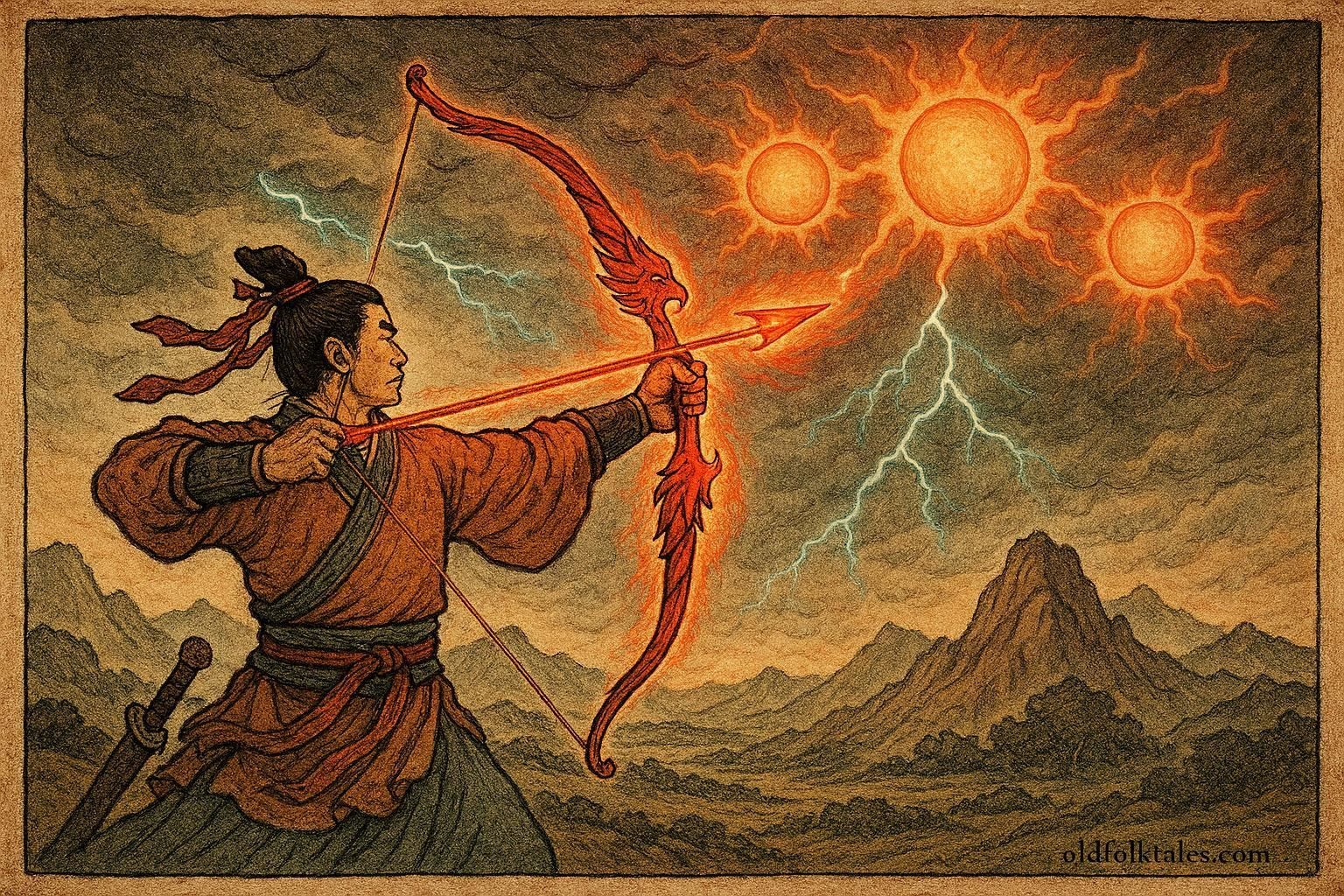
It was said that Houyi trained upon the Cloud Terrace Mountains, where winds whispered secrets of flight. There he was gifted the Red-Bird Bow, carved from the bones of the Vermilion Bird, and ten divine arrows forged from the purest sun-essence. With these weapons he became protector of balance, guardian of the realms of men.
But the heavens began to change.
From the eastern horizon rose not one sun, as had been ordained, but ten, the ten sons of the Celestial Sun Mother, who in youthful rebellion took to the sky together. Their combined blaze scorched the world. Rivers shrank into cracked earth. Forests collapsed into ashes. Animals cried out in terror, and people fled into caverns in search of shadows that no longer existed.
The Heavenly Emperor called his host to council. Thunder generals, cloud maidens, star sages, all trembled at the sight of the world below, shimmering like molten bronze. But only Houyi stepped forward when the Emperor asked who would restore the order of heaven.
“I will go,” the archer said. “For though the suns are divine, their path must not destroy the life we are sworn to watch over.”
Thus he descended to earth once more, where even gods hesitated to tread. The heat flayed the air. Mountains steamed like boiling cauldrons. Yet Houyi walked calmly, the Red-Bird Bow slung across his back, his ten arrows glowing like coiled serpents of light.
He reached the Burning Plains, where the ten suns wheeled wildly overhead. Their young voices sang with unruly joy, unaware of the devastation they wrought.
“Children of Heaven!” Houyi called. “Return to your ordained rhythm, one sun at a time! The world cannot bear your radiant play.”
But the suns only laughed, believing him weak, a lone figure swallowed in blazing gold.
So Houyi nocked his first arrow.
With a breath that stilled the wind and a stance drawn from the oldest martial patterns of the sky, he loosed the shaft. It tore upward like a streak of divine judgment. One sun-child screamed and burst, feathers of flame scattering like sparks across the heavens. The remaining suns froze in fear.
Still they refused to retreat.
Houyi shot another. Then another. Each arrow carried the force of cosmic balance, each strike removing a sun and restoring a measure of shadow to the earth. Trees shuddered back to life; rivers hissed as cooled water flowed again.
But as the ninth sun fell, Houyi hesitated.
Only one remained, the eldest, trembling alone in the vast sky.
He raised his final arrow, feeling the weight not only of duty but of consequence. Should the last sun die, eternal darkness would swallow creation. Yet should it burn unchecked, the cycle of destruction might repeat.
The eldest sun spoke then, its voice small as a child’s.
“I am afraid. I did not mean for our play to bring death. Spare me, Archer of Heaven. Let me remain so the world may live.”
Houyi lowered the bow.
“But promise,” he said, “that you shall rise and set each day, giving both warmth and rest to the living.”
“I promise,” the last sun whispered.
With that vow sealed, Houyi returned the tenth arrow to his quiver.
Earth cooled. Winds stirred again. Humanity emerged, bowing in gratitude to the archer who had brought back the balance of heaven and earth.
Yet the tale does not end in triumph alone. For with each arrow loosed, Houyi felt some measure of his immortality ebb. The act of striking divine beings, even in righteousness, bound him closer to the mortal realm. In the end, the Heavenly Emperor honored his sacrifice but decreed that Houyi would walk the world as a hero between realms, no longer fully divine, yet never fully human.
Thus he became known as the Immortal Archer, one who bore the burden of celestial justice, but who knew intimately the sorrow of necessary violence. He trained mortal kings, guided wandering heroes, and taught the art of archery as a discipline of harmony rather than conquest.
In later ages, some said he sought the Elixir of Immortality to regain what had faded, but others whispered that he sought it instead for love, for a life shared with the mortal woman Chang’e, whose fate became bound to the moon.
But that is another tale.
Here ends the story of how Houyi, Heaven’s Archer, saved the world by dimming the sky, and ensured that light and darkness would forever walk in measured rhythm.
Author’s Note
Houyi’s legend symbolizes the struggle between duty and compassion. Though armed with the power to destroy, he chooses restraint, restoring balance rather than dominance. His story echoes throughout Chinese cosmology as a reminder that heroism sometimes lies in what one spares, not what one strikes down. Houyi remains a figure of cosmic responsibility, moral tension, and the enduring hope that even divine beings can act with compassion.
Knowledge Check
-
From what celestial origin does Houyi arise?
-
What catastrophe is caused by the ten suns?
-
How does Houyi restore balance to the world?
-
Why does he spare the final sun?
-
What consequence does Houyi suffer for striking down the divine suns?
-
What symbolic theme is central to Houyi’s story?
Cultural Origin: Chinese Mythology, rooted in early Taoist cosmology and ancient myth cycles of the Warring States and Han periods.
Source: Classic of Mountains and Seas (Shan Hai Jing); later Taoist cosmological texts and oral traditions.