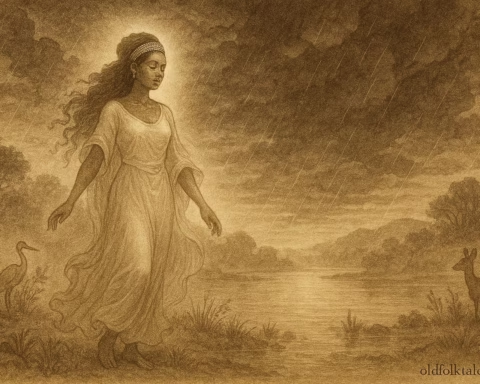
In the shadowed age when the Nine Worlds trembled beneath the weight of old oaths and rising monsters, a prophecy drifted across the windswept heights of Asgard. A Valkyrie, Sváva, daughter of the shining halls, spoke the words that seeded fate: A king shall be born again. A spirit older than his bones. A warrior who bears the iron crown of destiny. And so were the threads spun, long before Helgi Hjörvarðsson came gasping into the mortal world.
Helgi’s father, Hjörvarðr the brooding king, ruled with the silence of a mountain glacier. His queen was Sigrlinn, a woman whose eyes mirrored storm-waters and whose courage had saved nations. Yet it was not from them that Helgi’s deepest nature came. For he carried the reborn spirit of a heroic king slain in ages past, an essence called forth by Valkyrie song, by memory, and by need. From childhood he was unlike other sons of men: he spoke little, learned swiftly, and listened to the wind as though it whispered battle-lore.
But Helgi’s early life was not crowned with ease. When he was scarcely grown, a misshapen troll-woman named Hrímgerðr stalked the realm, hungering for the blood of nobles. She spat curses, called for Helgi’s death, and haunted the borders of the kingdom. Many warriors feared her, for by night her strength doubled, and her voice could twist the senses of men. Yet Helgi felt the tug of destiny; monsters were drawn to him as sparks to steel, and he must rise.
Before he could face Hrímgerðr, fate brought him to the one who already knew his name, Sváva, the Valkyrie who had sung him into life. In the lonely glens beneath snow-crowned cliffs, she approached him clad in armor bright as dawn. Her spear shimmered with the runes of ages. When he beheld her, memory surged like fire through his blood. She had watched his past life fall beneath blades. She had chosen his rebirth. She would guide him still.
“Helgi,” she said, “Iron-Crowned one, the night-creature seeks to drown this land in fear. Stand, and your name will be sung beyond death.”
She offered him a blade reforged in celestial flame. With it, Helgi rode forth to challenge Hrímgerðr at the shoreline where tides hissed like coiling serpents. The duel raged until the moon dipped low. Words sharper than weapons cut between them, for the troll-woman wielded taunts like spears. Yet Helgi’s resolve did not falter. At dawn, when sunlight stretched across the fjord, her powers waned. With a final cry, she fell, and the sea swallowed her.
This victory marked Helgi as more than mortal. His fame grew, and kings sought alliance with the Iron-Crowned youth. But fate bends even heroes toward sorrow.
For Helgi’s love for Sváva, the Valkyrie whose voice had shaped his existence, deepened with every meeting. They swore oaths to one another, though both knew such love carried peril. A Valkyrie belonged to the spheres of prophecy and war, not to the hearths of mortal men. Yet she remained by his side, guiding him in battle, guarding him in dreams.
Soon came word of a more terrible foe: a monstrous warlord whose forces ravaged neighboring realms. Helgi gathered warriors, sailed across bitter waters, and carved a path through shield-walls and firestorms. In the final clash he met the warlord in single combat. The fight shook the earth. Blood and prophecy wove together in the air. Though Helgi triumphed, he bore wounds that no weapon of Midgard should survive.
Sváva descended to him, her wings trailing silver frost. She held him as the light faded from his eyes.
“Do not weep,” he whispered. “You brought me into this life. Let me go to the next without fear.”
Her tears fell upon his brow like cold stars. She knew his soul would be reborn; heroes such as Helgi tread the cycles of life like the turning of seasons. But her heart broke nonetheless. The Norns had given Helgi a great destiny, but not a long one.
Helgi died as he had lived, crowned with iron, ringed with glory, and beloved by one who walked between worlds.
And somewhere in the unseen realms, where the Valkyries whisper to sleeping spirits, the hero’s essence stirred once more.
Author’s Note
Helgi Hjörvarðsson stands as one of the earliest and most enigmatic heroic figures of the Norse poetic tradition. His story blends reincarnation, Valkyrie romance, and monstrous adversaries into a tapestry of fate that echoes the Norse understanding of cyclical time. Helgi’s legacy lies in his embodiment of the heroic ideal: a life shaped by destiny, courage, brief love, and a death that promises renewal. Through him, the Poetic Edda reveals how even doom-laden paths can blaze with meaning.
Knowledge Check
-
What prophecy preceded Helgi’s birth?
-
Who is Sváva, and what role does she play in Helgi’s destiny?
-
What made Hrímgerðr such a dangerous adversary?
-
Why is Helgi known as the Iron-Crowned hero?
-
How does Helgi’s love for Sváva deepen his moral struggle?
-
What symbolic meaning lies in Helgi’s death and promised rebirth?
Cultural Origin: Norse (Icelandic medieval poetic tradition)
Source: Helgakviða Hjörvarðssonar, Poetic Edda (c. 13th century compilation of earlier oral tradition).