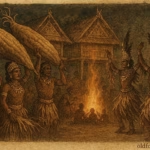
When the desert wind stills and the stars ignite the night, the Ju/’hoansi of the Kalahari gather around a fire that glows like the heartbeat of the earth. They begin to sing, low, pulsing melodies, while others clap in rhythm. From this circle rises one of humanity’s oldest sacred acts: the trance dance, a ritual of healing and renewal that links the living to the spirit world.
This ancient ceremony, also known as the curing dance, begins as both a social gathering and a spiritual summons. Men and women join together; healers and elders move in a circle around the fire while the community claps and chants in unison. As the songs intensify, some dancers begin to tremble, their breath quickens, their bodies quiver, signaling the awakening of n/um, the sacred energy believed to reside within the body.
As n/um “heats up” and rises through the spine, the healer enters a deep trance state called !kia, a condition where the spirit crosses into the invisible world. Here, the healer can “see” the causes of illness, summon ancestral guidance, and draw away harmful forces. The act is both mystical and physical: healers often groan, cry, or collapse as the power flows through them. By touching or breathing upon others, they pass this healing energy on, purifying the body and renewing the bonds between people and the land.
The dance lasts the entire night. The fire burns low, the songs shift, and the circle of bodies sways like a single organism. For the Ju/’hoansi, healing is not individual, it is collective. The sickness of one person threatens the balance of all, and so the entire community participates in the act of restoration.
Mythic Connection
In San cosmology, the world is an intricate web of life forces linking people, animals, and the landscape. The trance dance mirrors this cosmic structure, serving as a bridge between the human and the divine. The Ju/’hoansi believe that the power of n/um was a gift from //Gauwa, the Great Spirit, who placed it within humans so they could heal one another and maintain the sacred order of life.
During the trance, healers are said to fly across the desert in spirit form, visiting ancestral realms or confronting malevolent beings that cause suffering. This flight symbolizes the thin boundary between the living and the spirit world, a journey of courage that renews cosmic harmony.
Each element of the ritual holds symbolic depth. The fire represents the creative and destructive energy of //Gauwa. The rhythmic clapping echoes the heartbeat of creation. The trance itself is a sacred death and rebirth, a healer’s temporary surrender to spiritual fire so that life might be renewed.
Through the dance, the San reaffirm their unity with nature. The sand beneath their feet, the desert wind, the animal cries in the distance, all participate in the rhythm of the ritual. In this sense, the trance dance is both a religious act and an ecological statement: it embodies the understanding that the health of the person and the health of the world are one and the same.
Cultural and Social Meaning
Anthropologists like Richard B. Lee and Megan Biesele describe the trance dance as a living institution of emotional, social, and moral balance. In small, mobile hunter-gatherer societies, tension can easily arise, jealousy, quarrels, grief. The dance serves as a communal therapy, releasing conflict through song and movement.
Every participant contributes. Women’s clapping and singing maintain rhythm and spiritual focus; men and women healers dance until exhaustion, guided by the power of n/um. Apprentices learn through observation, slowly discovering how to awaken their own inner power. This process is not learned through doctrine but through embodied wisdom, a sacred knowledge encoded in rhythm, breath, and touch.
Even today, amid modern influences and displacement pressures, the Ju/’hoansi continue to perform the trance dance. It endures as both heritage and survival , a cultural heartbeat that keeps their spiritual philosophy alive. What was once a desert ceremony has become a symbol of cultural identity, celebrated across Southern Africa as one of the world’s oldest continuous religious traditions.
Author’s Note
The Ju/’hoansi trance dance reminds us that healing is not confined to medicine or ritual, it is a shared act of compassion, rhythm, and spiritual renewal. Within the fire-lit circle, the San people teach a universal truth: that the health of a community depends on unity, empathy, and reverence for the sacred life-force connecting all beings. Their ancient ritual stands as a living dialogue between earth, spirit, and humanity’s eternal search for harmony.
Knowledge Check
1. What is the main purpose of the Ju/’hoansi trance dance?
To heal physical and emotional illness, restore social harmony, and strengthen the community’s connection with the spirit world.
2. What does “n/um” represent?
It is a sacred energy within the body that becomes active during the trance, granting healers the power to cure and communicate with spirits.
3. What happens when a healer reaches the state of “!kia”?
The healer enters a deep trance, allowing their spirit to journey into the unseen realm to confront illness and restore balance.
4. How does the dance benefit the community socially?
It unites everyone in song and movement, resolving tensions, renewing relationships, and reinforcing collective identity.
5. Who is //Gauwa in San mythology?
//Gauwa is the Great Spirit who gifted humanity the power of n/um and taught them to use it for healing and harmony.
6. Why is the trance dance significant today?
It survives as a symbol of cultural resilience, linking the modern San to their ancestral traditions and philosophy of interconnectedness.