On the tiny coral island of Nauru, where the Pacific Ocean stretches endlessly in every direction, and the boundary between earth and sky seems barely a hand’s width apart, there exists a legend that explains why the winds blow as they do and why certain stars guide navigators across the vast waters. It is the story of Eijebong, the Sky Maiden, whose love was captured but whose spirit could never truly be bound to the earth, and whose departure left behind both heartbreak and the celestial gifts that sailors still use to find their way home.
Long ago, when the distance between the sky-world and the earthly realm was not so great as it is today, beings from above would occasionally descend to visit the world of mortals. These sky-dwellers were creatures of extraordinary beauty, as different from humans as clouds are from stone. They possessed wings, delicate, powerful things that caught the light like mother-of-pearl and allowed them to soar between worlds as easily as seabirds ride the wind.
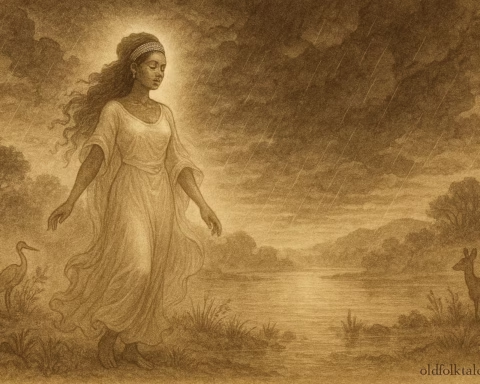
Among these celestial beings was Eijebong, a maiden of particular grace and curiosity. While others of her kind remained contentedly in the sky-world, Eijebong felt drawn to the island below. She would watch the humans going about their lives fishing in the lagoon, gathering coconuts, tending their fires and she wondered what it might be like to walk upon solid earth, to feel coral sand beneath her feet, to taste the salt spray of ocean waves.
One evening, as the sun painted the sky in shades of amber and rose, Eijebong could resist the pull no longer. She spread her magnificent wings and descended, gliding down through the warm tropical air until she landed on a secluded stretch of beach. The sensation was overwhelming the solidity of the ground, the texture of sand, the weight of her body without the support of air beneath her wings. She laughed with delight, running along the shore, marveling at this strange, heavy, wonderful experience of being earthbound.
But Eijebong was not alone on that beach.
A fisherman had been checking his nets nearby, and he had witnessed her descent with a mixture of awe and desire. He had never seen anything so beautiful her luminous skin, her flowing hair, and most especially those wings that marked her as a being from the realm above. In that moment, a plan formed in his mind, a plan born of longing but lacking in wisdom. If he could somehow keep her here, if he could prevent her from returning to the sky, perhaps this celestial maiden could become his wife.
Quietly, carefully, the fisherman crept closer while Eijebong was distracted by her exploration of the beach. Her wings lay folded behind her, resting after the descent. With quick movements, the fisherman seized the wings and ran, hiding them in a secret place where Eijebong would never think to look deep within a hollow in the coral cliffs, covered with palm fronds and carefully concealed.
When Eijebong turned to leave, preparing to return to her sky-home before full darkness fell, she discovered with horror that her wings were gone. She searched frantically, calling out in a language that sounded like wind chimes and distant thunder, but the wings could not be found. Without them, she could not fly. Without them, she was trapped in the earthly realm, as bound to the ground as any human.
The fisherman emerged from his hiding place, feigning surprise at finding her distressed. He offered comfort, offered shelter, offered to help her search though of course he ensured they never searched in the right places. Days turned to weeks, and Eijebong, with no other options and nowhere else to turn, eventually accepted the fisherman’s protection and, in time, his proposal of marriage.
To outside observers, it seemed like a good match. The fisherman was kind in his way, providing for Eijebong’s needs, and she, despite her captivity, tried to make a life in this heavy, grounded world. She learned to cook human food, to weave mats from pandanus leaves, to live without the freedom of the skies. When a child was born to them a son who had his mother’s luminous eyes and his father’s strong hands Eijebong felt her heart torn between love for this earthly family and longing for the home she had lost.
The child grew, and with each passing season, Eijebong felt the weight of her imprisonment more acutely. She would stand on the beach at sunset, staring up at the sky with an expression of such profound longing that even her husband felt guilt stirring in his chest. She would tell their son stories of the sky-world, of clouds that felt like silk and stars that sang, and the boy would listen with wide eyes, sensing that his mother was describing not fantasy but memory.
Years passed. The child grew from infant to boy, from boy to young man. And one day, while exploring the coral cliffs as children will do, investigating places their parents think safely hidden he discovered something extraordinary in a deep hollow: a pair of wings, dusty and folded, but still emanating a faint luminescence even after all this time.
The boy brought his discovery home, not understanding what he had found but knowing instinctively that these beautiful objects belonged to his mother. When Eijebong saw her wings, a transformation came over her. The resigned sadness that had characterized her earthly years fell away, replaced by a radiance that made her seem once again the celestial being she had always been. She embraced her son fiercely, whispered words of love to him, and looked at her husband with an expression that mixed gratitude, sorrow, and something that might have been forgiveness.
“I have loved the child we created together,” she said, her voice carrying harmonics that no earthly throat could produce. “And I have learned things in this heavy world that I could never have known in the lightness of the sky. But I was never meant to be caged, even in a cage made of kindness and companionship. You took my wings and trapped me here, and though I made the best of my captivity, I must return to where I belong.”
She fastened the wings to her shoulders, and they seemed to remember their purpose, spreading wide and catching the evening breeze. The fisherman reached out, perhaps to apologize, perhaps to beg her to stay, but Eijebong was already rising. She ascended swiftly, gracefully, joyfully a being returning to her natural element after years of unnatural constraint.
But she did not simply disappear. Eijebong rose high into the sky, and there she transformed, her physical form dissolving into patterns of stars that navigators would come to recognize and rely upon. Her spirit became the winds themselves sometimes gentle and guiding, sometimes fierce and untameable, but always present, always moving between earth and sky as she had always longed to do.
From that day forward, sailors on the Pacific learned to read the star patterns that Eijebong had become, using them to navigate across trackless waters and find their way home. They learned to understand the winds that carried her essence, knowing which breezes would fill their sails and which storms demanded respect and caution. Mothers would point to certain stars and tell their children, “That is Eijebong, the Sky Maiden. She reminds us that some beings are meant to be free, and that love cannot truly exist where freedom is denied.”
The fisherman lived out his days on Nauru, and though he provided well for his son, he was never again seen to smile. He would stand on the same beach where he had first seen Eijebong descend, staring up at the stars that had once been his wife, understanding too late that true love honors freedom rather than capturing it.
And in the sky above, Eijebong dances eternally among the stars, guiding sailors home while remaining forever free to soar between the worlds.
Click to read all Myths & Legends – timeless stories of creation, fate, and the divine across every culture and continent
The Moral Lesson
The legend of Eijebong teaches us that love built on captivity and deception is ultimately hollow and unsustainable. True love requires freedom and honesty; attempting to possess another person by removing their agency or hiding essential parts of their identity will eventually fail and cause lasting harm. The story also illustrates that some beings whether literally or metaphorically are meant for realms we cannot confine them to, and trying to bind them to our world denies their essential nature. However, Eijebong’s transformation into navigational stars and winds demonstrates that even relationships founded on flawed premises can produce lasting gifts when handled with grace.
Knowledge Check
Q1: Who was Eijebong in Nauruan mythology?
A1: Eijebong was a Sky Maiden from the celestial realm who possessed wings that allowed her to fly between the sky-world and earth. She descended to Nauru out of curiosity about the earthly realm and became trapped when a fisherman hid her wings, forcing her to remain on earth and eventually marry him.
Q2: How did the fisherman trap Eijebong on earth?
A2: While Eijebong was exploring the beach after descending from the sky-world, the fisherman stole her wings and hid them in a secret hollow in the coral cliffs, covered with palm fronds. Without her wings, Eijebong could not fly back to her sky-home and was forced to remain in the earthly realm.
Q3: What happened when Eijebong’s son found her wings?
A3: When Eijebong’s son discovered the hidden wings while exploring and brought them to his mother, she experienced a transformation, regaining her celestial radiance. She embraced her son, acknowledged her love for him, explained to her husband why she must leave, and then ascended back to the sky-world where she belonged.
Q4: How did Eijebong’s return to the sky explain natural phenomena?
A4: After ascending to the sky-world, Eijebong transformed into star patterns that navigators use to guide their journeys across the ocean. Her spirit also became the winds—sometimes gentle and guiding, sometimes fierce—that sailors must understand and respect, explaining both wind patterns and navigational stars recognized in Nauruan culture.
Q5: What does Eijebong’s captivity symbolize in this legend?
A5: Eijebong’s captivity symbolizes relationships built on deception and the denial of freedom. Her stolen wings represent agency and autonomy that were taken from her, while her years on earth represent how people can adapt to constraint but never truly thrive when their essential nature is suppressed. The story illustrates that love without freedom is ultimately imprisonment.
Q6: What cultural purpose do the navigational stars serve in this story?
A6: The navigational stars that Eijebong became serve as practical tools for Pacific sailors to find their way across vast ocean distances. Culturally, they represent how Eijebong’s story transforms personal tragedy into communal benefit her return to freedom created lasting gifts that help others navigate their own journeys, turning her experience into guidance for future generations.
Cultural Origin: Nauru, Central Pacific, Micronesia