
In the shadowed valleys and mist-wrapped hills of ancient Britain, when the land lay fractured and leaderless after the death of Uther Pendragon, darkness seemed to settle over the realm like a heavy cloak. Lords and nobles squabbled amongst themselves, each claiming the right to rule, while common folk suffered through endless winters of uncertainty and strife. Yet whispered on the wind, passed from village to village by wandering bards and mystics, came word of a prophecy: a boy, hidden and unknown, would one day prove himself worthy to unite the broken kingdom.
That boy was Arthur, raised far from the intrigues of court in the humble household of Sir Ector. The child knew nothing of his true heritage, nothing of the royal blood that flowed through his veins. His guardian was none other than Merlin, the great wizard whose eyes could pierce the veil of time itself, who had orchestrated Arthur’s concealment to protect him from those who would see Uther’s line ended forever. Under Merlin’s watchful gaze, the young Arthur grew strong of body and pure of heart, learning the virtues of humility, courage, and compassion lessons that would serve him far better than any crown.
Click to read all Myths & Legends – timeless stories of creation, fate, and the divine across every culture and continent
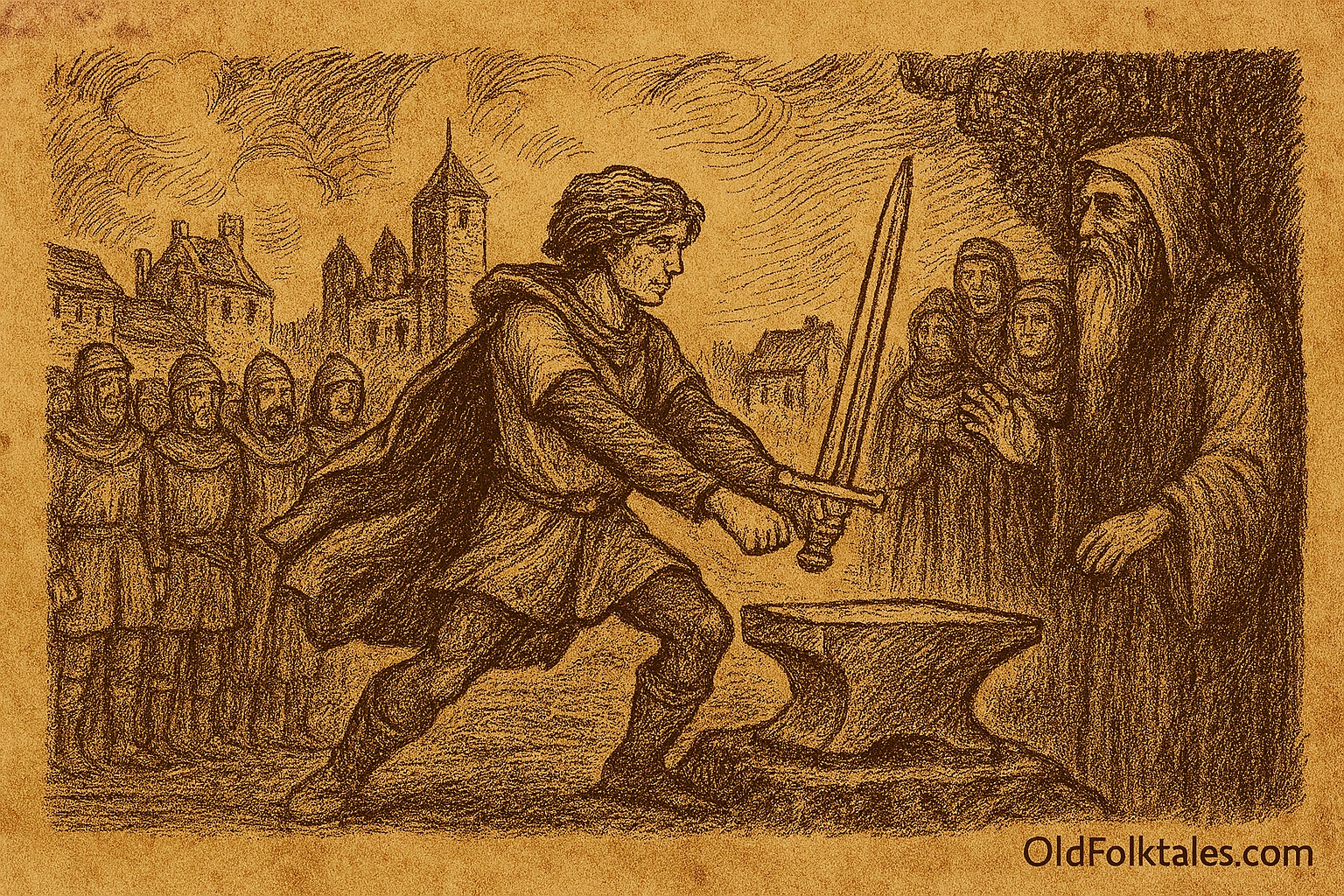
The day of revelation came without fanfare or ceremony. In the churchyard of London stood an anvil, and thrust deep within its iron heart was a magnificent sword, its blade gleaming even in the grey British dawn. Upon the stone were inscribed words that had frustrated every nobleman in the land: “Whoso pulleth out this sword of this stone and anvil is rightwise king born of all England.” Knights and lords had tried and failed, their pride wounded as deeply as their straining muscles. Some claimed it was sorcery; others muttered it was an impossible test.
Young Arthur, attending his foster brother Kay as a squire at a tournament, found himself in need of a sword. Almost absently, without understanding the weight of the moment, he grasped the hilt of the sword in the stone and drew it forth as easily as one might pluck a flower from soft earth. The blade sang as it cleared the anvil, this was Excalibur, the sword of kings. When the lords and ladies witnessed this miracle, they fell to their knees. The prophecy had been fulfilled. The rightful king had come.
Thus began the golden age of Camelot. Arthur built his court not as a place of hierarchy and dominance, but as a fellowship of equals. He commissioned a great Round Table, where no knight sat above another, where valor and virtue mattered more than birth or title. To this table came the greatest warriors and noblest hearts of the age: Sir Lancelot of the Lake, whose sword arm was unmatched in all of Christendom; Sir Gawain, Arthur’s own nephew, strong and loyal; Sir Percival, pure of spirit; and many others whose names would echo through the centuries.
Under Arthur’s wise rule, guided by Merlin’s counsel, Britain knew peace and prosperity. The king ruled with justice and mercy, defending the weak and punishing the wicked. His knights rode forth on noble quests, the greatest of which was the search for the Holy Grail, the sacred cup from which Christ drank at the Last Supper. This vessel, said to grant divine favor and healing to the pure of heart, became the symbol of their highest aspirations, the embodiment of the spiritual ideals that elevated Camelot above mere military might.
But even in paradise, serpents lurk. The rot began subtly, with glances that lingered too long, with honor tested by forbidden desire. Sir Lancelot, Arthur’s greatest knight and most trusted friend, fell deeply in love with Queen Guinevere, Arthur’s beloved wife. She, too, could not resist the pull of her heart. Their secret love affair, when finally revealed, shattered the perfect harmony of Camelot like a stone through glass. The fellowship of the Round Table, built on trust and honor, fractured along fault lines of loyalty and betrayal.
In this moment of weakness, darkness found its opening. Mordred, Arthur’s own son born of an unwitting, tragic union with his half-sister seized his chance for power. Bitter and ambitious, Mordred raised an army and challenged his father for the throne. Pride, betrayal, and the weight of past sins converged in a perfect storm that would sweep away everything Arthur had built.
The final confrontation came at Camlann, a battlefield that would be forever stained with tragedy. Father and son met in single combat, surrounded by the bodies of fallen knights and shattered dreams. Arthur’s blade found its mark, piercing Mordred’s treacherous heart, but not before the usurper dealt his father a mortal wound. As Arthur fell, the age of chivalry died with him.
Yet death was not the end. Three mysterious queens appeared, their barge draped in mist, and bore the dying king across dark waters to Avalon, the mystical isle beyond mortal reach. There, legends say, Arthur sleeps still, his wounds tended by ancient magic, waiting for the day when Britain faces its darkest hour and needs him once more. For he is not merely a king who was he is the Once and Future King, whose return has been promised when hope seems lost forever.
The Moral Lesson
The legend of King Arthur teaches us that true leadership springs not from birthright or force, but from virtue, humility, and the courage to serve others. It reminds us that even the greatest fellowship can be undone by betrayal and unchecked passion, and that the consequences of our choices both noble and flawed ripple through generations. Yet it also offers eternal hope: that goodness, once planted in the world, never truly dies but waits to bloom again when most needed.
Knowledge Check
Q1: Who was Merlin and what role did he play in Arthur’s life? A: Merlin was a powerful wizard who served as Arthur’s guardian and advisor. He orchestrated Arthur’s secret upbringing away from court to protect him from enemies, guided his education in virtue and wisdom, and counseled him throughout his reign as king of Britain.
Q2: What was the significance of the Round Table in Camelot? A: The Round Table symbolized equality and fellowship among Arthur’s knights. Its circular shape meant no knight sat at the head, representing Arthur’s vision of a court where valor and virtue mattered more than rank or birthright, and where all nobles met as equals in service to justice.
Q3: What was the Holy Grail and why did the knights quest for it? A: The Holy Grail was the sacred cup used by Christ at the Last Supper. It represented divine favor, spiritual purity, and healing. The quest for the Grail symbolized the knights’ pursuit of their highest spiritual ideals and the ultimate test of their worthiness and purity of heart.
Q4: How did Sir Lancelot’s relationship with Queen Guinevere affect Camelot? A: Lancelot’s forbidden love affair with Queen Guinevere shattered the trust and harmony that held Camelot’s fellowship together. When their secret romance was revealed, it fractured the brotherhood of the Round Table, creating divisions based on betrayal and conflicting loyalties that ultimately weakened the kingdom.
Q5: Who was Mordred and why did he betray King Arthur? A: Mordred was Arthur’s illegitimate son, born from a tragic, unwitting union with Arthur’s half-sister. Bitter and ambitious, Mordred exploited Camelot’s weakened state after the Lancelot-Guinevere scandal to raise an army and challenge his father for the throne, leading to the final, fatal battle at Camlann.
Q6: What does the legend of Arthur’s journey to Avalon represent? A: Arthur’s journey to the mystical isle of Avalon represents the enduring nature of hope and heroic virtue. The legend that he sleeps there, healing and waiting to return in Britain’s darkest hour, symbolizes the belief that true goodness never dies but remains dormant, ready to awaken when most desperately needed.
Source: Adapted from Geoffrey of Monmouth’s Historia Regum Britanniae
Cultural Origin: Medieval British/Celtic mythology, Arthurian Legend tradition, Britain (England and Wales)






