In the time when the world was still young, and the boundary between the living and the dead remained thin as morning mist, there existed a realm far beneath the earth, a place of darkness, trial, and terror known as Xibalba, the Place of Fright. This underworld was no mere land of the dead but a kingdom of twisted power, ruled by lords whose very names invoked dread in the hearts of mortals.
At the pinnacle of this nightmarish hierarchy sat two supreme rulers: Hun-Came, whose name meant One Death, and Vucub-Came, whose name meant Seven Death. These were no ordinary death gods. They were cunning, prideful beings who delighted in the suffering of mortals and who commanded legions of lesser lords, each specializing in different forms of torment and disease. Together, they maintained absolute dominion over Xibalba’s dark corridors, its rivers of corruption, and its halls of deception.
The underworld itself was a labyrinth of horrors. Its paths twisted and turned through absolute darkness, lit only by the faint phosphorescence of decay. Rivers of blood flowed thick and red through carved channels in the stone, their surfaces rippling with an unnatural current. Nearby ran rivers of pus, yellow-green and reeking, their poisonous vapors rising in choking clouds. The very air in Xibalba tasted of death metallic and sweet, heavy with the weight of countless souls who had entered but never returned.
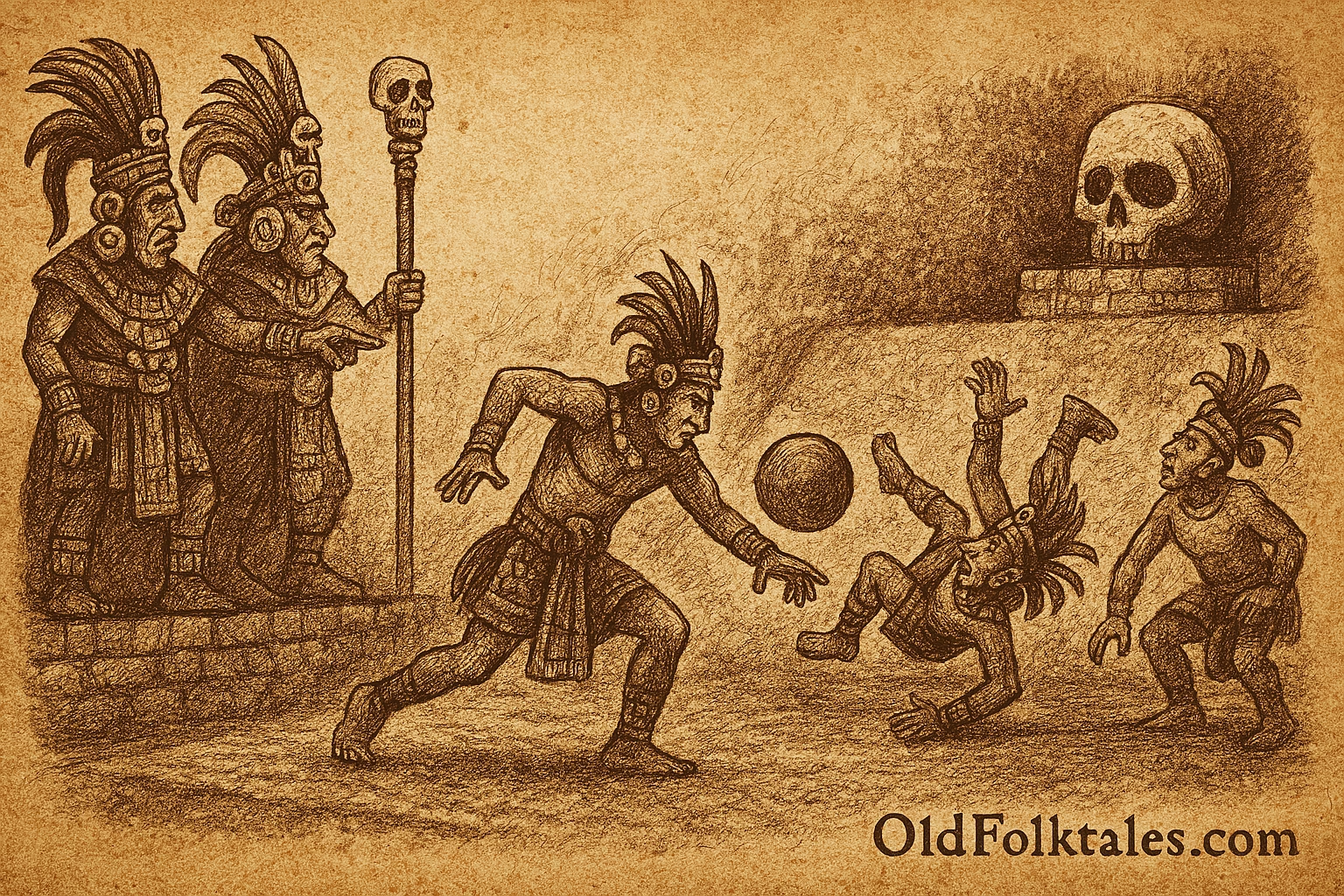
Above this realm of shadows, on the surface of the earth where the sun still shone and the maize still grew, humans lived their lives in the light. Among them were ballplayer’s athletes who engaged in the sacred ballgame, the ancient Maya sport that was more than mere entertainment. The ballgame was cosmic drama, a ritual battle between opposing forces, played on courts that represented the threshold between worlds.
The sound of this game was distinctive and powerful. The heavy rubber ball made from the sap of trees, solid and weighty struck the stone courts with deep, resonant thuds that echoed across the landscape. The players, protected by thick padding around their hips and torsos, threw themselves at the ball with fierce dedication, keeping it aloft using only their bodies, never their hands or feet. Each impact sent shockwaves through the ground. Each bounce created a rhythm that pulsed like a heartbeat.
And far below, in the depths of Xibalba, One Death and Seven Death heard that sound.
At first, it was barely perceptible a distant thumping, a vibration that traveled through layers of earth and stone to reach the throne room of the death lords. But as the players above grew more skilled, more passionate in their game, the sound grew louder. The rhythm intensified. The very ceiling of Xibalba began to shake with each thunderous impact of ball against stone.
One Death’s face twisted with rage. His skeletal features contorted as dust fell from the cavern ceiling above his throne. “What is this noise?” he hissed, his voice like wind through a tomb. “What mortal dares disturb the peace of Xibalba?”
Seven Death rose from his seat, his robes of darkness swirling around him. “They play their game directly above us!” he spat. “They pound and crash and make their sport, with no thought for the lords beneath their feet. They show us no respect!”
The other lords of Xibalba gathered around Flying Scab, Gathered Blood, Bone Scepter, Skull Scepter, and all the others who delighted in bringing disease, injury, and suffering to humankind. They murmured among themselves, their anger building like storm clouds gathering on a dark horizon.
“This cannot stand,” One Death declared, his voice carrying the weight of absolute authority. “These mortals must be taught their place. They must learn that death is not to be disturbed, that the lords of Xibalba are not to be mocked by the trivial games of the living.”
Seven Death smiled, a terrible expression on his death’s-head face. “Summon them,” he commanded. “Let messengers be sent to the surface. Let these ballplayers be invited to Xibalba to play their game in our court, under our rules, where we shall see how skilled they truly are.”
The command was given, and messengers were dispatched four owls, creatures of darkness and death, who flew up through the hidden passages that connected the underworld to the world above. They emerged in the twilight, their eyes gleaming yellow, their wings silent as they glided toward the ballplayers’ homes.
When the owls arrived, they spoke with the authority of the death lords themselves. “One Death and Seven Death, the supreme rulers of Xibalba, command your presence,” they intoned. “You are summoned to the underworld to play ball in the court of the dead. You are to bring your equipment your rubber ball, your protective gear, all the tools of your game. You will face the lords themselves in the ultimate contest.”
To refuse such a summons was impossible. The ballplayers, though their hearts filled with dread, knew they had no choice. They gathered their equipment, embraced their families perhaps for the last time, and followed the owl messengers down, down, down into the earth.
The descent into Xibalba was a journey into nightmare. The path twisted through caverns where no light had ever shone, where the air grew cold and damp, where water dripped endlessly from unseen heights. The ballplayers stumbled in the darkness, guided only by the dim shapes of the owls ahead.
Then they reached the first river a torrent of blood, dark and thick, flowing with a sluggish current that seemed to pulse with the heartbeats of the dying. The stench was overwhelming. The ballplayers had to wade through it, the liquid rising to their chests, warm and viscous, clinging to their skin and clothes.
Beyond the river of blood lay the river of pus, even more horrifying. Its yellow-green surface bubbled and popped, releasing noxious gases that burned the lungs and made the eyes water. The ballplayers covered their faces as best they could and pushed forward, their stomachs churning with revulsion.
Finally, they emerged into a great hall. But this was no ordinary chamber. It was the House of Gloom, a place of absolute darkness where walls, floor, and ceiling were indistinguishable, where even sound seemed muffled and distant. The hall was filled with invisible obstacles sharp stakes, hidden pits, low-hanging beams all designed to wound and confuse visitors who could not see where they were going.
At the far end of this treacherous space sat wooden figures on thrones, carved and painted to resemble lords. “Greet the lords!” a voice commanded from the darkness.
The exhausted ballplayers, relieved to have survived the rivers, bowed low before these figures. “Great lords of Xibalba,” they said respectfully, “we have come as summoned.”
Immediately, the darkness erupted with cruel laughter. The wooden figures remained motionless they were merely statues, decoys to fool the arrogant living. The real lords sat hidden in the shadows, watching with delight as the mortals humiliated themselves by showing respect to carved wood.
“Fools!” One Death’s voice rang out. “You cannot even recognize the lords of Xibalba from mere decorations! You have already failed the first test!”
What followed was a series of impossible trials. The ballplayers were led to a bench and invited to sit but the bench was a heated stone that burned their flesh. They were given torches and cigars and told to keep them lit through the night without consuming them an impossible task. Each test was designed not to measure skill but to ensure failure, to humiliate and destroy these mortals who had dared disturb the peace of the underworld with their game.
When the ballplayers inevitably failed, One Death and Seven Death passed their judgment. There would be no game, no fair contest. The death lords had never intended to play fairly. They ordered the ballplayers seized and executed, their bodies torn apart by the servants of Xibalba.
But death was not the end of the humiliation. One Death took the head of one of the players and commanded that it be placed in the crook of a tree by the road a trophy, a warning, a testament to the power of the lords of Xibalba. The skull hung there, gleaming white in the dim light of the underworld, its empty eye sockets staring at all who passed.
And yet, something miraculous happened. The tree had been barren before, but when the skull was placed among its branches, it suddenly burst into fruit round, white calabash gourds that hung heavy on every limb. The skull itself seemed to merge with the tree, indistinguishable from the fruit that surrounded it.
The lords of Xibalba decreed that no one should approach this tree or taste its fruit, for it was tainted with death. But they could not stop what they had set in motion. The ballgame, which had once been merely sport, was now forever transformed linked eternally with death, with sacrifice, with the cosmic struggle between the world above and the world below.
From that day forward, every ballcourt became a threshold between worlds. Every game became a ritual reenactment of this first terrible summons, a reminder that life and death are intertwined, that the lords below are always listening, always watching, always ready to challenge those who dare to live too loudly, too proudly in the light above.
Click to read all Myths & Legends – timeless stories of creation, fate, and the divine across every culture and continent
The Moral of the Story
The tale of the Lords of Xibalba and the first ballplayers teaches profound lessons about hubris, respect for cosmic forces, and the nature of the sacred game. The ballplayers’ greatest mistake was not the noise they made but their failure to recognize that their actions had consequences beyond the physical world that the boundaries between life and death, earth and underworld, were thinner than they imagined. The story emphasizes the Maya understanding that the ballgame was never merely entertainment, but a sacred ritual connected to cosmic balance, sacrifice, and the eternal struggle between opposing forces. The death lords’ trickery reveals that the underworld operates by different rules, where deception and trial are the norm, and mortals must approach such realms with humility and wisdom.
Knowledge Check
Q1: Who were One Death and Seven Death in Maya mythology?
A: One Death (Hun-Came) and Seven Death (Vucub-Came) were the supreme rulers of Xibalba, the Maya underworld. They were powerful death gods who commanded other lords of disease and suffering, and they governed the realm of the dead with cunning, cruelty, and deception.
Q2: Why did the Lords of Xibalba summon the ballplayers to the underworld?
A: The death lords were enraged by the loud noise of the ballgame being played on the earth’s surface above Xibalba. The constant pounding and bouncing of the heavy rubber ball disturbed their peace and they saw it as disrespectful, so they summoned the players to punish them for their disruption.
Q3: What deadly obstacles did travelers face when entering Xibalba?
A: Those who descended into Xibalba had to cross a river of blood and a river of pus, then navigate through the House of Gloom, a hall of absolute darkness filled with invisible obstacles like sharp stakes, hidden pits, and low-hanging beams designed to wound and confuse visitors.
Q4: How did the Lords of Xibalba trick the ballplayers in the House of Gloom?
A: The death lords placed wooden carved figures on thrones to impersonate themselves. When the ballplayers respectfully greeted these statues as if they were the real lords, the actual lords hidden in the shadows mocked them for being unable to distinguish wood carvings from divine beings, declaring they had failed the first test.
Q5: What happened to the ballplayers’ remains after their execution?
A: After executing the ballplayers, One Death commanded that one player’s head be placed in a barren tree by the road as a trophy and warning. Miraculously, the tree burst into fruit white calabash gourds and the skull merged with the branches, becoming indistinguishable from the fruit surrounding it.
Q6: What cultural significance did this story have for the Maya ballgame?
A: This myth transformed the ballgame from mere sport into sacred ritual. It established the ballcourt as a threshold between the world of the living and the underworld, and made every game a cosmic reenactment of the struggle between life and death. For the Maya, playing ball became a profound religious act connected to sacrifice, cosmic balance, and the journey between worlds.
Source: Adapted from the Popol Vuh, Book I, translated by Dennis Tedlock (Simon & Schuster, 1985).
Cultural Origin: K’iche’ Maya, Guatemala (story known throughout Maya regions including Belize, Mexico, and Honduras)