
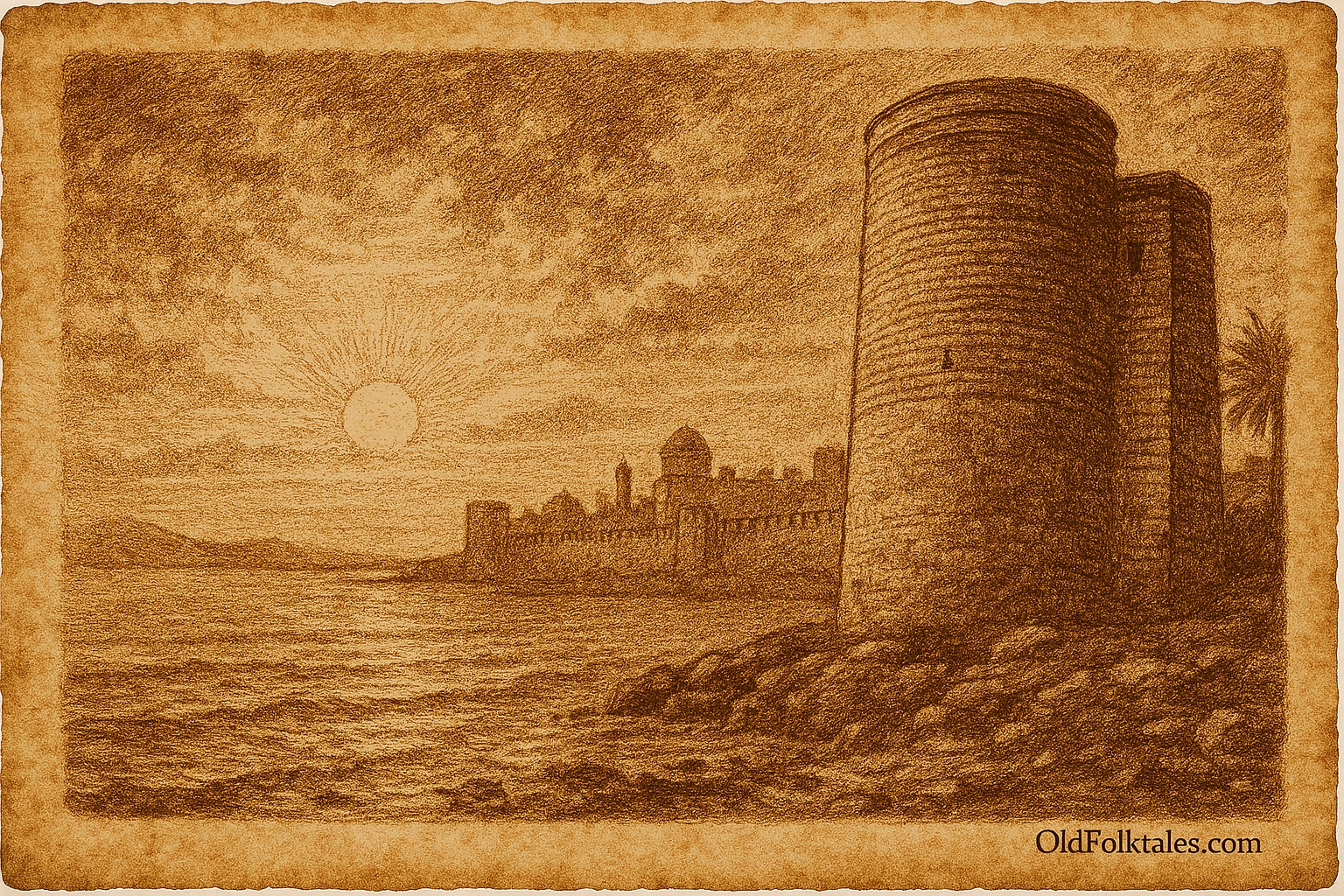
In the ancient city of Baku, where the wind carries salt from the Caspian Sea and the sun sets like fire over endless waters, there stands a tower of stone that has watched over the harbor for centuries. The locals call it Qiz Qalası the Maiden Tower, and though its origins are lost to time, every child in Azerbaijan grows up hearing the tragic tale of why it bears this name.
Long ago, when powerful khans and the Silk Road ruled Baku brought merchants from distant lands, a king resided in a palace overlooking the sea. He was a man of great wealth and influence, respected by neighboring rulers and feared by his enemies. His palace was filled with treasures from Persia, carpets from distant kingdoms, and golden vessels that caught the light like captured sunshine. But his greatest treasure, the one thing he valued above all his riches, was his daughter.
The princess was renowned throughout the land for her beauty and grace. Her eyes were dark as midnight, her voice like the sweetest music, and her spirit as free as the seabirds that danced above the waves. She spent her days in the palace gardens, reading poetry, playing the tar a traditional stringed instrument and gazing out at the Caspian Sea, dreaming of the world beyond the palace walls.
As the princess grew into womanhood, suitors came from every corner of the realm. Princes arrived with caravans laden with gifts, wealthy merchants offered fortunes, and warriors boasted of their conquests. But the king turned them all away. He claimed none were worthy of his precious daughter, that no man could ever deserve such a jewel. The princess, meanwhile, showed no interest in marriage, content with her books and her music and her freedom.
Then something terrible began to stir in the king’s heart. Day by day, his love for his daughter twisted into something dark and unnatural. The more he looked upon her, the more his reason fled and madness took its place. Finally, consumed by an obsession that defied all law and morality, the king made a decision that would bring shame upon his house forever.
He summoned his daughter to his throne room. The princess entered, expecting perhaps news of state matters or another rejected suitor. Instead, her father spoke words that turned her blood to ice.
“My daughter,” the king declared, “I have decided. You will marry and your husband shall be me.”
The princess stood frozen, unable to believe what she had heard. This was forbidden by every law, condemned by every faith, an abomination that would bring disgrace upon their entire lineage. Horror, revulsion, and despair crashed over her like waves against rocks.
“Father,” she whispered, her voice trembling, “what you ask is impossible. It is against the laws of God and man. It is a sin that would curse us both forever.”
But the king, lost to madness, would not hear reason. He had convinced himself that his desire was love, that his power gave him the right to anything he wished. “I am the king,” he proclaimed. “My word is law. You will obey.”
The princess fled to her chambers, her mind racing with terror. There was no one to help her the king’s word was absolute, and who would dare challenge their ruler? She could not flee the city; guards watched every gate. She could not seek help from neighboring kingdoms; by the time any message arrived, it would be too late. She was trapped, with no escape from the horror that awaited her.
That night, as she lay sleepless, a desperate idea came to her. If she could not refuse outright, perhaps she could delay. Perhaps, in time, her father’s madness would pass, or perhaps fate would intervene to save her.
The next morning, she returned to the throne room. The king looked upon her eagerly, expecting her submission.
“Father,” the princess said, her voice steady despite the terror in her heart, “if you truly love me as you claim, if your desire is sincere, then I ask one thing before I give you my answer.”
“Anything,” the king said quickly. “Name it, and it shall be yours.”
“Build me a tower,” she said. “Build it here, overlooking the sea a tower so tall and magnificent that it touches the very sky. Build it of the finest stone, make it strong enough to withstand any storm, make it beautiful enough to be remembered for a thousand years. When it is complete, I will climb to the top, and there I will give you my answer.”
The king, blind to her true intention, agreed immediately. He summoned the finest architects and stonemasons in the land. Hundreds of workers labored day and night, quarrying limestone, hauling massive blocks, fitting each stone with perfect precision. The tower rose slowly, month after month, growing taller and taller until it dominated the Baku skyline. Its walls were thick and strong, its design elegant and mysterious, tapering slightly as it climbed toward the clouds.
During those long months of construction, the princess walked the palace in a daze, like a ghost haunting her own life. She watched the tower grow, knowing that with each stone laid, her fate drew closer. She prayed to heaven for deliverance, but no miracle came. She considered a hundred plans of escape, but each was impossible. The tower became both her hope and her doom the thing that delayed her nightmare, and the thing that would end it.
Finally, after nearly a year of construction, the tower was complete. It stood tall and proud on the rocky shore, its uppermost platform seeming to touch the sky itself, just as the princess had requested. The king sent word: “The tower is finished. Come give me your answer.”
The princess dressed in white, like a bride preparing for a wedding or like a soul preparing for judgment. She walked slowly through the city streets toward the tower, the people watching in silence, sensing that something momentous and terrible was about to unfold. She entered the tower and began to climb the spiral staircase within, her footsteps echoing in the stone chamber.
Up and up she climbed, past window after window, each one offering a glimpse of the world outside the bustling city, the palace where she had lived, the mountains in the distance. Finally, she reached the top platform, open to the sky and wind. Before her stretched the vast Caspian Sea, its waters deep blue and endless, waves rolling toward the shore in eternal rhythm.
The princess stood at the edge and looked down. Far below, she could see the rocks and the water. She could see the king and his court gathered, waiting for her decision. She looked up at the sky, so clear and infinite, and whispered a final prayer.
“Forgive me,” she said to the heavens. “But I choose honor over life, death over shame.”
And then, with her white robes billowing like wings, she threw herself from the tower into the sea below.
The king’s cry of anguish echoed across the water. He rushed to where his daughter had fallen, but it was too late. The sea had claimed her, and with her died the king’s mad dreams. Grief and guilt consumed him, and he was never the same. The tower he had built as a monument to his desire became instead a monument to his daughter’s courage and sacrifice.
From that day forward, the tower was known as the Maiden Tower Qiz Qalası, a reminder that no power, no matter how great, has the right to violate the sacred bonds of family and morality. The princess’s death was not in vain; it protected her honor and stood as an eternal warning against tyranny and forced marriage.
Today, the Maiden Tower still stands in old Baku, a UNESCO World Heritage site, its stones weathered by centuries of wind and salt spray. Visitors climb its spiral stairs and stand where the princess once stood, looking out over the same sea that received her final sacrifice. And the people of Azerbaijan still tell her story, remembering the maiden who chose death over dishonor, who proved that the human spirit cannot be conquered, even by kings.
Click to read all Myths & Legends – timeless stories of creation, fate, and the divine across every culture and continent
The Moral Lesson
The legend of the Maiden Tower teaches that personal honor and moral integrity are worth more than life itself when faced with profound injustice. The princess’s tragic choice demonstrates the ultimate resistance against abuse of power and the violation of sacred boundaries. Her sacrifice stands as a timeless warning against tyranny, forced marriage, and the corruption that comes from unchecked authority. The story emphasizes that true strength lies not in submission to power, but in the courage to resist wrong even at the ultimate cost and that such courage can create monuments that outlast empires, inspiring future generations to defend their dignity and freedom.
Knowledge Check
Q1: What is the Maiden Tower of Baku and why is it significant in Azerbaijani culture?
A: The Maiden Tower (Qiz Qalası) is an ancient stone structure in old Baku, Azerbaijan, overlooking the Caspian Sea. It is significant as both a UNESCO World Heritage site and the subject of a legendary tale about a princess who chose death over dishonor. The tower symbolizes resistance against tyranny, forced marriage, and the abuse of power, making it an important cultural monument in Azerbaijan.
Q2: Why did the king in the Azerbaijani legend want to build the tower?
A: In the legend, the king built the tower because his daughter requested it as a condition before giving her answer to his forbidden marriage proposal. The princess asked for a tower “so tall it touches the sky,” hoping to delay the terrible fate that awaited her. The king, blinded by his obsession, agreed and spent months constructing the magnificent tower overlooking the Caspian Sea.
Q3: What did the princess’s request for the tower symbolize in this Asian legend?
A: The princess’s request for the tower symbolized her desperate attempt to buy time and delay an inevitable horror. It represented her intelligence and resourcefulness in the face of impossible circumstances using her father’s obsession against him to create space for hope or intervention. The tower became a physical manifestation of the time between her nightmare and its conclusion.
Q4: Why did the princess throw herself from the Maiden Tower in the Azerbaijani tale?
A: The princess threw herself from the tower to escape her father’s forbidden and shameful marriage proposal, which violated all moral, religious, and social laws. Faced with a choice between dishonor and death, she chose to sacrifice her life to preserve her honor and integrity. Her suicide was an act of ultimate resistance against tyranny and the abuse of parental power.
Q5: What does the Maiden Tower legend teach about forced marriage and abuse of power?
A: The legend teaches that forced marriage, especially when combined with abuse of power, is a profound violation of human dignity that can lead to tragedy. It demonstrates that no authority not even a king or parent has the right to violate sacred moral boundaries. The princess’s sacrifice serves as an eternal warning against tyranny and a reminder that true power cannot conquer the human spirit’s commitment to honor and integrity.
Q6: How is the Maiden Tower remembered in modern Azerbaijan?
A: The Maiden Tower is remembered as a UNESCO World Heritage site and one of Azerbaijan’s most important cultural monuments. It stands in old Baku overlooking the Caspian Sea, attracting visitors who climb its stairs and hear the tragic legend. Azerbaijanis continue to tell the princess’s story as a cautionary tale about tyranny, forced marriage, and the importance of personal honor, keeping the legend alive across generations.
Source: Adapted from Azerbaijani folklore and oral traditions
Cultural Origin: Baku, Azerbaijan, South Caucasus Region of Western Asia






