
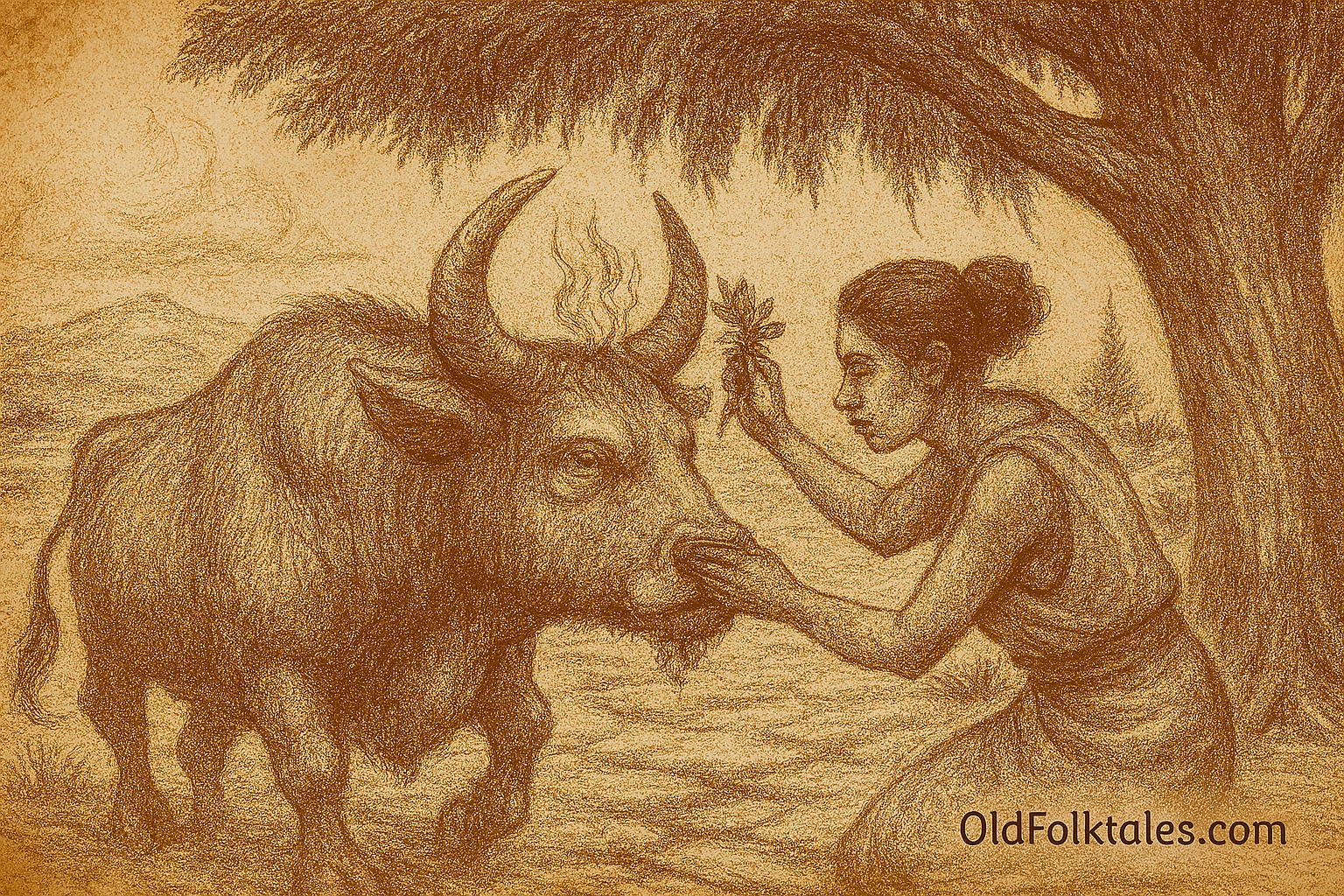
The land lay cracked and gasping beneath an unforgiving sun. Day after endless day, the sky stretched blue and empty above the parched earth of Africa. The clouds that once brought life-giving rain now drifted far overhead, distant and indifferent to the suffering below. Fruit withered on brittle branches before it could ripen. The grazing animals grew thin, their ribs showing through dusty hides as they searched desperately for fodder. The water holes had become nothing more than circles of dried mud, cracked like old pottery.
It seemed the heavens had forgotten the people entirely.
But high above in those distant clouds, the rain itself was watching. As an unseen force that moved between sky and earth, the rain could sense the world below in ways mortals could not imagine. One day, carried on a warm updraft, the rain caught the scent of something that made him pause the enticing fragrance of a young woman from one of the villages below.
Click to read all Myths & Legends – timeless stories of creation, fate, and the divine across every culture and continent
Curious, the rain looked down through the haze of heat and distance. There she was: a woman whose skin gleamed like wet stone after a storm, whose hair was as dark as berries heavy with morning dew. In that moment, desire seized the rain, and he forgot his purpose. He no longer thought of quenching the thirsty earth. He thought only of her.
The rain was no ordinary element he possessed consciousness, intention, and the power to transform himself. And so he chose a form that would allow him to walk upon the earth: the shape of a magnificent bull, though within that powerful body beat the thoughts and desires of a man.
On a shaft of brilliant lightning, the great Rain Bull descended from the heavens. When his hooves struck the ground, the impact rolled across the land like rumbling thunder. He was enormous and terrifying, a creature of pure elemental power made flesh. He walked with purpose toward the low hut where the young woman lay sleeping, and as he drew near, the very air around him grew thick and misty with his breath, like a cloud heavy with moisture waiting to break.
Inside her hut, the young woman stirred. The sweet, unmistakable smell of rain that precious scent she had nearly forgotten filled her dwelling. She opened her eyes to see an impossible sight: a great bull kneeling before her doorway, his ears laid back, his tail lashing, his forelegs bent in a gesture that seemed almost like courtship.
“Who is this?” she whispered to herself, her heart beating fast. “Is he man or bull?”
The young woman was not one to panic. She recognized that magic was at work here, and magic required a careful response. Thinking quickly, she reached for a bundle of buchu twigs that hung drying in her hut. The aromatic leaves of the buchu plant were known throughout her people for their special properties they soothed, they calmed, they carried a magic all their own. Perhaps, she reasoned, they might have a calming effect on this strange Rain Bull.
Moving deliberately, she gathered up her kaross a soft cloak made of carefully prepared animal skin and wrapped it around her body, tying it securely. As the Rain Bull approached, she could smell the overwhelming scent of bull sweat mixed with raw desire. It was a frightening smell, primal and demanding.
When he came close enough, she pressed a sprig of buchu firmly against the hard space between his curving horns and pushed with all her strength, trying to force him back.
The Rain Bull would not be moved so easily. He stamped his massive hoof, and the earth beneath them rumbled with thunder that echoed across the dry plains. His intention was clear: he wanted to take her away with him, to claim her for his own. But just as clear was the fact that she did not wish to go. His eyes, dark and clouded as a storm, fixed upon her.
Yet something was beginning to happen. The strange charm of the buchu was seeping into his consciousness, softening the edges of his desire. He stamped again, but this time with less certainty, shaking his great head as confusion began to cloud his purpose.
The young woman understood her danger. She was wise enough to know that angering such a powerful being could bring disaster not just upon herself, but upon her entire village. Yet somewhere beneath the bull’s frightening form and the man’s burning desire, she caught that sweet scent of rain once more and she knew that any hope of rain, any possibility of water returning to the land, must be welcomed with grace rather than rejected with fear.
So as the Rain Bull stood there, frustrated and uncertain, she made her choice. She smiled at him and climbed onto his broad back.
The Rain Bull began to trot away from the village, and the sound of his hooves striking the dry ground was like the patter of rain on parched earth a sound the people had not heard in far too long. Across the veld he carried her, trotting steadily toward the far distant mountains where the rain was said to come from, where the storm clouds gathered and the lightning was born.
They left behind the worst of the drought the scattered stones, the drifts of parched sand, the cracked earth and eventually she spotted a single kiepersol tree spreading its broad shade leaves in the distance.
“My bones ache from riding on your back,” she called out to the Rain Bull, her voice carrying a note of genuine discomfort. “Wherever it is you are taking me, I shall never be able to please you when I get there if I arrive so bruised and weary. Let me rest a while. There is cool shade beneath that tree. Let us stop there, just for a moment.”
The Rain Bull, perhaps influenced by the lingering effects of the buchu or perhaps by some remaining thread of gentleness, turned toward the kiepersol tree and walked into its welcoming shade. He stopped, and the young woman slipped down from his back with relief.
Hidden beneath the tree’s concealing canopy, she reached under her kaross and drew out another sprig of buchu she had tucked away. The Rain Bull arched his back with pleasure as she began to stroke his neck, though in truth she was rubbing it thoroughly with the aromatic leaves. The fragrant scent crept deep into his nostrils, drowsing his senses like a lullaby.
To her amazement, it was the Rain Bull, not the young woman, who settled down to sleep.
At first, she was frightened by what she had done. What if he awoke angry? What if his fury brought destructive storms instead of gentle rain? She climbed quickly into the branches of the kiepersol tree, seeking safety among the leaves. But as the Rain Bull slept on, breathing deeply and peacefully, her courage slowly returned. Carefully, quietly, she climbed back down and ran as fast as her legs would carry her, back across the veld toward her village.
The Rain Bull awoke in the cool stillness of evening. The harsh scent of bull and the complicated thoughts of man had both faded from his awareness. There was only the fresh, green scent of buchu leaves filling the air. He had forgotten entirely that he had been courting the young woman, forgotten the desire that had brought him down from the sky. Instead, he remembered only what he truly was: rain.
And so it was rain that began to fall, gently at first, then more steadily, upon the thirsty earth. Rain that brought new life to the grazing plants and filled the empty water holes with fresh, clean water. Rain that saved the village and all the creatures of the land.
The people rejoiced, dancing and singing as the precious water fell from the sky at last. Everyone admired the young woman who had somehow brought this blessing. She had not angered the Rain Bull when he wore the thoughts of a man, yet she had not surrendered herself to him either. They looked everywhere for her, wanting to sing her praises and honor her cleverness, but she was nowhere to be found among them.
She was inside her hut, alone, rubbing her body thoroughly with buchu leaves to take away any lingering scent of the bull. She worked until all that remained on her skin was the sweet, clean smell of the rain.
The Moral Lesson
This story teaches us that wisdom and cleverness can triumph over raw power, and that sometimes the best way to handle a dangerous situation is not through direct confrontation but through patience, strategy, and respect. The young woman honored the Rain Bull’s power without submitting to his inappropriate desires, using her knowledge of natural magic to protect herself while still allowing him to fulfill his true purpose. Her actions remind us that preserving dignity and community welfare sometimes requires both courage and cunning, and that understanding the deeper nature of a problem can lead to solutions that benefit everyone.
Knowledge Check
Q1: Who is the Rain Bull in this South African folktale? A: The Rain Bull is the rain itself transformed into the shape of a bull with the thoughts of a man. He descended from the sky on a shaft of lightning after becoming entranced by a young woman’s beauty during a severe drought.
Q2: What is buchu and why is it significant in the story? A: Buchu is a plant with aromatic leaves that possess calming and soothing properties in South African traditional culture. The young woman used buchu strategically to calm the Rain Bull’s aggressive desires and eventually put him to sleep, allowing her to escape while ensuring the rain would return to her drought-stricken land.
Q3: How did the young woman save herself and her village? A: The young woman used wisdom and strategy rather than force. She pressed buchu against the Rain Bull’s forehead to calm him, agreed to ride with him to avoid his anger, then used more buchu to put him to sleep under a kiepersol tree. When he awoke, he had forgotten his desire and returned to his true nature, bringing rain to the parched land.
Q4: What does the kiepersol tree represent in the story? A: The kiepersol tree serves as a place of refuge and transformation in the story. Its shade provided the concealment the young woman needed to use the buchu, and it became the location where the Rain Bull’s transformation from desire-driven being back to his true purpose as rain-bringer occurred.
Q5: What is the cultural meaning behind the Rain Bull story? A: This South African myth explains the natural phenomenon of drought ending and rain returning while teaching important lessons about wisdom, respect for natural forces, and the power of using intelligence over direct confrontation. It reflects how traditional African cultures understood weather patterns through mythological narratives and valued clever problem-solving, especially in women.
Q6: Why did the young woman rub herself with buchu at the end? A: She rubbed herself with buchu to remove any trace of the bull’s scent, symbolically cleansing herself of the encounter while retaining only “the sweet smell of the rain.” This act represents purification and the restoration of proper boundaries between the mortal and elemental worlds, while honoring what was good about the encounter the return of rain.
Source: Adapted from “South African Myths and Legends” told by Jay Heale
Cultural Origin: Indigenous South African Folklore (Khoisan and Bantu traditions)






