In the seasons before memory grew long, in the time when the first footprints were still fresh upon the earth, there came upon the land of the Shona a silence that swallowed hope. The rains, which had fallen faithfully as the rising sun since the world’s beginning, ceased their coming. Day followed merciless day, and the sky hung above like hammered bronze hard, bright, and yielding nothing. The rivers that had sung their way through valleys fell mute, their beds cracking into patterns like broken pottery. The cattle grew thin, their ribs showing like the fingers of clutching hands, and the grain stores that had seemed bottomless began to reveal their dusty floors.
The people gathered in the shadow of their drought, and their voices rose together in lamentation. They called upon Mwari, the High God, the Ancient of Days whose dwelling place was beyond the reach of mortal eyes, whose breath had first stirred life into clay. They burned offerings of what little they could spare. They poured libations upon ground so thirsty it drank the precious water before the liquid could even darken the dust. But the heavens remained closed, and no answer came down from the heights where Mwari kept his eternal watch.
Click to read all Myths & Legends – timeless stories of creation, fate, and the divine across every culture and continent
Among the people lived a man whose name has been worn smooth by the passage of countless tellings, but whose courage remained sharp as the day it was first tested. He was neither chief nor spirit medium, neither the strongest warrior nor the wisest elder. But within his chest beat a heart that refused to accept silence as an answer, and in his mind grew a determination that would not bend beneath the weight of impossible things.
“I will go to the mountain,” he declared before the assembled elders. “I will climb to where the earth touches the sky, and I will call upon the servants of Mwari until one answers or I perish in the attempt.”
The elders spoke words of warning. The sacred mountain was not for common feet to tread. Its slopes were the dwelling place of the Mhondoro the lion spirits who served as intermediaries between the High God and the people below. These were not the lions that roamed the grasslands, but beings of power and ancient authority, carrying within them the souls of great chiefs and the wisdom of ages beyond counting. To approach them unbidden was to court destruction.
But the man’s resolve could not be shaken, for he had seen children too weak to play and heard the silence where songs of planting should have been. At dawn, as the sun climbed into another pitiless sky, he began his ascent.
The mountain rose before him like a judgment. Its lower slopes, once green with life, now lay brown and brittle. As he climbed higher, the vegetation grew sparse, then disappeared entirely, leaving only stone that burned beneath his hands and feet. The air grew thin, and each breath came with effort, as though the mountain itself sought to push him back to the lowlands where he belonged.
For three days and three nights he climbed, sustained by determination alone, for he had brought neither food nor water, believing that if he was meant to succeed, the spirits would provide, and if he was meant to fail, provisions would only delay the inevitable. On the fourth dawn, as he pulled himself over a final outcropping of rock, he found himself upon a plateau that seemed to exist between earth and heaven.
The air here held a different quality thick with presence, heavy with watching. The man steadied himself and raised his voice, calling out in the formal words that even the drought had not made him forget: “O Mhondoro, great spirit who serves the High God, hear the cry of one who speaks for his people! We die of thirst! The children wither! The cattle fall! If we have sinned, teach us our error! If we have forgotten our duties, remind us! But do not let silence be the only answer from the heavens!”
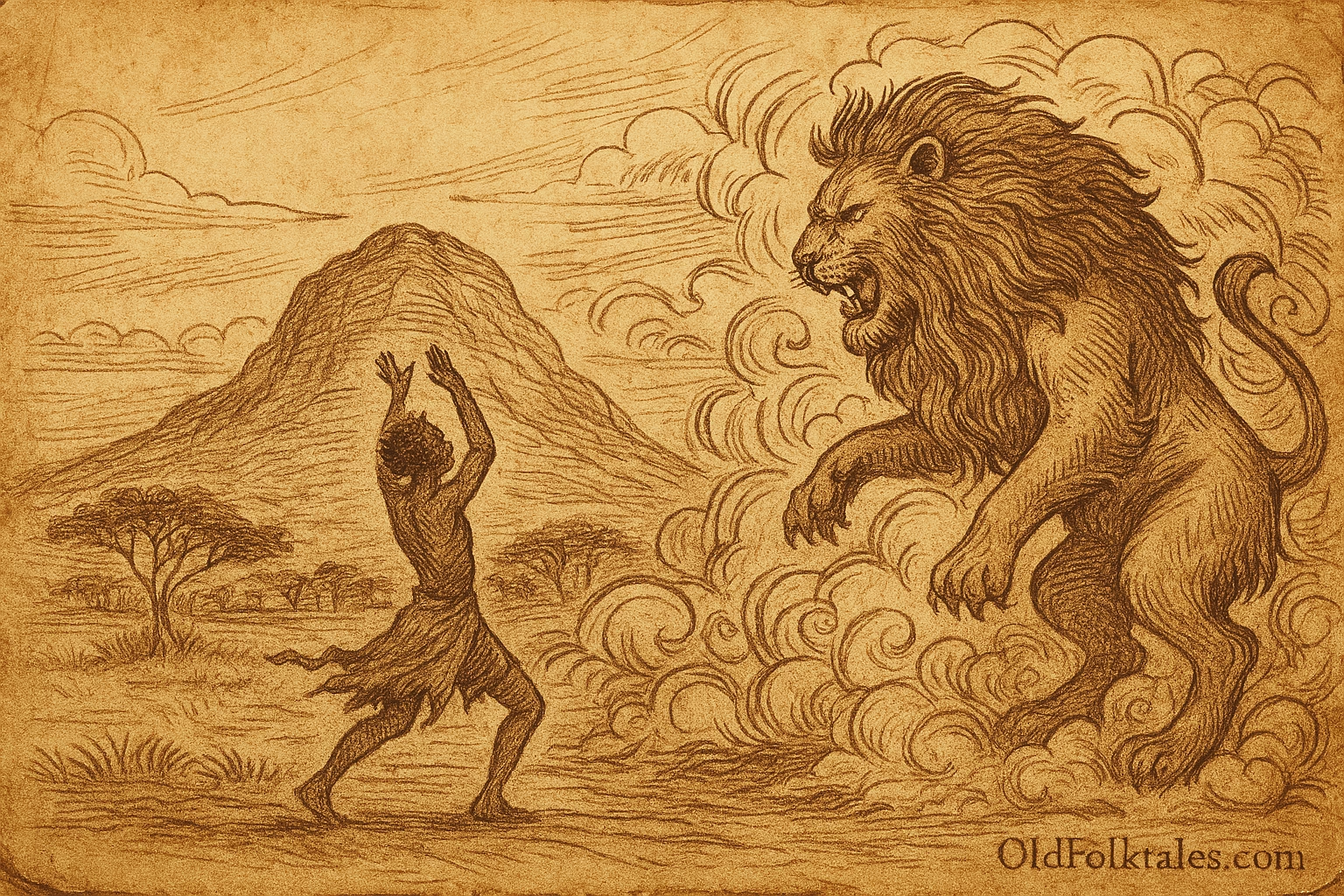
For a long moment, nothing stirred. Then the plateau began to tremble. Clouds gathered from nowhere, boiling up from the rock itself, and within those clouds moved something vast and terrible. The roar that split the air was not the voice of any earthly lion, but something deeper, older, carrying within it the weight of authority that predated human understanding.
The Mhondoro emerged from the cloud and flame part lion, part something that had no name in human language, its eyes holding the amber light of suns that had set before the current sun was born. When it spoke, its voice was the rumble of distant thunder, the first thunder the world had ever heard.
“Brave one,” the spirit intoned, “Mwari has heard your people’s cries. But the rains do not fall because men have forgotten how to call them. In the beginning, there was a song and a dance a way of speaking to the sky in the language it understands. This knowledge was lost when your ancestors grew comfortable and forgot that every gift must be asked for, every blessing acknowledged.”
The Mhondoro then began to move, and its movement was a dance that made the mountains tremble. Its roar became rhythm, and within that rhythm was a pattern that spoke to something deep in the man’s bones. The spirit sang words in a tongue that was older than language, yet somehow the man understood, and as he understood, he learned.
“Watch,” commanded the Mhondoro. “Listen. Learn. This is the rain song. This is the thunder dance. When your people perform it with grateful hearts, the heavens will remember their purpose, and the waters will fall again. But remember the rain is not commanded. It is requested. It is honored. Each storm is Mwari speaking through us, reminding all who live below that life is a gift renewed, not a right assumed.”
The man watched and learned, his body memorizing movements that seemed impossible yet felt ancient and natural all at once. He learned how feet must strike the earth to echo in the sky, how voices must rise and fall like wind through valleys, how hands must shape the air to draw down blessing from above.
When the teaching was complete, the Mhondoro spoke once more: “Go down to your people. Teach them what you have learned. And when the first drops fall, remember every storm carries our voice. Every lightning flash is our signature. The thunder you hear is us, reminding humanity that the bond between earth and heaven must be renewed with each season.”
The spirit dissolved back into cloud and flame, and the man began his descent. He moved swiftly now, as though the mountain itself hastened his journey, and by nightfall he stood again among his people, who had gathered in wonder at his return.
That very evening, beneath the watching stars, he taught them the rain song and the thunder dance. The people formed a circle and began to move as he instructed, their feet striking the earth in the ancient pattern, their voices rising in the primordial words. The rhythm built and built, and as it built, the people felt something stir in the air around them.
The first rumble came from far away the voice of the Mhondoro echoing from the mountain heights. Then the clouds gathered, swift and dark, boiling across the sky with purpose. Lightning wrote bright signatures across the darkness, and thunder rolled across the plains like the roar of celestial lions.
Then the rain came.
It fell in great sheets, soaking the parched earth, filling the riverbeds, washing away the dust of drought. The people danced on, now in joy rather than supplication, their upturned faces streaming with the gift from above. And in every thunderclap, they heard the voice of the Mhondoro, and through that voice, the attention of Mwari himself.
From that day forward, the Shona people have kept the rain song and the thunder dance. Each storm that passes over their land carries within it the roar of the lion spirit and the reminder that the waters of life flow not by chance, but by covenant a bond between earth and heaven that must be honored, renewed, and celebrated with each turning of the seasons.
Author’s Note
This Shona myth beautifully articulates the relationship between humanity and the natural world as one of reciprocal respect rather than dominion or helplessness. The story transforms rain and thunder from mere meteorological phenomena into a form of divine communication a tangible reminder of the covenant between the earthly and spiritual realms. The Mhondoro, as intermediary, represents the Shona understanding that the divine is not distant and unreachable, but accessible through proper knowledge and respectful approach. The myth also emphasizes that blessings must be actively maintained through ritual, gratitude, and remembrance, suggesting that drought comes not from divine caprice but from human forgetfulness. In this framework, every storm becomes both gift and lesson, teaching that relationship with the sacred requires ongoing attention and honor.
Knowledge Check
1. Who is Mwari in Shona religious cosmology? Mwari is the High God, the Ancient of Days and supreme creator deity in Shona belief. He dwells beyond mortal reach but governs all creation and communicates with humanity through intermediary spirits rather than directly.
2. What is a Mhondoro and what role does it serve? A Mhondoro is a lion spirit that serves as an intermediary between Mwari and humanity. These are not ordinary lions but spiritual beings carrying the souls of great chiefs and ancient wisdom, dwelling on sacred mountains and acting as divine messengers.
3. Why had the rains stopped falling on the Shona people? According to the myth, the rains ceased because people had forgotten the original rain song and thunder dance the proper way of requesting and honoring the gift of water. Their ancestors had grown comfortable and stopped actively maintaining the covenant with the divine through ritual.
4. What did the man learn on the sacred mountain? The man learned the ancient rain song and thunder dance from the Mhondoro a specific pattern of movement, rhythm, and vocalization that speaks to the sky in its own language, allowing humans to properly request and honor the gift of rain.
5. What is the significance of thunder in this myth? Thunder is understood as the voice of the Mhondoro speaking from the heights, serving as a reminder with each storm that rain is not automatic but flows from the covenant between heaven and earth. Each thunderclap carries the lion spirit’s roar, calling people to remember their relationship with the divine.
6. What deeper principle about blessings does this story teach? The myth teaches that blessings are not rights to be assumed but gifts to be requested, honored, and actively maintained through ritual and gratitude. It emphasizes reciprocal relationship rather than entitlement humans must participate in sustaining the covenant through remembrance and proper observance to continue receiving divine favor.
Origin: Shona People, Zimbabwe