Long before the island of Timor rose from the waves, before its mountains touched the clouds and its forests whispered with ancient voices, there was only the endless blue expanse of the sea. In those distant times, the spirits moved freely between water and land, and the boundary between kindness and destiny was as thin as morning mist.
In a small coastal village, there lived a boy whose heart was as vast as the ocean itself. He was not wealthy, nor was he the son of a chief or warrior. He was simply a child who saw the world with eyes of compassion, who could not pass by suffering without stopping to help. His mother had taught him that all living creatures deserved respect, that the earth and sea were filled with spirits worthy of honor.
Click to read all Myths & Legends – timeless stories of creation, fate, and the divine across every culture and continent
One day, as the boy walked along the shore searching for shells and driftwood, he came upon a sight that filled him with sorrow. There, stranded on the hot sand far from the water’s edge, lay a crocodile. But this was no fearsome predator. The great reptile was dying, its powerful body weakened by hunger and thirst, its scales dull and cracked from the merciless sun. It had been caught by the receding tide and now lay helpless, too weak even to drag itself back to the sea.
Most people would have run away in fear, or perhaps felt satisfaction at seeing such a dangerous creature rendered harmless. But the boy felt only pity. He looked into the crocodile’s ancient eyes and saw suffering the same suffering any creature feels when death draws near.
“Do not be afraid,” the boy whispered, kneeling beside the massive creature. “I will help you.”
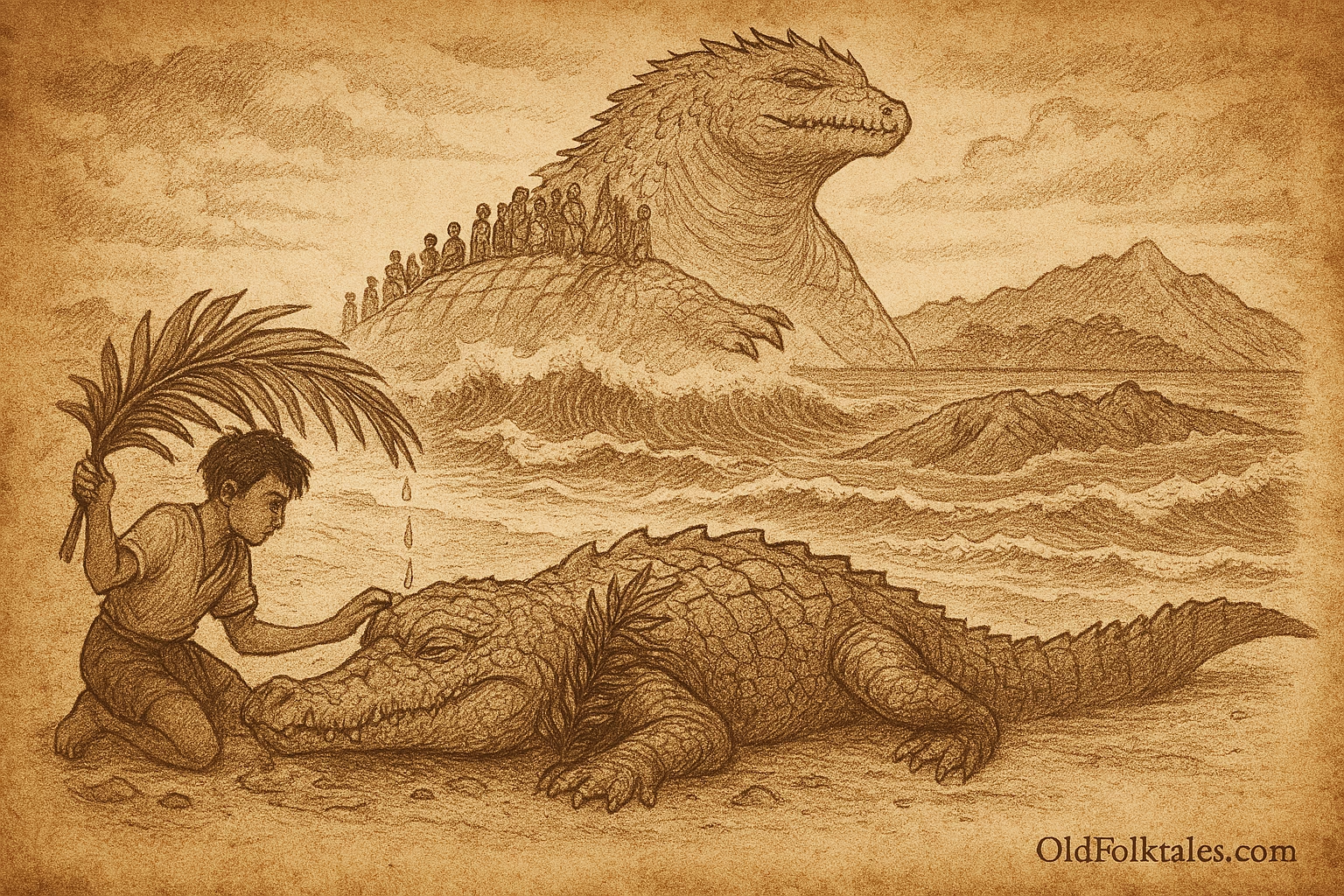
The crocodile could barely move, but something flickered in its gaze recognition, perhaps, or gratitude yet unspoken. The boy knew he could not carry such a large animal alone. Instead, he ran back to his village and gathered palm leaves and cloth. He soaked them in fresh water from the stream and returned to drape them over the crocodile’s body, protecting it from the burning sun.
For three days and three nights, the boy stayed with the dying crocodile. He brought water and poured it gently over the creature’s snout so it could drink. He brought fish from his family’s meager supply and placed them near the crocodile’s jaws. He sang softly to keep the animal calm, the same lullabies his mother had sung to him as a baby. Other villagers thought him foolish, wasting time and food on a beast that would surely die.
But on the fourth morning, a miracle occurred. The crocodile’s eyes, which had been dim and clouded, suddenly brightened. Strength flowed back into its mighty limbs. With the boy’s help, it managed to drag itself across the sand, back toward the welcoming waves. At the water’s edge, it paused and turned its head to look at the boy one final time.
“You have saved my life,” the crocodile spoke, its voice deep and ancient as the ocean floor. “I will never forget your kindness. One day, I will repay this debt.”
Then it slipped beneath the surface and disappeared into the deep blue waters.
Years passed. The boy grew taller and stronger, but he never forgot the crocodile he had saved. He continued to treat all creatures with respect, and he often walked along the shore, gazing out at the sea and wondering if his old friend still swam somewhere in its depths.
Then came a time of great danger. War erupted between neighboring tribes, and the boy’s village found itself under attack. Enemies approached from the land, their weapons gleaming, their intentions deadly. The villagers had no army to defend them, no walls to hide behind. They fled toward the shore, but the sea stretched endlessly before them there was nowhere to run, nowhere to hide.
The boy stood at the water’s edge, his people huddled behind him in fear. He closed his eyes and remembered the crocodile, the promise it had made. Almost without thinking, he called out across the waves: “Old friend, if you can hear me, we need your help!”
The sea began to churn and boil. Waves rose higher and higher, and from the depths emerged the crocodile but it was no longer the dying creature the boy had saved. It had grown enormous, as large as a mountain, its scales gleaming like jade, its eyes burning with ancient power. It was a spirit creature now, transformed by gratitude and bound by sacred promise.
“Climb upon my back,” the crocodile commanded, its voice rumbling like thunder. “All of you. I will carry you to safety.”
The villagers, terrified of both their enemies and the massive creature before them, hesitated. But the boy stepped forward without fear and climbed onto the crocodile’s broad back. Seeing his courage, the others followed men, women, children, and elders, all clambering onto the creature’s vast, scaled surface.
The crocodile began to swim, carrying its precious cargo across the sea. It swam for days and nights, moving steadily through calm waters and stormy waves alike. The boy sat near the creature’s head, speaking softly to it, thanking it for remembering his kindness. The crocodile replied that true friendship transcends time and form, that a debt of gratitude is sacred and eternal.
Finally, they reached a place where the water grew shallow, where coral reefs broke the surface and the sea birds circled overhead. Here, far from the wars and dangers of their old home, the people would be safe. They began to disembark, preparing to build a new life.
But the great crocodile had given everything to this journey. The effort of carrying so many people across such a vast distance, combined with its ancient age, had drained the last of its life force. As the final villager stepped off its back onto the shallow reef, the crocodile spoke one last time to the boy who was now a man.
“I am content,” it said, its voice growing faint. “I have repaid my debt, and more importantly, I have helped my friend. Let my body become your new home. Build your villages upon my back, plant your gardens in my scales, and know that I will always protect you, even in death.”
With those words, the mighty crocodile closed its eyes and breathed its last. But instead of sinking into the ocean, its body began to transform. The scales hardened into rock and soil. The spine rose up to form a mountain range. The legs became peninsulas stretching into the sea. Where there had been a living creature, there now rose a magnificent island, its shape unmistakably that of a great crocodile at rest.
The people wept with gratitude and sorrow. They named their new home Timor, and they built their villages upon the land that had once been their savior’s body. They vowed that crocodiles would forever be sacred, that they would never harm them, for in every crocodile they saw the spirit of their ancestor the ancient one who had sacrificed everything out of gratitude for a small boy’s kindness.
To this day, the island of Timor retains the shape of a crocodile, its mountains forming the spine, its coastline curving like a reptilian body at rest. The people of Timor-Leste honor crocodiles as lafaek, their sacred ancestors, and tell this story to their children so they will remember that kindness returns to us in ways we cannot imagine, and that every act of compassion ripples through time, creating bonds that even death cannot break.
The Moral Lesson
The legend of the boy and the crocodile teaches us that compassion toward all living beings, even those we might fear, creates bonds that transcend time and circumstance. The boy’s selfless act of kindness toward a dying creature was repaid a thousandfold when his people needed help most desperately. This story reminds us that no act of goodness is ever wasted it echoes through the world in unexpected ways. It also teaches respect for nature and all creatures, showing how humans and animals are connected in a sacred web of mutual obligation. Finally, it demonstrates that true gratitude knows no limits and that the greatest sacrifices come from love and loyalty.
Knowledge Check
Q1: What is the significance of the crocodile in Timor-Leste culture?
A1: In Timor-Leste culture, crocodiles are considered sacred ancestors (lafaek) because of this origin legend. They are treated with respect and reverence as the creature whose body became the island itself, protecting the Timorese people.
Q2: How did the boy show compassion to the dying crocodile?
A2: The boy covered the crocodile with wet palm leaves to protect it from the sun, brought it fresh water to drink, fed it fish from his family’s supply, and stayed with it for three days and nights, singing to keep it calm.
Q3: Why did the crocodile grow so large after the boy saved it?
A3: The crocodile transformed into a giant spirit creature, empowered by gratitude and the sacred bond created by the boy’s act of kindness. It grew large enough to carry an entire village on its back to safety.
Q4: How did the island of Timor come into existence according to this legend?
A4: After carrying the villagers to safety across the sea, the ancient crocodile died and its body transformed into the island of Timor its scales became rock and soil, its spine formed mountains, and its body created the island’s distinctive crocodile-like shape.
Q5: What does this legend teach about the relationship between humans and nature?
A5: The legend teaches that humans and nature exist in a sacred relationship of mutual respect and obligation. Acts of kindness toward animals and the natural world create bonds that protect and sustain communities across generations.
Q6: Why does the island of Timor have a crocodile-like shape?
A6: According to the legend, Timor retains the shape of a crocodile because it literally is the transformed body of the great crocodile ancestor who sacrificed itself to save the people, with its spine forming the mountain ranges and its limbs creating the peninsulas.
Source: Adapted from “Lafaek: The Crocodile Legend” preserved in Timor oral tradition archives
Cultural Origin: Timor-Leste (East Timor), Southeast Asia