In the time before memory, when the world was young and the Great Plains stretched endlessly beneath vast skies, the Arikara people were the first to receive the sacred gift of corn. This is the story of how that blessing came to be.
A young hunter from the Arikara tribe set out one morning in search of game to feed his people. His moccasins carried him far across the rolling prairie, through tall grasses that whispered secrets in the wind. As the sun climbed higher in the sky, he came upon a high hill that rose like a watchful guardian above the land.
From the summit, the young man gazed down into a beautiful valley where two rivers met, their waters flowing together in an eternal embrace. There, at the sacred junction where the rivers joined, stood a magnificent buffalo bull alone, powerful, and perfectly still.
Click to read all Myths & Legends – timeless stories of creation, fate, and the divine across every culture and continent
The hunter’s heart quickened with excitement. Buffalo meat would feed many families, and the hide would provide warmth through the coming winter. But as he studied the terrain, searching for an approach that would bring him within bowshot, something else captured his attention. The valley below was breathtakingly beautiful. The riverbanks were low and gentle, lined with cottonwoods and willows whose leaves danced in the breeze. The water sparkled like scattered stars beneath the sun.
Yet there was a problem. The buffalo faced north, and no matter how the young man studied the land, he could find no way to approach without being seen. The animal would surely detect him and flee. So the hunter decided to wait, hoping the buffalo would move closer to the river’s edge or into one of the ravines where bushes and shrubs could conceal his approach.
He waited all day. The sun traced its arc across the endless blue sky, painting the clouds gold and crimson as it descended toward the western horizon. But the buffalo did not move. It stood as still as stone, as if rooted to that very spot.
That night, the young man made a cold camp on the hilltop, not daring to light a fire that might frighten his quarry. He had brought little food with him, expecting a quick hunt. His stomach growled as he lay beneath the stars, feeling sorry that he could not reach the buffalo. Sleep came fitfully, interrupted by hunger and anticipation.
Before dawn broke, the hunter rose and hurried once more to the top of the hill. As the first rays of sunlight painted the eastern sky with rose and gold, he looked down into the valley. The buffalo still stood in exactly the same place but now it faced east, toward the rising sun.
Again, the young man waited. All through that second day, he watched with growing bewilderment as the buffalo remained motionless. It did not graze. It did not walk to the river to drink. It simply stood, facing the east as if in eternal prayer to the morning star.
When the sun set that evening, casting long purple shadows across the valley, the buffalo had not moved a single step.
The hunter’s food was nearly gone now. His belly ached with hunger, but a deeper curiosity had taken hold of his mind. On the third morning, he returned to his vigil. The buffalo stood in the same spot, but now it faced south. Once more, the young man watched through the entire day as the great beast remained absolutely still, never eating, never drinking, never resting.
On the fourth morning, the pattern continued. The buffalo now faced west, toward the setting sun and the land where spirits dwell. The hunter watched all day, his mind churning with questions. Why did the buffalo not move? What kept it standing in that precise location? Surely no ordinary animal behaved this way. The young man began to understand that he was witnessing something sacred, something touched by powers beyond the natural world.
That night, he thought deeply about what he had seen. “Wahkoda must be at work here,” he whispered to the stars. “The Great Mystery is revealing something to me.”
On the fifth morning, the young man rose before dawn and climbed the hill with a sense of destiny pulling at his heart. As sunlight flooded the valley with golden light, he looked down to where the buffalo had stood for four days and four nights.
The buffalo was gone.
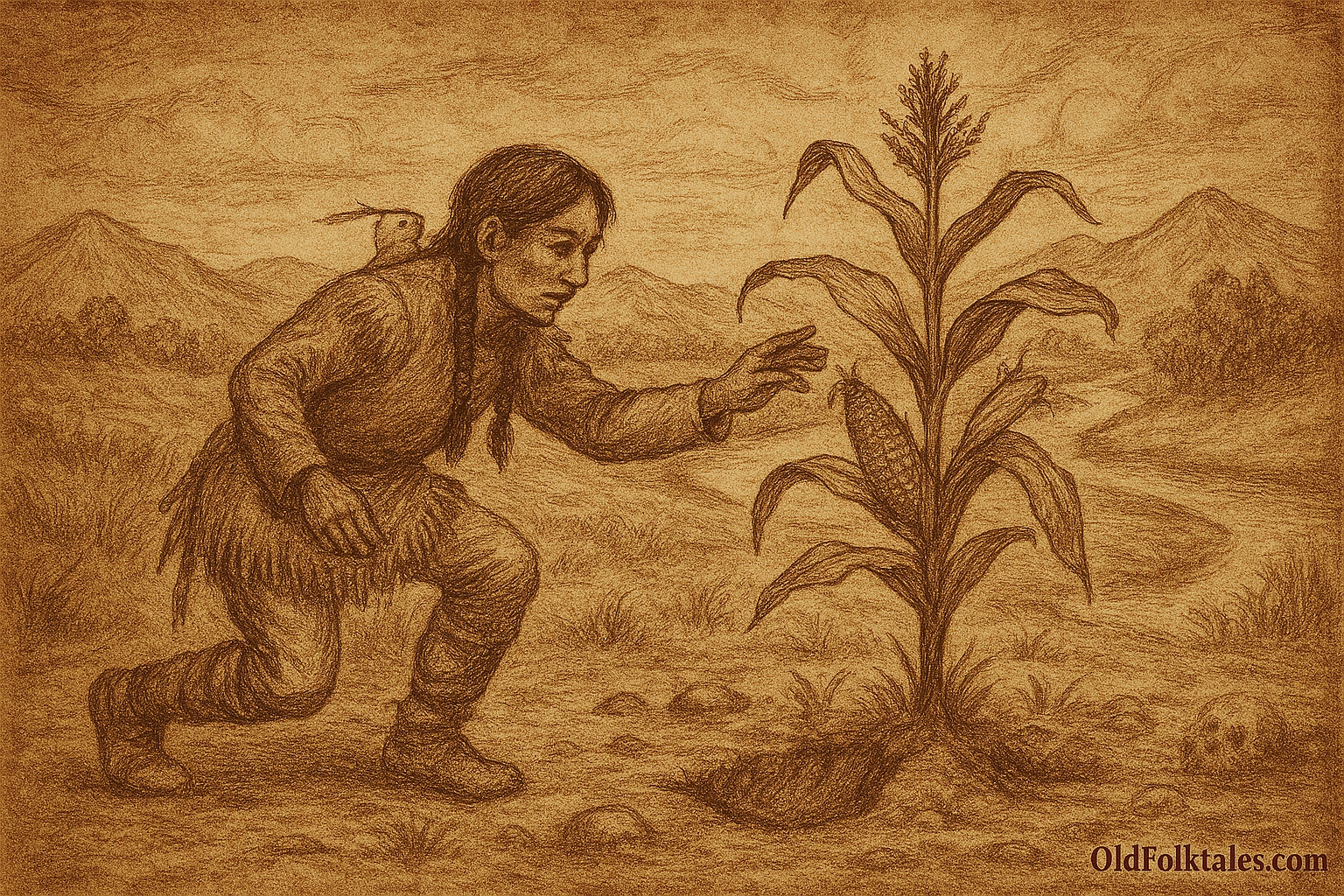
But in its place stood something equally mysterious a strange bush unlike any plant the hunter had ever seen. His heart pounding, he descended into the valley and approached the spot carefully, reverently. When he arrived, he saw it was not a bush at all, but a young plant, green and strong, pushing up from the earth.
He examined the ground carefully. There, clear as day, were the tracks of the buffalo four sets of prints showing where it had stood facing north, east, south, and west. In the very center, where all four directions met, was a single deep track. From that sacred print, the mysterious plant had grown.
The hunter searched in widening circles, but found no tracks leading away. The buffalo had not walked away. It had simply vanished, leaving this gift in its place.
Understanding flooded through the young man like sunlight breaking through clouds. He turned and ran back to his village as fast as his legs would carry him. Bursting into the council lodge, he told the chiefs and the people everything he had witnessed the strange buffalo that stood without moving for four days, the plant that grew from its final track, the mysterious disappearance.
The chiefs rose immediately. “This must be seen,” they declared. The entire village traveled to the valley where the two rivers met. They examined the tracks, noted the absence of any trail leading to or from the spot, and gazed in wonder at the young plant growing from the earth.
“Wahkoda has given us this plant,” the eldest chief proclaimed. “The Great Mystery has blessed us with a gift. We must protect it and learn its purpose.”
The Arikara people knew many plants that could be eaten roots and berries, herbs and seeds. They understood that each plant had its season, its time of ripeness. So they guarded this sacred plant carefully, building a shelter around it to protect it from harsh weather and grazing animals. They took turns watching over it, generation by generation, day and night.
As summer progressed, a flower appeared on the plant, beautiful and delicate. Then, at one of the joints along its stalk, something new began to emerge. It pushed out slowly, covered with fine hair that was first green, then slowly turned brown as the days passed.
The people gathered to examine this new growth. “Perhaps the fruit is ripe,” some suggested when the hair turned completely brown. But no one dared touch it. They had waited this long; they could wait longer to understand Wahkoda’s gift completely.
Finally, a young man stepped forward. He was brave but had lived a difficult life, facing many hardships. “My life has not been good,” he said quietly. “If any evil should come from touching this fruit, it will not matter so much if it happens to me. Let me test it for the people.”
The chiefs and the elders discussed his offer and agreed. The young man approached the plant with steady steps. He placed his hand upon the stalk, feeling its strength. Then he grasped the strange fruit boldly and announced, “It is solid. It is ripe.”
With careful fingers, he pulled apart the outer layers the husks that protected the treasure within. His eyes widened. “It is red!” he exclaimed. “Red as the sunset, red as the sacred clay!”
He removed a few of the grains kernels that caught the light like polished stones and showed them to the waiting people. Then, with everyone holding their breath, he placed several kernels in his mouth and ate them.
The people waited in tense silence. Moments passed. The young man smiled. “It is good,” he said. “It is sweet and nourishing. Wahkoda has given us food!”
When fall came and the prairie grasses turned brown, the leaves of the sacred plant also turned brown. The people harvested the ears carefully, storing them through the winter with great reverence. When spring returned and the earth warmed once more, the kernels were divided equally four seeds to each family.
The entire village moved their lodges to the valley where the buffalo had stood, where the two rivers met. When the hills turned green with new life, the people planted the seeds. But first, they built little mounds in the earth, imitating the mound from which the first plant had grown. They sang songs and offered prayers, asking Wahkoda to bless their planting.
The crops grew strong and tall. When harvest time arrived, the people discovered that the corn came in many sacred colors red like the sunset, yellow like the sun, white like the clouds, and blue like the sky. Each color was a reminder of the directions, of the buffalo that had faced north, east, south, and west.
The next year, the harvest was abundant. The Arikara had more corn than they could use. Remembering that gifts are meant to be shared, they sent messengers to other tribes the Omaha, the Pawnee, and others. They invited them to visit and feast, and they gave generously of the corn seeds so that all people might benefit from Wahkoda’s blessing.
This is how the sacred gift of corn spread across the Great Plains, carried from tribe to tribe, a living reminder of patience, faith, and the mysterious ways the Great Spirit provides for the people.
The Moral of the Story
This profound Arikara legend teaches us the sacred values of patience, observation, and reverence for the divine mysteries of nature. The young hunter’s willingness to wait and watch, despite his hunger, allowed him to witness a spiritual transformation that would feed his people for generations. The story reminds us that the greatest gifts often require patience and that we must be observant and respectful of signs from the natural and spiritual worlds. The communal approach to understanding the corn protecting it together, waiting for the right time to harvest, and sharing the gift with other tribes demonstrates the importance of collective wisdom, cautious respect for the unknown, and generosity in prosperity. Most importantly, this legend emphasizes that sustenance comes not just from our own efforts, but as sacred gifts from Wahkoda (the Great Mystery), gifts that should be received with gratitude, protected with care, and shared with others so that all may benefit from the Creator’s blessings.
Knowledge Check
Q1: Who are the Arikara people in this Native American corn origin story?
A1: The Arikara (also known as Arikaree or Ree) are a Native American tribe indigenous to the Great Plains region, historically living along the Missouri River in present-day North Dakota and South Dakota. According to this legend, they were the first people to receive corn (maize) as a sacred gift from Wahkoda, and they later shared this blessing with other Plains tribes including the Omaha and Pawnee.
Q2: What does the buffalo symbolize in the Arikara corn legend?
A2: The buffalo in this legend serves as a sacred messenger and transformer, representing Wahkoda’s (the Great Mystery’s) divine intervention in the natural world. Its four-day vigil facing north, east, south, and west symbolizes the four sacred directions and the completeness of creation. The buffalo’s transformation into corn represents the cycle of life, death, and rebirth, showing how one form of sustenance (buffalo meat) can spiritually transform into another (corn) for the people’s benefit.
Q3: What is the significance of Wahkoda in Plains Indian mythology?
A3: Wahkoda (also spelled Wakonda or Wakanda) represents the Great Mystery or Great Spirit in Arikara and other Plains Indian beliefs. It is the supreme creative force that governs all natural and spiritual phenomena. In this legend, Wahkoda demonstrates care for the people by providing corn as a reliable food source, teaching that divine providence works through natural processes and that sacred gifts require patience, respect, and communal stewardship.
Q4: Why did the young man wait four days to approach the buffalo?
A4: The hunter waited because he could not get close enough for a shot without being detected, as the buffalo faced a different direction each day. His patience, though initially driven by hunting strategy, became a spiritual lesson. The four days represent a sacred number in many Native American traditions, corresponding to the four directions, four seasons, and four stages of life. His patience allowed him to witness the miraculous transformation that would benefit all his people.
Q5: What moral lessons does the Legend of the Corn teach?
A5: The legend teaches multiple important lessons: patience and careful observation can reveal sacred mysteries; gifts from the Creator should be received with reverence and gratitude; community wisdom is essential when facing the unknown; bravery sometimes means risking oneself for the common good; and prosperity should be shared generously with others rather than hoarded. It also emphasizes that sustenance comes as a sacred gift requiring proper care and respect.
Q6: How did corn spread to other Native American tribes according to this story?
A6: According to the legend, after the Arikara successfully cultivated corn and had abundant harvests, they sent messengers to invite other tribes specifically mentioning the Omaha to visit them. They shared both the corn itself and the seeds, teaching other tribes how to plant and care for this sacred crop. This generosity reflects the cultural value of sharing blessings and ensuring that divine gifts benefit all people, not just one tribe.
Source: Adapted from Myths and Legends of the Great Plains, edited by Katharine Berry Judson (A.C. McClurg & Co., 1913), retold by S.E. Schlosser.
Cultural Origin: Arikara (Arikaree) Nation, Great Plains region of North America (present-day North Dakota and South Dakota, United States)