In the lush forests of Kongo country, where the great river wound its way through lands both ancient and alive with spirit, where the trees grew so tall they seemed to hold up the sky itself, there lived two creatures as different as day and night. One was Tortoise, known throughout the forest for his cunning ways and clever schemes. The other was Chameleon, a quiet creature who moved through the world slowly and deliberately, his skin shifting colors to match whatever branch or leaf he rested upon.
The village at the forest’s edge was preparing for a celebration. The chief’s daughter had reached the age of marriage, and her father had announced that any suitor who could prove himself worthy might seek her hand. She was known for her beauty, certainly, but even more for her wisdom and kindness. Many young men and animals alike hoped to win her favor, but the chief, being wise himself, did not want his daughter married to someone chosen merely for strength or appearance.
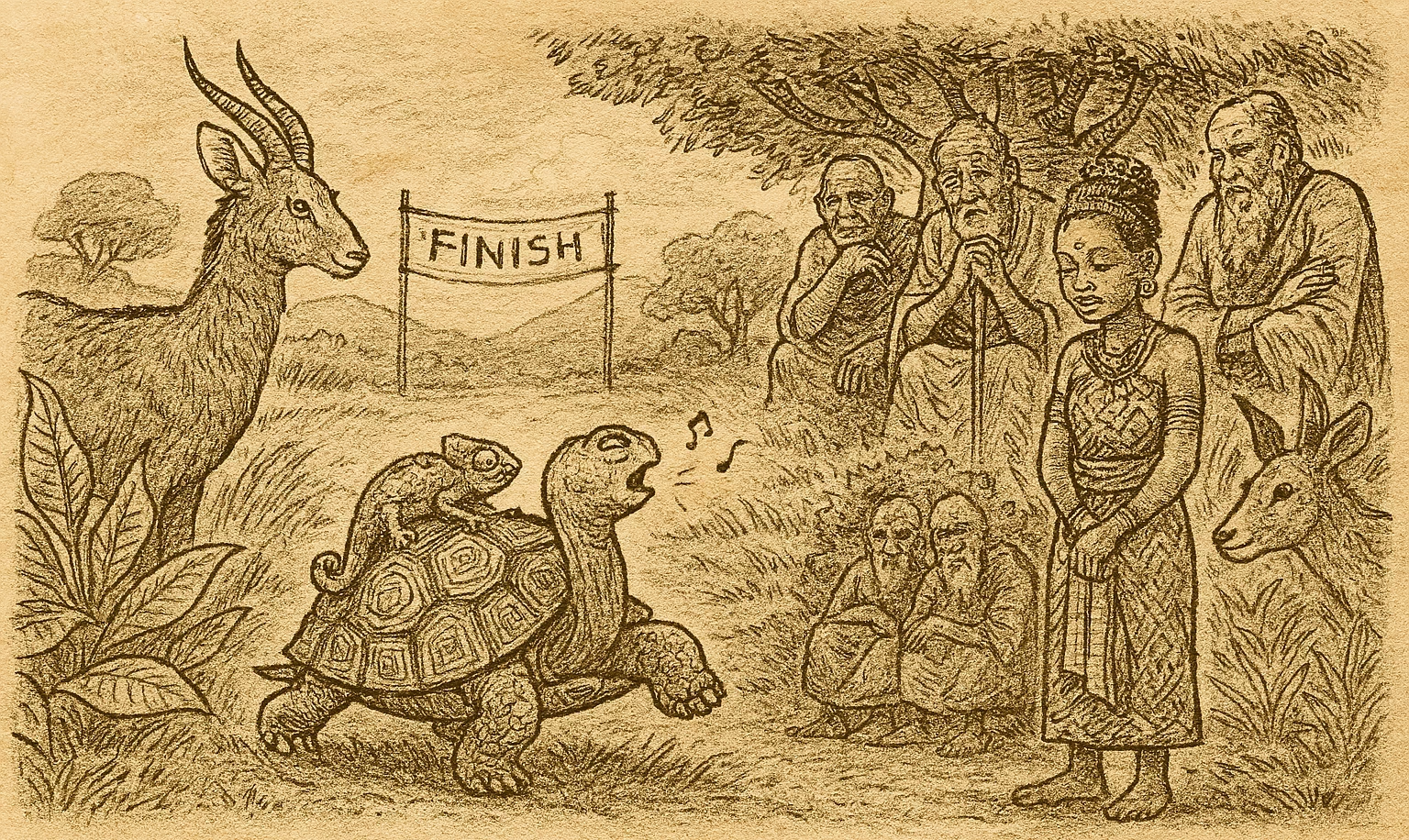
“Let there be a test,” the chief declared, his voice carrying across the gathered crowd. “A race from the old baobab tree at the forest’s edge to the sacred stone near my compound. Whoever arrives first shall have the honor of courting my daughter, provided she finds him acceptable.”
The distance was considerable, a journey that would test both speed and endurance. Many creatures immediately began to calculate their chances. Antelope knew his swift legs could carry him quickly. Monkey believed his ability to swing through the trees would give him advantage. Even Leopard, despite his preference for stalking rather than running long distances, considered entering.
But it was Tortoise who stepped forward first, his voice loud and confident despite his small size. “I will enter this race,” he announced. “And I will win.”
The crowd erupted in laughter. Tortoise, the slowest creature in the forest, believed he could win a race? Surely this was one of his jokes, another scheme that would somehow turn to his advantage. But Tortoise was entirely serious, his eyes gleaming with that particular light that meant his mind was already spinning plans and possibilities.
What most creatures did not know was that Tortoise had been courting the chief’s daughter in his own way for many seasons. He had engaged her in conversations about matters of wisdom and philosophy. He had made her laugh with his stories. She had come to appreciate his intelligence, even if she was uncertain whether she could marry someone so obviously fond of trickery and deception. This race, Tortoise believed, would be his opportunity to prove that cleverness could triumph over any obstacle.
As the creatures assembled at the starting point beneath the ancient baobab tree, its massive trunk scarred with age and wisdom, Tortoise noticed Chameleon moving slowly along a nearby branch. Chameleon had not announced his intention to race. He simply observed, as was his nature, his eyes rotating independently to take in the scene from multiple angles at once.
The chief’s representative, an elder whose judgment was trusted by all, explained the rules. “The race begins at sunrise tomorrow. All who wish to compete must be here when the first light touches the top of the baobab. The first to reach the sacred stone and touch it with their own body shall be declared the winner. No interference with other racers is permitted.”
That night, Tortoise could hardly sleep. He rehearsed his strategy again and again. He knew the path well, knew where he could take shortcuts, knew where the terrain favored his low, steady movement over the leaping and bounding of others. He was confident that while he might not be fastest, his knowledge and planning would see him through.
What Tortoise did not know was that Chameleon had been watching him for a long time. Chameleon had observed every trick, every scheme, every clever manipulation Tortoise had employed over the years. And Chameleon, despite his quiet nature and slow movements, had learned something important: the best way to defeat a trickster is not to compete with his tricks but to use his own cleverness against him.
As dawn approached and the sky began to lighten from black to deep blue to the soft colors of early morning, the racers gathered. Antelope stretched his legs, his muscles rippling beneath his smooth hide. Monkey chattered excitedly, already eyeing the tree branches he would use for his route. Leopard paced impatiently, his spotted coat catching the growing light.
Tortoise arrived, his shell freshly cleaned for the occasion, his eyes alert and focused. He positioned himself carefully at the starting line, mentally reviewing his planned route one final time. What he did not notice, what no one noticed in the dim pre-dawn light and the excitement of the moment, was Chameleon slowly, silently, settling onto the back of Tortoise’s shell.
Chameleon’s remarkable ability to change colors served him perfectly in this moment. His skin had shifted to match the exact pattern and shade of Tortoise’s shell, the browns and greens blending so completely that he became virtually invisible. His grip was light, his body flat against the shell’s curve, his presence undetectable to the creature carrying him.
The elder raised his hand. The moment stretched out, taut with anticipation. Then, as the first ray of sunlight touched the topmost branch of the baobab tree, the elder’s hand dropped. “Go!”
The forest exploded with motion. Antelope leaped forward with powerful strides. Monkey launched himself into the trees with whoops of excitement. Leopard surged ahead with fluid grace. And Tortoise, steady and determined, began his careful, calculated journey.
The race progressed much as everyone expected. The swift creatures pulled far ahead, their forms quickly disappearing down the forest path. The slower creatures, including Tortoise, maintained their own pace, each hoping that endurance or clever route selection might overcome their lack of speed.
Tortoise felt confident. He knew that Antelope often tired quickly, that Monkey sometimes became distracted, that Leopard preferred short bursts to long sustained effort. He believed that his steady, unwavering pace and his knowledge of the terrain would gradually close the gap. What he did not feel, what he had no reason to notice, was the slight additional weight on his shell or the faint, careful breathing of the passenger who rode with him.
As the race wore on, some competitors indeed fell behind. Antelope had sprinted too fast and now panted heavily, having to slow to catch his breath. Monkey had become distracted by a tree full of ripe fruit and stopped to eat. Leopard, as Tortoise had predicted, was not built for this kind of sustained distance and had settled into a pace slower than his initial burst.
Tortoise, meanwhile, maintained his steady rhythm. Step by step, never rushing, never stopping, he moved along the path he had chosen. His legs worked like small machines, tireless and consistent. His mind remained focused on the goal ahead: the sacred stone, the victory, the chief’s daughter.
As the race neared its end and the sacred stone came into view, Tortoise felt a surge of triumph. He could see it now, sitting in the clearing near the chief’s compound, its ancient surface carved with symbols of the ancestors. None of the other racers were in sight. He had done it! Through patience and planning, through knowledge and determination, he had won!
But just as Tortoise approached the sacred stone, just as he prepared to stretch forward and claim his victory, something extraordinary happened. From his very own shell, a form suddenly detached and leaped ahead. Chameleon, who had ridden unseen and unnoticed the entire journey, propelled himself forward in one final burst of movement and landed squarely on the sacred stone a full moment before Tortoise could reach it.
Tortoise stopped as if he had walked into an invisible wall. His eyes went wide with shock and disbelief. “What… how… you…”
Chameleon, now clearly visible against the gray surface of the sacred stone, his skin slowly shifting back to his normal coloration, looked at Tortoise with eyes that held something that might have been amusement or might have been justice. “I touch the stone first,” Chameleon said simply. “The rules say the first to touch it with their own body wins. I have touched it.”
The crowd that had gathered to witness the finish erupted in confusion and excited chatter. Tortoise’s shock quickly transformed into rage. “Fraud! Deception! He cheated!” Tortoise cried out, his voice shrill with indignation. “He rode on my shell! He did not race at all! He tricked me!”
The chief and the village elders emerged from the compound to investigate the commotion. As the situation was explained, as witnesses described what they had seen, the elders gathered in a circle to discuss and debate. Tortoise argued passionately that Chameleon had violated the spirit of the competition, that riding on another racer’s shell could not possibly be considered legitimate racing.
Chameleon said little, simply waited with his characteristic patience, allowing the truth of what had happened to speak for itself.
Finally, the oldest elder, a woman whose wisdom was legendary throughout Kongo country, spoke. Her voice was not loud, but everyone fell silent to hear it. “Tortoise, you come before us complaining that you were tricked. You, who have built your entire reputation on tricks and clever schemes. You, who have deceived others countless times for your own benefit. Now you cry foul when someone uses cleverness against you?”
She paused, letting her words sink in like rain into dry earth. “The rules stated that the first to touch the stone with their own body would win. Chameleon touched the stone with his own body. He carried himself there, even if he did so by riding on you. He used your strength and your knowledge of the path, yes, but he also used his own abilities, his camouflage, his patience, his understanding of your nature.”
Another elder spoke up, nodding in agreement. “For years, we have watched you trick others, Tortoise. We have seen you benefit from the labor and resources of others through deception. Now you have been treated as you have treated others, and you complain of unfairness?”
The chief himself stepped forward. “The saying of our people is true: a trick answers a trick. You cannot build your life on cleverness and deception and then cry for justice when someone proves cleverer than you. Chameleon wins the race and the right to court my daughter, if she will have him.”
All eyes turned to the chief’s daughter, who had been watching these proceedings with great interest. She looked at Tortoise, who still sputtered with indignation, unable to accept that he had been outsmarted. Then she looked at Chameleon, quiet and patient, who had used his own form of wisdom to achieve his goal but did so without malice, almost as a lesson rather than a victory.
She smiled. “I find I am curious about Chameleon,” she said. “Anyone who can out-trick the master trickster must have wisdom worth knowing. I accept his suit.”
Tortoise had no words left. He withdrew from the gathering, his shell somehow seeming heavier than before, carrying not just his body but the weight of his humiliation and the bitter knowledge that he had been beaten at his own game.
The story spread quickly through the forest and beyond, told and retold with delight, especially by those who had been victims of Tortoise’s tricks in the past. And whenever Tortoise tried to complain about the injustice done to him, someone would always remind him: a trick answers a trick. The trickster cannot complain when he himself is tricked.
Click to read all Myths & Legends – timeless stories of creation, fate, and the divine across every culture and continent
The Moral Lesson
This clever Kongo folktale teaches us that those who live by deception cannot claim moral high ground when they themselves are deceived. Tortoise, who built his reputation on outsmarting others, had no legitimate complaint when someone proved more clever than himself. The story warns that if we use trickery and manipulation as our primary tools in life, we must accept that others may use the same methods against us. Most importantly, it teaches the principle of reciprocal justice, that our own methods and behaviors set the standard by which we ourselves will be judged. As the Kongo wisdom states, you cannot cry about the rain when you yourself have been watering the clouds.
Knowledge Check
Q1: Why was Tortoise confident he could win the race despite being the slowest creature?
A: Tortoise was confident because he relied on his cleverness rather than physical speed. He knew the path well, understood the terrain, and had observed the weaknesses of his competitors, knowing that Antelope tired quickly, Monkey got distracted, and Leopard preferred short bursts to long distances. His confidence came from believing his intelligence and planning would overcome his physical limitations, as they had in past situations.
Q2: How did Chameleon manage to ride on Tortoise’s shell without being detected?
A: Chameleon used his natural ability to change colors and camouflage himself. He made his skin match the exact pattern and shade of Tortoise’s shell, blending so perfectly that he became virtually invisible. Combined with his light weight, flat positioning against the shell’s curve, and the dim pre-dawn light, his presence went completely unnoticed throughout the entire race.
Q3: What made Chameleon’s trick different from Tortoise’s usual deceptions?
A: While both used cleverness, Chameleon’s trick was a direct response to Tortoise’s own lifestyle of deception. It functioned more as a lesson than malicious manipulation. Chameleon observed and learned from Tortoise’s methods, then used Tortoise’s own confidence and blindness to his vulnerabilities against him. The trick was poetic justice rather than simple deception, teaching rather than merely taking advantage.
Q4: What does the phrase “a trick answers a trick” mean in the context of this story?
A: This phrase embodies the principle of reciprocal justice: those who use trickery as their way of life cannot legitimately complain when they become victims of tricks themselves. It means that if you establish deception as your method of operating in the world, you cannot appeal to fairness or honesty when someone deceives you in return. The standard you set for others becomes the standard applied to you.
Q5: Why did the elders rule in Chameleon’s favor despite Tortoise’s protests?
A: The elders ruled for Chameleon because, first, he technically followed the rules by touching the stone with his own body, and second, because they recognized that Tortoise had no moral standing to complain about being tricked when his entire reputation was built on tricking others. The elders used this moment to teach a larger lesson about consistency and accountability, that one cannot live by one set of rules and demand to be judged by another.
Q6: What does this tale reveal about Kongo cultural values regarding justice and behavior?
A: The story reveals that Kongo culture values consistency, reciprocity, and the principle that your own actions set the terms for how you will be treated. It shows cultural appreciation for cleverness and intelligence but also emphasizes that these qualities must be tempered with awareness that others possess them too. The tale reinforces that community elders serve as moral arbiters who see through false claims of victimhood and understand the deeper principles of justice, which includes holding people accountable to their own standards.
Source: Adapted from The Mwindo Epic and Other Congolese Narratives by Daniel Biebuyck and Kahombo Mateene (1989), which includes documented Kongo tortoise trickster tales from oral tradition.
Cultural Origin: Kongo People, Democratic Republic of Congo and Republic of Congo, Central Africa