In the days when the great kingdom of Benin stood in its glory, when bronze workers cast images that captured the very breath of life and when the Oba’s word carried the weight of divine law, there lived a warrior whose name was spoken with both pride and caution. He was called Osaze, meaning “favored by God,” and no man in living memory had matched his prowess in battle. His spear never missed its mark, his shield turned aside every blow, and enemies fled at the mere whisper that he approached their borders.
But Osaze carried within his chest a pride that grew like a weed in fertile soil, choking out the wisdom that might have tempered his strength. He believed himself beyond the reach of ordinary fate, blessed by forces that set him apart from common mortality. When other warriors spoke of death with the proper reverence, Osaze would laugh and declare that death itself would fear to claim one such as he.
Click to read all Myths & Legends – timeless stories of creation, fate, and the divine across every culture and continent
The years passed, and Osaze’s legend grew until it seemed to fill the entire kingdom. Young men imitated his bearing, mothers invoked his name to inspire courage in their sons, and the Oba himself relied upon Osaze as the shield of the realm. But time, which bows to no warrior’s strength, continued its patient work. Osaze’s hair showed silver, his step grew less sure, and the injuries that had once healed quickly began to linger.
Then came the fever a sickness that no medicine could touch, no ritual could turn aside. It moved through Osaze’s body like fire through dry grass, and even his legendary strength could not stand against it. As he lay upon his deathbed, surrounded by wives and children and warriors who had served beneath him, Osaze’s final words were not prayers or blessings, but a vow spoken through cracked lips: “I will return. Death cannot hold me.”
When his spirit departed his body, it found itself standing at the edge of a great river that had not existed in the land of the living. This was the Omi, the boundary water that separates the world of breath from the world of shadows. The river ran silent and dark, its surface reflecting no light from the sky above, and along its banks grew no vegetation only smooth stones worn by the passage of countless departed souls.
A ferryman waited there, ancient beyond reckoning, his face bearing the marks of every grief humanity had ever known. Without words, he extended a weathered hand, and Osaze stepped into the boat. The crossing was neither long nor short, existing outside the measurements by which the living mark their days. When the boat touched the far shore, Osaze stepped out into a realm of perpetual twilight, where shadows had substance and silence had weight.
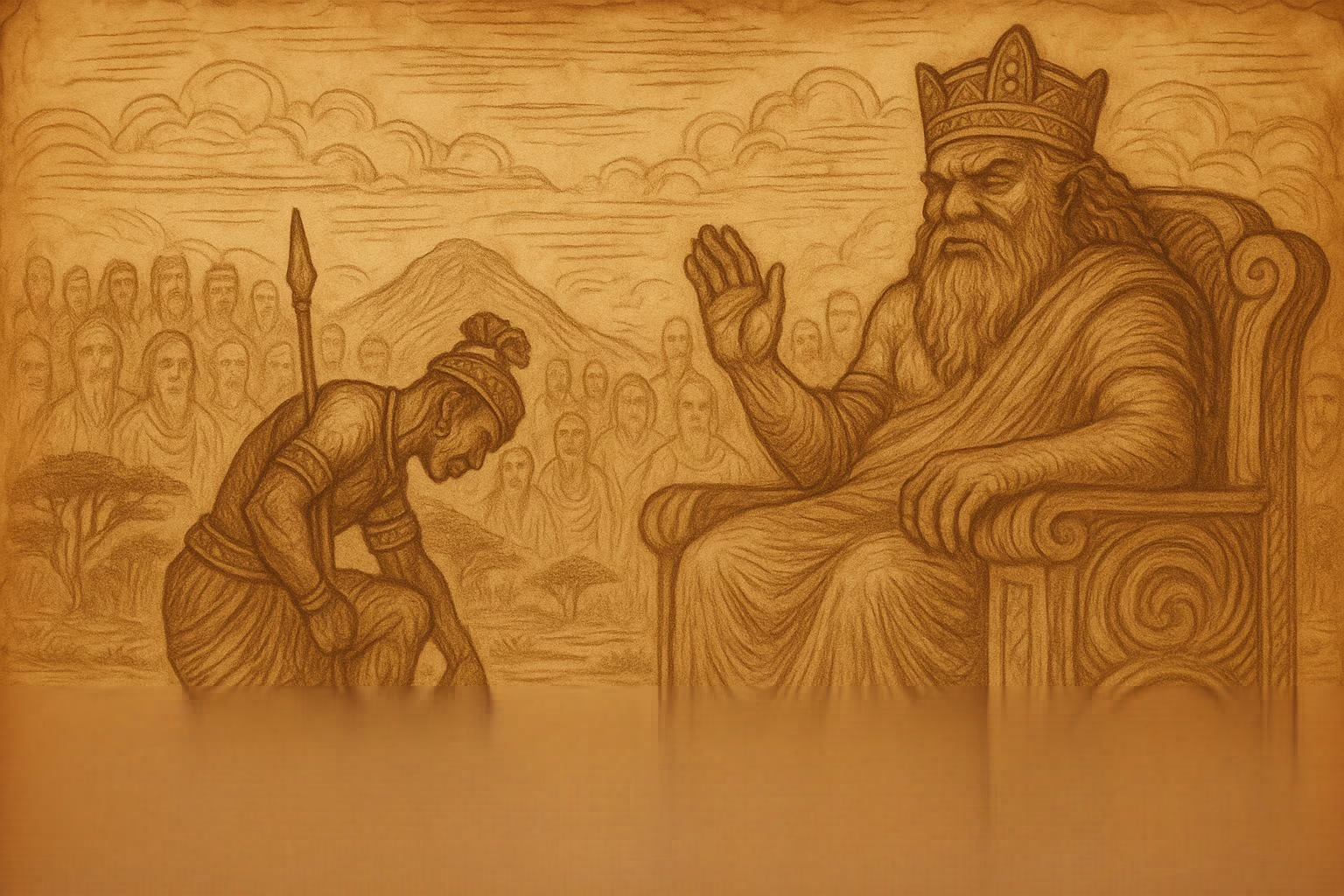
Before him rose a throne carved from a single piece of night, and upon that throne sat Ogiuwu, the Lord of Death, the Final Judge, he who had received every soul since the first human drew breath and released it for the last time. Ogiuwu’s appearance shifted like smoke sometimes appearing as an ancient man bent with the wisdom of ages, sometimes as a warrior in his prime, sometimes as something that had no form the living mind could comprehend. But his eyes remained constant deep as wells, holding within them the memory of every life that had ever ended.
Around the throne stood the ancestors those who had lived with honor and been welcomed into the eternal gathering. Osaze recognized among them warriors he had known, elders who had taught him, and faces from stories told when he was young. They watched him with expressions that mixed welcome and warning.
“Osaze,” spoke Ogiuwu, his voice like wind through a vast cavern, “your deeds in life are known to us. You fought bravely for your people. You provided for your family. You showed courage in battle.” The Lord of Death paused, and in that pause lay a weight that pressed upon Osaze’s spirit. “But you also harbored pride that blinded you to your proper place in the order of things. You believed yourself above the laws that govern all who walk and breathe.”
Before Osaze could respond, the ground beneath him became transparent, and he saw laid out below his entire life every deed, every word, every intention. He saw moments of genuine heroism, but also saw how his pride had wounded others, how his arrogance had dismissed the contributions of fellow warriors, how his certainty had closed his ears to wise counsel.
“The deeds weigh,” intoned Ogiuwu, and Osaze felt an invisible scale measuring the substance of his soul. The good deeds and there were many settled on one side. The pride, the dismissed wisdom, the wounded spirits left in his wake these settled on the other. The scale swayed, tipped, and finally found a balance that was neither full condemnation nor complete vindication.
“You may join the ancestors,” Ogiuwu declared, “for your service to your people earns you that place. But you must first acknowledge what you refused to accept in life that you are bound by the same laws as all who walk beneath the sun.”
But Osaze’s pride, which had not died with his body, rose up within him like a serpent disturbed. “I made a vow,” he declared, his voice ringing through the underworld with all the authority he had wielded in life. “I swore I would return to the land of the living. A warrior’s word is sacred, even here. I demand passage back across the river!”
A profound silence fell across the realm of the dead. The ancestors drew back, their faces showing sorrow and dismay. Even the shadows seemed to recoil from such presumption. Ogiuwu rose from his throne, and his form grew until it filled the sky of that twilight realm.
“You dare to make demands of death itself?” The Lord’s voice was no longer wind in a cavern but thunder that shook the foundations of existence. “You believe your vow supersedes the fundamental law that separates the living from the dead? You would tear the boundary between worlds to satisfy your pride?”
Osaze stood his ground, though his spirit trembled. “A warrior keeps his word, even if it leads him into the jaws of a leopard. I swore I would return, and return I shall.”
Ogiuwu’s eyes, deep as wells, grew deeper still, and in their depths, Osaze saw a terrible compassion. “So be it,” the Lord of Death pronounced. “You wish to return? Then return you shall but not as you imagine. You rejected the peace of the ancestors. You refused to accept your place in the proper order. Therefore, you shall exist between worlds, belonging fully to neither, a warning to all who would make the same mistake.”
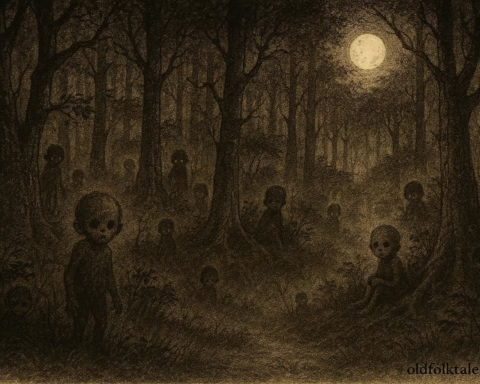
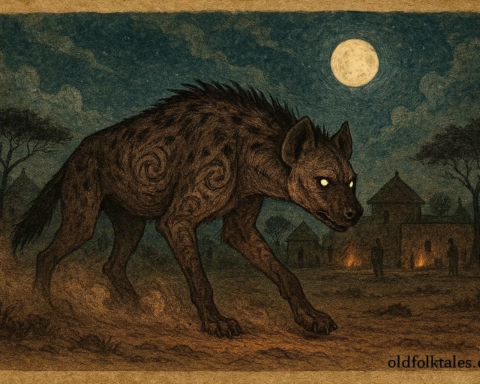
The underworld began to dissolve around Osaze, but he was not being welcomed back to life. Instead, he felt himself being stretched thin, his substance scattered across the boundary between the living and the dead. When the transformation was complete, Osaze found himself returned to the mortal realm, but not as he had been. He was now a restless ghost, forever wandering the forests of his homeland, unable to interact with the living yet unable to join the ancestors in peace.
His footsteps, when he walks, shake the earth and echo as thunder across the sky the sound of a warrior’s tread that can no longer find a battlefield. His voice, crying out in anguish and regret, becomes the wind that moans through the forest at night, speaking words that the living can almost understand but never quite grasp. He appears sometimes to travelers in the deep woods, a shadowy figure that radiates both power and profound sorrow, and those who see him return to their villages changed, speaking less of their own importance and more of the wisdom in accepting the natural order of things.
In the kingdom of Benin, parents tell their children the story of Osaze when they see pride growing like a weed in young hearts. The priests remind the people that every soul, no matter how mighty in life, must bow before Ogiuwu’s judgment. And when thunder rolls across the land or wind moans through the trees, the elders nod knowingly and say, “Osaze walks tonight, still paying the price for defying death.”
Author’s Note
Knowledge Check
1. Who is Ogiuwu in Edo cosmology? Ogiuwu is the Lord of Death and the Final Judge in Edo belief, who receives every departed soul and weighs their earthly deeds to determine their eternal destiny. He sits upon a throne in the underworld and possesses the authority to grant souls entry into the realm of ancestors or condemn them to darker fates.
2. What is the river Omi and what is its significance? The river Omi is the boundary water that separates the world of the living from the world of the dead. Every departed soul must cross this dark, silent river with an ancient ferryman to reach the underworld where they will face judgment before Ogiuwu.
3. What criteria did Ogiuwu use to judge Osaze’s soul? Ogiuwu weighed Osaze’s deeds on an invisible scale, considering both his positive actions his bravery in battle, provision for family, and service to his people against his negative qualities, particularly his pride, arrogance, and dismissal of others’ wisdom and contributions.
4. What was Osaze’s fatal mistake in the underworld? Osaze’s fatal mistake was demanding to return to the living world, invoking his deathbed vow as justification and refusing to accept his proper place in the cosmic order. This act of supreme hubris making demands of death itself showed he had learned nothing from his life and rejected the opportunity for peaceful rest among the ancestors.
5. What form did Ogiuwu’s punishment take? Rather than granting Osaze peaceful rest among the ancestors or even simple oblivion, Ogiuwu transformed him into a restless ghost condemned to wander forever between the worlds of the living and the dead. His footsteps became thunder, his cries became the moaning wind, and he exists as a perpetual warning against pride and defiance of cosmic law.
6. What broader moral lesson does this myth teach about death and the afterlife? The myth teaches that death is not to be feared but respected as part of the natural order, and that the quality of one’s afterlife depends on both moral conduct and proper humility before divine authority. It emphasizes that even great achievements cannot excuse prideful rejection of one’s place in the cosmic hierarchy, and that attempting to defy fundamental laws brings suffering rather than triumph.