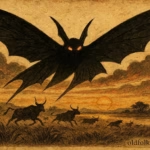
Across the Indigenous cultures of North America’s Pacific Northwest and Great Plains, the Thunderbird reigns as a being of immense spiritual and natural force. Towering, radiant, and alive with storm-energy, it is said to dwell in high mountain ranges or above the clouds, where its wingbeats generate thunder and its flashing eyes or lightning-snakes create bolts of lightning.
In the traditions recorded by Franz Boas among the Tillamook and Kwakwaka’wakw, Thunderbird is a massive raptor whose wings can darken the sun, whose feathers shimmer with blue and white fire. When it flaps its wings, the sky trembles; when it blinks, lightning flashes across the sea. Among Plains nations such as the Blackfoot, Lakota, and Menominee, Thunderbird is a divine warrior spirit, a bringer of rain, fertility, and cosmic justice.
Explore the shadows of world mythology, where demons test the soul and spirits watch over mankind
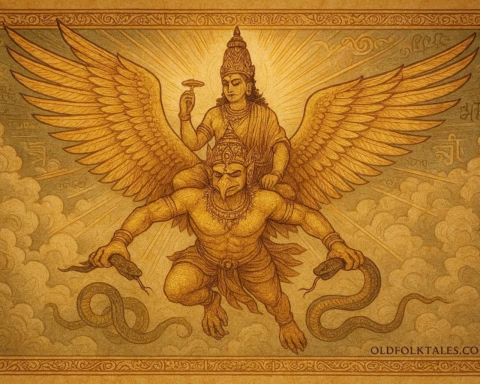
Its form varies by region. On the Northwest Coast, Thunderbird’s hooked beak and crest resemble that of an eagle or condor, often depicted carrying serpents or whales. Among the Plains, its shape may merge with eagle iconography, majestic yet fierce, its body marked by lightning patterns or double-headed symmetry, symbolizing balance of the directions.
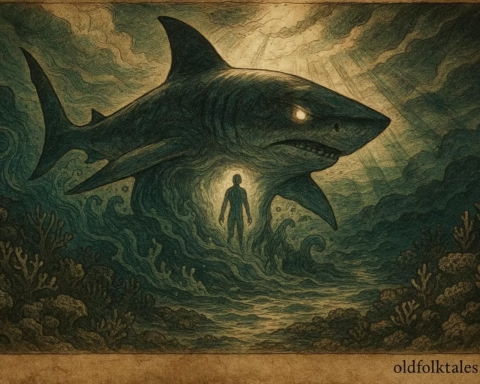
In Boas’s 1898 record of Tillamook stories, Thunderbird descends from the mountains to battle Whale, a monstrous sea being that threatens coastal life. Their clash shakes the earth, churns the ocean, and sends thunder and lightning across the sky, an Indigenous cosmological explanation for storms and earthquakes.
Among the Blackfoot and Lakota, Thunderbird is less a single being and more a category of storm spirits. They are the heavenly warriors who fight underworld serpents or water monsters (often called Unktehi or Underwater Panther in neighboring traditions). Their battles sustain the balance of creation, keeping waters in their boundaries and ensuring the cycle of rain and renewal.
Behavior and Mythic Role
Thunderbird acts according to both cosmic duty and moral vision. It is not a whimsical weather-god but a guardian enforcing equilibrium. It punishes arrogance and corruption, aids heroes, and renews the world through storm and rain.
In coastal stories, Thunderbird often intervenes when humanity forgets gratitude or balance. When people take too much from the sea or the land, Whale rises in anger, Thunderbird must then descend, grasping Whale in its talons, dragging it back beneath the waves, restoring harmony through tempest. This myth captures the ecological ethics of the Northwest: abundance and respect are inseparable.
On the Plains, the Thunderbird’s role is more ancestral and ceremonial. It grants power-dreams or visionary gifts to warriors, dancers, and medicine people. Those who dream of Thunderbird gain protective songs, lightning medicine, or the right to wear thunder motifs in regalia. The Thunderbird Society among the Lakota and Blackfoot Thunder Medicine Lodge are historic examples of ceremonial institutions tied to its veneration.
The Thunderbird’s calls herald the start of summer rains. In some accounts, four great Thunderbirds guard the cardinal directions; in others, a single Thunderbird commands the storm hosts. Despite its fearsome power, Thunderbird remains a protector of humanity, driving away malevolent spirits and ensuring fertile lands.
The creature’s adversaries, the Water Spirits or Underwater Panthers, represent stagnation and hidden chaos. Each clash between them renews life: thunder and lightning break the drought, rain revives crops, and the people remember gratitude.
Cultural Role and Symbolism
The Thunderbird stands at the intersection of nature, morality, and kinship. Its wings embody the forces that sustain life, wind, rain, and thunder, while its spirit enforces social and ecological balance.
- Cosmic Balance: Thunderbird vs. Whale (or Water Monster) dramatizes the balance between sky and sea, order and chaos.
- Moral Authority: Thunderbird punishes greed or disrespect toward nature, embodying the principle that imbalance invites destruction.
- Ancestral Power: Families or lineages claiming Thunderbird as a crest or guardian assert their connection to divine origins and the right to lead ceremonies.
- Ritual Significance: Thunderbird images adorn masks, totems, and dancer’s regalia. The rhythmic beating of drums in ceremonies mimics thunder, invoking its protection.
Throughout the Pacific Northwest, Thunderbird carvings crown totem poles as emblems of prestige and divine protection. In the Plains, its image decorates shields and beadwork, symbolizing courage and spiritual empowerment.
Ethnographers like Boas recorded how Thunderbird myths integrated with seasonal ceremonies. When thunder first sounded in spring, some nations performed purification rites, smudging fires, offering songs, to welcome the rain and honor the sky spirits.
To many Indigenous communities, Thunderbird remains a living presence, not a relic. The storm’s arrival, the rolling echo of thunder, is still understood as a sign of renewal and a reminder of humility before the forces of the natural world.
Explore the mysterious creatures of legend, from guardians of the sacred to bringers of chaos
Author’s Note
The Thunderbird’s universality across Indigenous North America is not a sign of diffusion alone but of shared cosmological perception. The land itself, its mountains, storms, and endless horizons, shapes the being. In studying the Thunderbird, one must resist flattening diverse nations’ traditions into a single myth.
Franz Boas’s early ethnographic collections, though invaluable, often translated oral stories through Western narrative expectations. Indigenous interpretations, preserved through ceremony and art, emphasize relationship over spectacle. The Thunderbird is not merely a weather deity; it is kin, a guardian whose power demands reciprocity, not worship.
In the age of ecological crisis, the Thunderbird’s lesson remains urgent: creation thrives only where balance and respect prevail. Storms, like stories, cleanse and renew.
Knowledge Check (Q&A)
- Q: What natural phenomena are created by Thunderbird’s movement and gaze?
A: Its wingbeats cause thunder, and lightning flashes from its eyes or lightning-snakes. - Q: In Pacific Northwest myths, what creature does Thunderbird often battle?
A: The Whale, representing imbalance or excess power from the sea. - Q: How is Thunderbird connected to ceremonies among Plains tribes?
A: It grants visions, songs, and protective power to dancers and warriors through thunder societies. - Q: What moral principle does Thunderbird embody?
A: The balance between taking and giving, respecting nature’s harmony. - Q: What do carvings or totems of Thunderbird signify for families?
A: Ancestral lineage, prestige, and divine guardianship. - Q: Why should Thunderbird not be viewed simply as a single “god”?
A: Because it represents a family of spirits and moral relationships, not a solitary deity.
Sources:
Primary Source: Franz Boas, “Traditions of the Tillamook Indians” (Journal of American Folklore, 1898); George Bird Grinnell, Blackfeet Indian Stories (1913)
Secondary Source: Smithsonian and tribal museum collections of Thunderbird regalia and art motifs
Origin: Pacific Northwest Coast (Tillamook, Tlingit, Kwakwaka’wakw, Haida), Plains (Blackfoot, Lakota, Menominee), and Plateau Nations