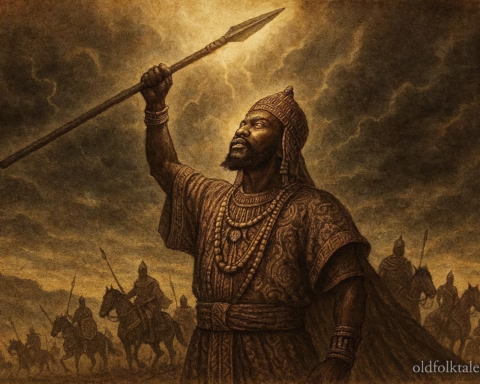
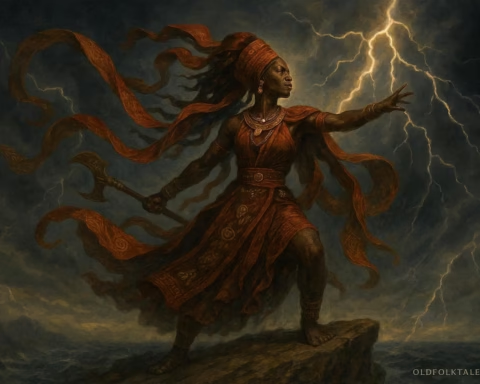
In the elder days, when the mists of Cornwall rose like breath from ancient gods, a child was born beneath an omen-bright sky. They named him Tristan, though some whispered that destiny named him first. His mother, the sister of Cornwall’s king, died in childbirth; his father, a wandering knight of unyielding honor, fell in battle before seeing the boy’s face. Thus Tristan entered the world marked by sorrow, yet also by wonder, for druids saw a silver thread around the infant’s spirit, a sign of divine favor from powers older than Rome, older than Arthur’s throne.
Raised in the halls of King Mark of Cornwall, Tristan grew swift as the cliff winds and bold as the sea that roared beneath Tintagel’s crags. His tutors said the gods had placed fire in the boy’s limbs; his swordmasters swore that no mortal learned so quickly. By the time he reached manhood, he shone like one born half among men and half among ballads.
THE HEROIC CHALLENGE
When word came that Ireland sent forth a monstrous champion, a giant of impossible strength named Morholt, demanding tribute in blood and gold, Cornwall trembled. None dared face him until Tristan stepped forward, his eyes bright with youthful certainty. “Let me go,” he said to King Mark. “If fate marked me for sorrow, let it also mark me for courage.”
Armed with only his father’s blade and a small band of loyal companions, Tristan crossed the storm-torn sea to meet the Irish giant. On a lonely isle between the two kingdoms, the battle raged from dawn’s first fire to twilight’s dying embers. Morholt struck like a mountain falling; Tristan answered with the speed of wind over stone. At last he drove his blade into the giant’s skull, yet Morholt’s poisoned spear wounded him in return.
The poison burned through Tristan’s blood, dimming his sight, stealing his strength. Knowing he would die if he returned home, he set himself adrift in a small boat, surrendering body and spirit to the mercy of the waves.
THE DIVINE ENCOUNTER
The sea bore him to Ireland, where fate wound its golden thread tighter still. He was found by Princess Iseult, renowned for her healing arts and for a beauty that poets claimed could stir the ghosts of old Celtic gods. Though Tristan hid his name, fearing the Irish would slay him for killing their champion, the princess nursed him, restoring him from shadow to life.
Some say the gods smiled upon that meeting; others say they sighed. For when Tristan later revealed his identity during a contest of skill, chaos erupted and he fled Ireland, but not before seeing in Iseult’s eyes a spark that mirrored his own.
THE MORAL STRUGGLE
Months later, King Mark sought peace with Ireland and asked Tristan to return as his envoy. His task: escort Iseult the Fair, the very princess who had once healed him, to Cornwall to become the king’s queen. Tristan obeyed, though dread knotted his heart.
Thus began the journey doomed to legend. On the ship’s deck, beneath the salt wind, the princess’s mother entrusted Tristan with a love potion meant for Mark and Iseult to share on their wedding night, a charm to bind affection swiftly between strangers.
But fate, ever playful and merciless, intervened. Tristan and Iseult, parched from the sun and unaware of the potion’s nature, drank it together.
At once the world shifted.
It was as if the sea calmed, the sky brightened, and every heartbeat echoed with a shared rhythm older than time. They saw in each other not merely beauty, nor kindness, nor valor, but the missing halves of their own souls, bound now by divine enchantment and impossible longing.
Yet both knew their love was forbidden. Tristan’s honor chained him to his duty; Iseult’s oath bound her to King Mark. Together they bore a love that could neither be spoken aloud nor silenced.
THE SYMBOLIC OUTCOME
Despite their efforts to hide the bond the gods had woven, whispers grew. Court intrigue sharpened like knives; Mark’s suspicion turned bitter. At last Tristan chose exile to protect Iseult’s name and keep peace in a kingdom already shadowed by strife.
He fled to wastelands, forests, and foreign courts, performing feats of heroism as bright as any sung of Hercules or Cú Chulainn. But every victory tasted hollow, for his heart remained in Cornwall.
At last, wounded in battle far from home, Tristan sent for Iseult, knowing only her healing could save him. He instructed his messenger: If she comes, raise white sails; if she refuses, let the sails be black.
Iseult, ever faithful, boarded the ship at once.
But Tristan’s jealous wife, who had married him in his exile, lied and claimed the sails were dark. Tristan, believing his beloved had forsaken him, breathed his last.
When Iseult arrived and found him dead, her cry split the heavens. She fell beside him, the potion’s bond pulling her spirit after his. Legend says two trees sprang from their graves, one twined around the other, uncuttable even by the king’s order.
Thus sorrow became symbol:
love stronger than kingdoms, stronger than death, stronger even than fate’s cruel hand.
AUTHOR’S NOTE
Tristan endures because he embodies the eternal struggle between duty and desire, loyalty and longing, human law and divine fate. His tale warns that even the noble may be broken by forces beyond their choosing, yet it also affirms that love, true, undeniable love, leaves a mark that outlasts empires.
KNOWLEDGE CHECK
-
What divine or prophetic sign marked Tristan at birth?
-
Which giant did Tristan defeat to save Cornwall?
-
How did Tristan first meet Iseult?
-
What mistake bound Tristan and Iseult in forbidden love?
-
Why did Tristan choose exile from Cornwall?
-
What symbolic miracle marked the lovers’ final resting place?
CULTURAL ORIGIN: Medieval Celtic and Arthurian tradition, chiefly from Cornish, Breton, and Irish narrative cycles of the 12th century.
SOURCE: Derived from the medieval romance “Tristan and Iseult”, preserved in versions by Béroul, Thomas of Britain, and later prose cycles within the Arthurian literary tradition.