Týr (Old Norse: Týr), one of the most ancient and solemn gods in the Norse pantheon, embodies law, sacred oaths, binding agreements, and the unflinching courage required to uphold both justice and cosmic order. While later mythic cycles elevate Odin and Thor to greater prominence, early Germanic tradition suggests that Týr once stood as a principal sky and war deity, linked to the Proto-Germanic Tīwaz, the divine guarantor of order and victory. His domain is not brute force but honorable resolve, the principle that both gods and humans must stand by their word even at terrible personal cost.
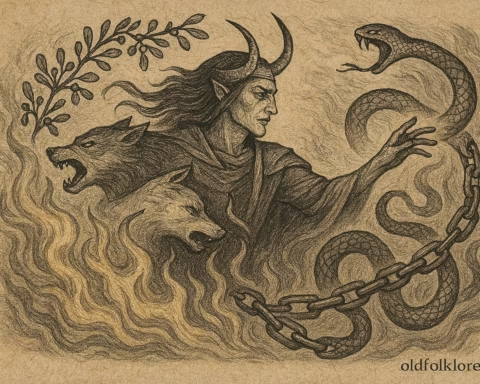
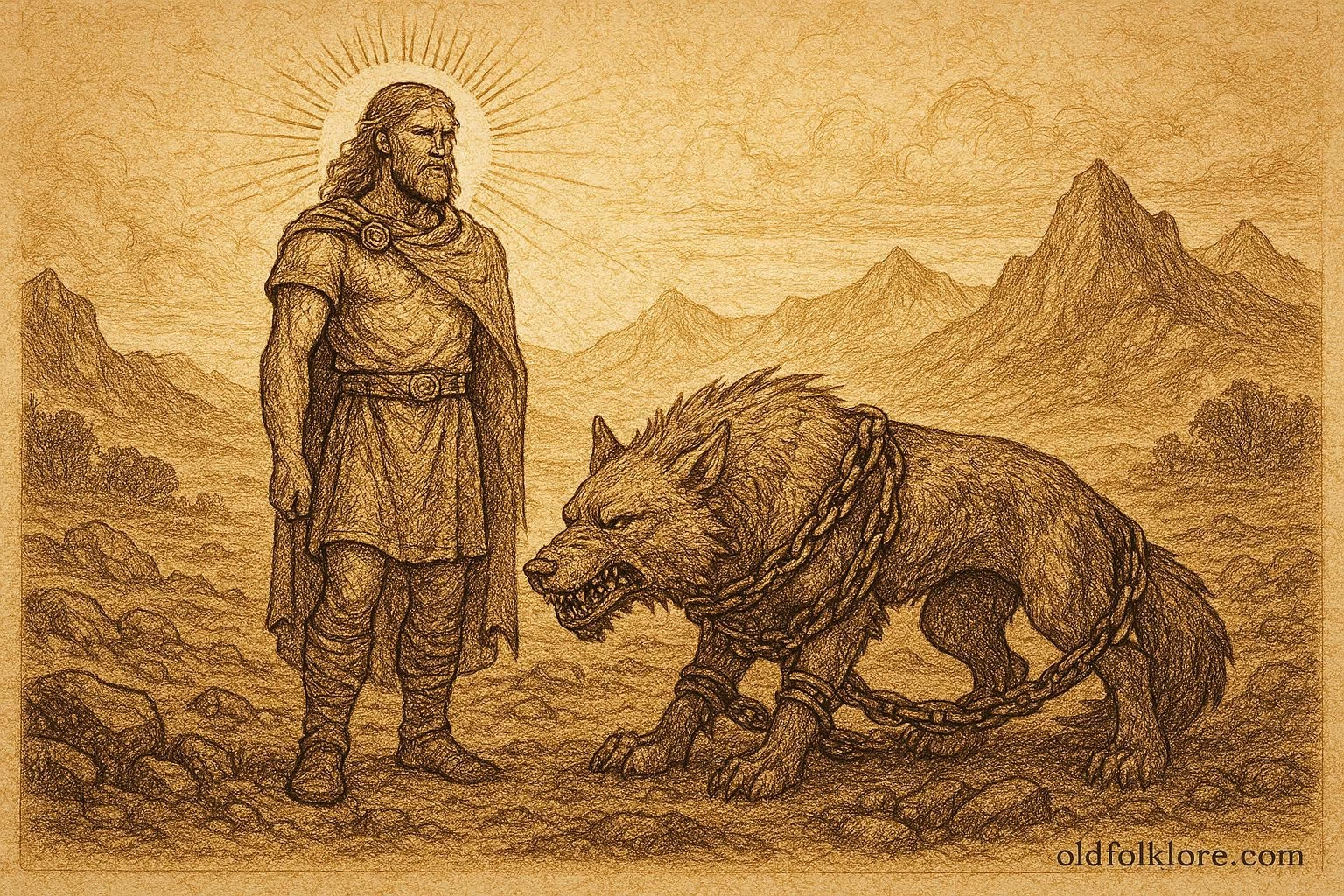
Týr is best known for the myth in which he places his hand in the jaws of the monstrous wolf Fenrir. The wolf, sensing a trap as the gods attempt to bind him, demands a token of good faith. Týr, understanding the price, extends his right hand without hesitation. When the gods refuse to release Fenrir, the wolf bites the hand off at the wrist, leaving Týr forever marked as the god who sacrificed bodily wholeness to preserve the world.
He is associated with the sword, legal assemblies (þing), and the uncompromising dignity of those who swear by truth. His symbol is often the upward-pointing rune Tiwaz, a spear-like sign of straightness, justice, and divine honor.
Mythic Story
In the old age before Ragnarok’s shadow grew long, when the Æsir still walked the shining lands of Asgard with confidence, the great wolf Fenrir was growing at a fearsome pace. Born of Loki and the giantess Angrboða, Fenrir was no ordinary creature. Even as a young beast he towered over the shrines of men and cast a darkness across the divine halls. His strength swelled with every bite of meat, every breath he drew, and every new word he learned, for the wolf was not merely powerful but cunning and quick of mind.
The gods feared what Fenrir might become, for prophecies whispered that he would one day break free and swallow Odin himself. Yet the Æsir could not slay him. Ancient law bound them: no being was to be killed before its appointed time. Thus they sought another solution, to bind the wolf with fetters strong enough to restrain him until the world’s doom.
They forged great chains of iron. The first, thick as a ship’s anchor rope, was named Læding. With careful words and forced cheer, the gods approached the young wolf. “Test your strength,” they said, “and show us how mighty you have become.”
Fenrir eyed them, but pride swelled in him, and he allowed the chain to be wound around his limbs. With a single twist of his massive body he snapped Læding into shards that flew like broken stars. The gods, masking their worry in strained smiles, congratulated him while hiding the shards beneath cloaks and cloistered hearts.
Next they forged Dromi, even stronger than the first. “Surely this will hold even you,” they said. Again Fenrir agreed, suspicious yet unwilling to refuse a challenge. When the gods had wrapped the second chain around him, Fenrir braced his paws, set his jaw, and tore Dromi apart with a mighty shake. The links rang like thunder as they scattered across the plain.
Now the gods’ unease deepened, for no earthly metal could restrain the wolf. Thus they turned to the dwarves of Svartalfheim, masters of impossible craft. The dwarves listened, nodded, and set to work. What they created was unlike any chain the world had ever seen. It was soft as silk, smooth as ribbon, and gleamed with quiet magic. They named it Gleipnir, wrought from six impossible ingredients: the sound of a cat’s footfall, the beard of a woman, the breath of a fish, the spittle of a bird, the sinews of a bear, and the roots of a mountain. No mortal had seen these things; indeed, they scarcely believed such substances could exist. Yet the dwarves had shaped them, for they trafficked in the unseen and the undoable.
When the gods brought Gleipnir to Fenrir, the wolf’s eyes narrowed. “That thread?” he growled. “You would bind me with a ribbon? You think me a fool.”
The gods reassured him, speaking in soothing tones, but Fenrir’s instincts screamed danger. Finally he set a condition: “If you would bind me with this strange thing, one of you must place a hand in my mouth as a pledge that no trick is intended. Should you prove false, I will bite it off.”
Silence fell over the plains of Lyngvi. The Æsir glanced at one another, each unwilling to risk life and limb. But one god stepped forward, Týr, the steadfast, the oath-keeper, the one who had always fed the wolf when others feared to approach him. Týr looked into Fenrir’s burning eyes and understood the price. Without a word, he extended his right hand.
The wolf opened his jaws, and Týr placed his hand between the terrible teeth. “Proceed,” he said, voice steady as stone.
The gods bound Fenrir with Gleipnir. The ribbon tightened, but the wolf could not break it. He strained, muscles rippling, claws gouging the ground, but the fetter held fast. Realization washed over him, he had been deceived.
With a roar that shook the roots of Yggdrasil, Fenrir clamped his jaws shut. The sharp bite severed Týr’s hand at the wrist. Blood fell like bright fire upon the grass, and Týr stood pale yet unbowed, his face set not in pain but in acceptance. He had known this would be the cost. He had offered it willingly.
Fenrir howled in fury, but the gods drove a sword into his jaws, holding them apart until the world’s end. Bound at last, the wolf lay writhing on the lonely island, and the Æsir retreated in silence. Týr, cradling his wound, returned to Asgard without complaint. His sacrifice would forever mark him as the god of honor, the one who upheld law not by decree but by the courage to suffer for its sake.
Author’s Note
Týr’s sacrifice stands as one of the most solemn moments in Norse mythology. Unlike other heroic feats driven by glory or conquest, Týr’s courage is quiet, deliberate, and bound to duty. His lost hand becomes a symbol of the cost of keeping one’s word, a reminder that law and justice are not abstractions but principles upheld through personal responsibility. In a world of shifting alliances and looming chaos, Týr represents the steadfast heart of honor itself.
Knowledge Check
Q1: What domain does Týr primarily govern?
A: Law, oaths, justice, and courageous duty.
Q2: Why could the gods not kill Fenrir?
A: Ancient divine law forbade killing a being before its destined time.
Q3: What was special about Gleipnir?
A: It was a magical ribbon forged from six impossible ingredients by dwarves.
Q4: Why did Fenrir demand a hand in his mouth?
A: As a safeguard against deceit while being bound.
Q5: Why did Týr volunteer his own hand?
A: Because he embodied honor and accepted the sacrifice needed to uphold divine order.
Q6: What does Týr’s lost hand symbolize?
A: The cost of duty, integrity, and keeping sacred oaths.
Source: Norse Mythology, Scandinavia.
Source Origin: Scandinavia (Norse Mythology)