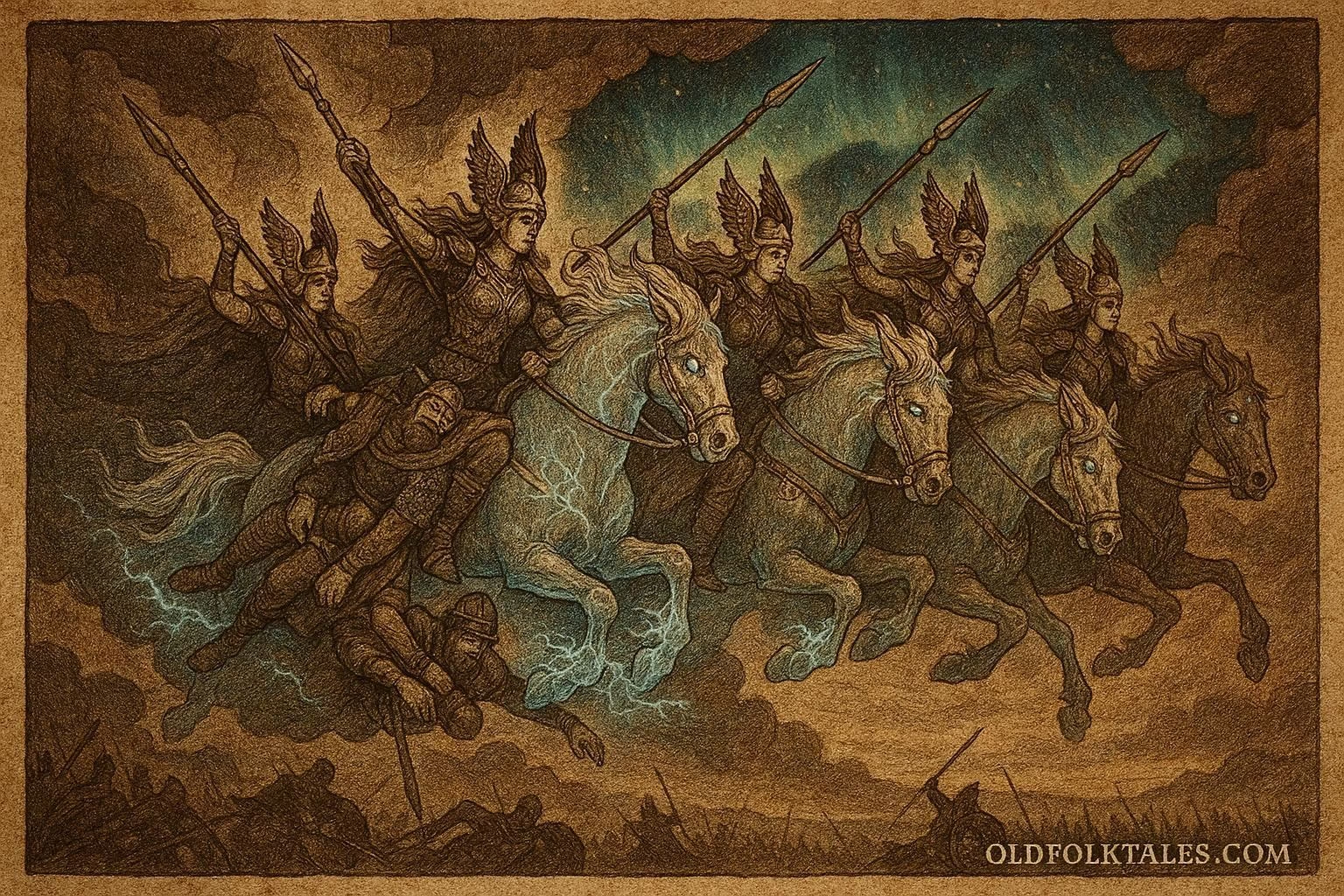
In the glimmer of dawn over a blood-red plain, the Valkyries ride. They are the valkyrjur, “choosers of the slain”, celestial maidens who descend upon battlefields to select which warriors will die and which will live. Their task: to bear the worthy dead to Valhalla, Odin’s hall of the fallen.
The earliest poetic sources, such as Helgakviða Hundingsbana I in the Poetic Edda, depict them as radiant and terrible: “From the south they came, riding through air and over sea, mail-clad maidens with shining spears.” In others they appear as supernatural women weaving the fates of men on a grisly loom of entrails, where swords are shuttles and skulls are weights.
Discover the gods, goddesses, and divine spirits who ruled the heavens and shaped human fate
Iconographically, Valkyries wear winged helmets or swan-feather cloaks, ride horses whose hooves spark lightning and carry spears that gleam like northern auroras. Yet not all are martial alone, many display tenderness or tragic love. They can bestow victory, foretell doom, or even become mortal brides, as in the tale of Brynhildr, the sleeping Valkyrie punished by Odin and later beloved of the hero Sigurd.
Their powers extend beyond war: they personify fate itself, binding the mortal world to divine judgment.
Myths and Literary Attestations
The Valkyries appear prominently in the Poetic Edda and Prose Edda, the two medieval Icelandic compilations that preserve Old Norse myth.
- In Grímnismál, Odin describes Valhalla, a hall with 540 doors, where those the Valkyries choose feast and fight each day. The Valkyries serve mead from goatskin horns to the slain heroes (einherjar).
- In Helgakviða Hundingsbana I, the Valkyrie Sigrúnaids her beloved Helgi, defying Odin’s command.
- Snorri Sturluson’s Prose Edda(c. 1220) codifies their hierarchy: “The Valkyries serve drink and take care of the table in Valhalla; but they are sent to every battle to choose those who are to be slain and those who are to be victorious.”
Skaldic poets invoked them as metaphors, kennings, for battle. A storm of arrows might be “the meal of the Valkyrie.” Thus, the Valkyrie becomes both literal and poetic agent of death, her wings shadowing the field whenever men draw swords.
Behavior and Attributes
Valkyries embody paradox. They are noble and dreadful, their beauty inseparable from violence. Some ride under Odin’s orders; others act from independent will. They can appear as swan-maidens, descending from the clouds to bathe in lakes. If a mortal steals their feather cloak, they may be bound to live as his wife until the cloak is recovered, a tale pattern shared with Finnic and Celtic myths, showing intercultural mythic diffusion.
In sagas such as Völsunga Saga and Helreið Brynhildar, their disobedience leads to punishment: Brynhildr is cursed to sleep within a ring of fire until a hero awakens her. This motif aligns them with Indo-European divine-bride figures, bearers of sacred knowledge confined to mortal fate.
Physically, Valkyries traverse realms. They ride through air and over sea, their horses dripping foam that becomes dew or hail upon the earth. The battlefield itself becomes a liminal zone, half mortal, half divine, where they perform their grim harvest.
Cultural Role and Symbolism
Within Norse cosmology, Valkyries function as agents of fate and cosmic order. They enforce Odin’s will and sustain the cyclical economy of death and renewal that prepares the world for Ragnarök, the final battle. Every warrior they choose strengthens the host that will fight beside the gods.
Their dual role, as both servers and sovereigns, reflects early Germanic ideas about the sacred feminine. Women in Viking society performed ritual, prophecy, and household magic (seiðr). The Valkyries magnify these roles on a mythic scale: they are divine seeresses, war-prophetesses, and hostesses of the honored dead.
Symbolically, they express a profound Northern worldview: death in battle is not defeat but transformation. The Valkyrie’s choice sanctifies mortality. She does not slay; she selects. Her gaze makes death meaningful, turning violence into destiny.
Some scholars read the Valkyrie as the mythic echo of a female death-spirit (akin to the Irish banshee), later reinterpreted in heroic religion. Others view them as a poetic personification of the raven and swan, sacred birds of war and purity. In either view, they bridge the raw and the transcendent, the thunder of combat and the stillness of the afterlife hall.
Historical Context and Evolution
The valkyrjur are attested in Viking-Age poetry (9th–11th centuries CE) long before their codification in Icelandic manuscripts. Runic inscriptions mention “Valkyrie riders,” and archaeological finds, amulets and picture stones from Gotland, depict female riders welcoming warriors, confirming the belief’s deep roots.
By the 13th century, when Christian scribes recorded the Eddas, the Valkyrie image had softened. She became less a death-demon and more a chivalric muse, inspiring later medieval romances and operatic adaptations. In Richard Wagner’s Die Walküre, she reemerges as tragic heroine rather than divine collector, a transformation that nonetheless retains her mythic core: the power to choose and to love across death.
Moral and Philosophical Meaning
In Norse ethics, the Valkyrie’s judgment embodies honor and inevitability. Battle becomes a testing ground for courage; the Valkyrie, an impartial witness who redeems valor regardless of victory.
Her symbolism thus transcends war. She personifies acceptance of fate, what the Norse called wyrd, and the spiritual dignity of meeting one’s end without fear. For a culture that faced long winters and seafaring peril, such acceptance was not nihilism but harmony with cosmic law.
Explore the mysterious creatures of legend, from guardians of the sacred to bringers of chaos
Author’s Note
Among all mythic beings of the North, none capture the austere beauty of its worldview like the Valkyrie. She is the snow-bright manifestation of fate, terrible yet just, remote yet compassionate. Her presence on the battlefield turns chaos into ceremony.
When we read the Eddaic verses, we glimpse a people who saw in death not an ending but a continuation of story. To the Norse imagination, life’s highest honor was to be seen, to be chosen, by such a being. The Valkyrie’s ride across the storm sky remains a symbol of courage witnessed and remembered.
Knowledge Check
- What does the Old Norse word “valkyrja” literally mean?
→ “Chooser of the slain.” - Which two main medieval texts preserve Valkyrie mythology?
→ The Poetic Edda and the Prose Edda. - Who is the best-known Valkyrie heroine punished by Odin?
→ Brynhildr (Brünnhilde in later adaptations). - What do Valkyries do after the battle?
→ Escort chosen warriors to Valhalla and serve them mead. - What natural phenomena were said to come from Valkyries’ horses?
→ Dew or hail formed from the foam dripping from their bridles. - What moral ideal do Valkyries symbolize in Norse culture?
→ Courageous acceptance of fate and honor in death.
Source: Poetic Edda (Codex Regius, c. 1270); Prose Edda (Snorri Sturluson, 13th century)
Origin: Old Norse / Medieval Scandinavia (Icelandic manuscript preservation of older oral tradition)