In the ancient age when the earth still quivered beneath the strides of gods and titans, Lanka rose like a jewel upon the southern sea, its golden towers shimmering beneath the gaze of the heavens. In that radiant kingdom was born Vibhishana, third son of the sage-king Visravas and brother to Ravana the mighty, whose name would one day roar across creation. Unlike Ravana, born with the fire of conquest blazing through his veins, Vibhishana entered the world wrapped in a stillness that seemed older than time. From his infancy, celestial sages whispered that he bore the mark of dharma itself, a spirit attuned not to power, but to truth.
Even among the rakshasas, beings of tremendous power and fierce desire, Vibhishana lived as one forged from gentler metal. He meditated while others trained for war, spoke of righteousness while others coveted dominion, and sought peace where others gloried in terror. His mother would often find him in the hours before dawn, his body glowing faintly with the purity of his prayers, as though sacred fire burned quietly in his heart.
Explore the shadows of world mythology, where demons test the soul and spirits watch over mankind
Yet Vibhishana loved his brother Ravana deeply. For Ravana, despite his pride, was magnificent, scholar, warrior, master of the Vedas, favored by Shiva himself. Vibhishana believed that such greatness need only be guided to shine for the good of all beings.
That faith was tested the day Ravana carried Sita away from the forest of Panchavati.
The news struck Lanka like a lightning bolt cleaving a tranquil sea. Vibhishana felt the air itself recoil. For though Ravana was invincible in battle, his act of abducting the wife of Rama, Vishnu incarnate, avatar of cosmic balance, would tear open a wound in the fabric of the world.
When Vibhishana entered the royal hall, Ravana sat upon a throne carved from the bones of conquered kings. His ten heads glowed with triumph; his twenty arms rested on weapons drenched in the echoes of a thousand wars. Around him gathered the might of Lanka: generals, sorcerers, and rakshasa lords.
Vibhishana stepped forward, unarmored, unarmed, carrying only the weight of truth.
“Brother,” he said, voice steady as the ocean under moonlight, “release Sita. Her purity is unbreakable; her husband is no mortal prince but the upholder of dharma. You cannot win this war.”
A hush fell.
Ravana’s eyes ignited like twin suns. “You dare speak against me in my own court?”
“I speak for your good,” Vibhishana replied. “For the good of Lanka. Evil cannot be sanctified by strength. Return her, seek peace, and glory will yet remain with you.”
Ravana’s laughter rolled through the hall like a storm breaking mountains. His ministers echoed him, intoxicated by power. Only a few eyes faltered, those who sensed the gathering shadow.
At last Ravana thundered, “If you fear Rama, leave! But I will not bow, neither to man nor god.”
Vibhishana bowed his head, not in submission, but in sorrow deeper than oceans. “Then I leave Lanka,” he said quietly. “I leave because I must not stand on the side of adharma. May the gods protect you, Ravana. For though I love you, I cannot follow you into darkness.”
He turned and walked from the golden hall. Death threats rained upon him. Fires of hatred flared where love once had burned. Yet his steps did not waver. For the path of righteousness is often lonely, and in that loneliness Vibhishana found clarity.
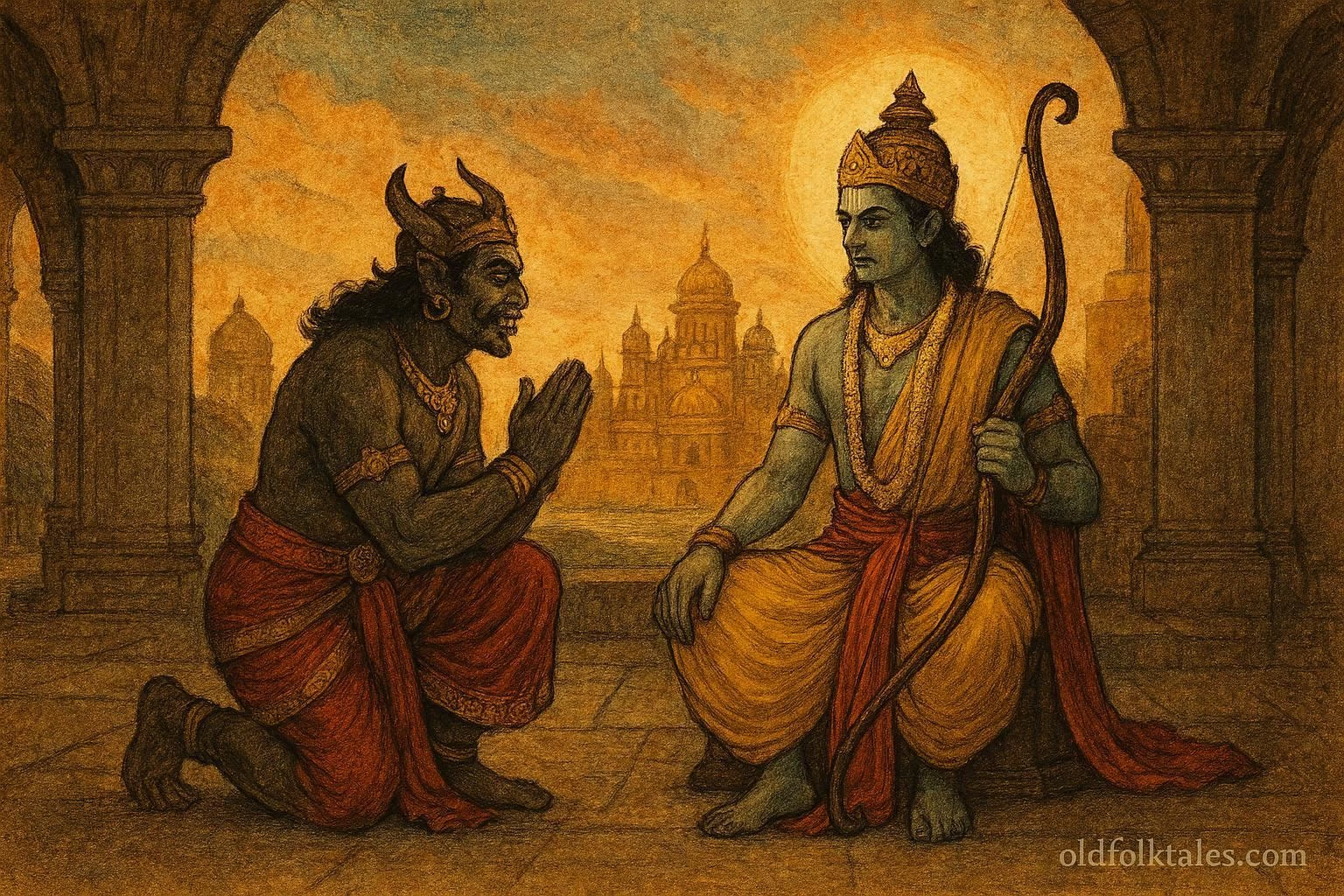
Crossing the sea, he arrived before Rama’s camp, unarmed, exiled, alone. Warriors raised their bows; suspicion burned in their eyes. But Rama, whose gaze pierced all hearts, stepped forward.
“Why do you come to me, brother of my enemy?” Rama asked.
Vibhishana knelt. “Because truth stands with you. I seek no throne, no reward. Only the chance to uphold dharma in this war that my brother has unleashed.”
Rama saw the purity within him, the glow of that inner fire Vibhishana had tended since youth, and lifted him to his feet. “Arise, Vibhishana,” he said. “A man who leaves evil for truth is ever my friend.”
Thus Vibhishana became a pillar of Rama’s army. He guided the Vanaras across the ocean, counseled strategy against the illusions of rakshasas, and faced his own kin in battle. In his heart a tempest raged, every fallen soldier of Lanka was a thread torn from the tapestry of his childhood, but he held firm, for he fought not to destroy, but to restore balance.
When Ravana fell beneath Rama’s divine arrow, Vibhishana wept, not in triumph, but in grief for a brother who had lost his way. Rama placed the crown of Lanka upon Vibhishana’s head, saying, “Rule with justice, for dharma has chosen you.”
And so he did. Under Vibhishana’s reign, Lanka became not a fortress of terror but a sanctuary of wisdom, prosperity, and peacea testament to the truth that moral courage can reshape even the destiny of kingdoms.
AUTHOR’S NOTE
Vibhishana’s legacy endures as a reminder that loyalty is not blind obedience, but devotion to righteousness. His courage to stand against his own brother to defend truth elevates him among the great moral heroes of world mythology.
KNOWLEDGE CHECK
-
What was Vibhishana’s divine or semi-divine origin?
-
Why did Vibhishana oppose Ravana’s decision to abduct Sita?
-
What moral struggle defined Vibhishana’s journey?
-
How did Rama recognize Vibhishana’s sincerity?
-
What symbolic meaning does Vibhishana’s coronation carry?
-
How does Vibhishana’s story redefine the idea of loyalty?
CULTURAL ORIGIN: Hindu epic tradition; ancient Indian mythology within the Ramayana cycle.
SOURCE: Valmiki Ramayana, Yuddha Kanda; classical Sanskrit epic attributed to sage Valmiki.